Pricing Wiki
Customer Segmentation
Partition customers by jobs-to-be-done and willingness to pay, then package and price to capture maximum value.
Snapshot
What it is
A segmentation strategy that groups customers by distinct use cases and their willingness to pay, then aligns packages, fences, and price points to each segment.
Why it matters
Single-price models leave "consumer surplus" on the table (charging too little to whales) or suffer from "deadweight loss" (pricing out smaller users).
When to use
When your user base shows diverse behavior (e.g., hobbyists vs. enterprise) or when your CAC/LTV ratio is stalling.
Key takeaways
Price is a proxy for value: Different segments derive different utility from the same feature set.
Price the Customer, Not the Product: Your product is the wrong unit of analysis. Different customers extract different value from the same product; therefore, the price should vary based on the customer's use case and WTP.
Don't "Average" Your Market: Designing for the average customer leads to features the low-end doesn't need (driving up cost) and features the high-end finds insufficient (driving down value). You must build distinct packages for distinct needs.
Fences Must Be Enforceable: If your high-value segment can easily buy the low-value segment's product (cannibalization), your segmentation has failed. You need logical barriers (features, limits, support) to keep high-WTP users from downgrading.
On this page9 sections
What is Segmentation by WTP/Use Case?#
Segmentation by WTP (Willingness to Pay) & Use Case is the strategic division of a market based on how much customers are willing to pay and why they need the product (their "job to be done"), rather than who they are (demographics) or how big they are (firmographics).
Key definitions#
-
Price Fences: The specific criteria (policies, product features, or metrics) used to separate high-WTP customers from low-WTP customers, preventing the former from accessing the lower prices intended for the latter.
-
Segment: A group of customers with similar JTBD, value drivers, and WTP distribution.
-
Package (plan/tier): A curated bundle of features mapped to a target segment's outcomes and WTP.
Mental model#
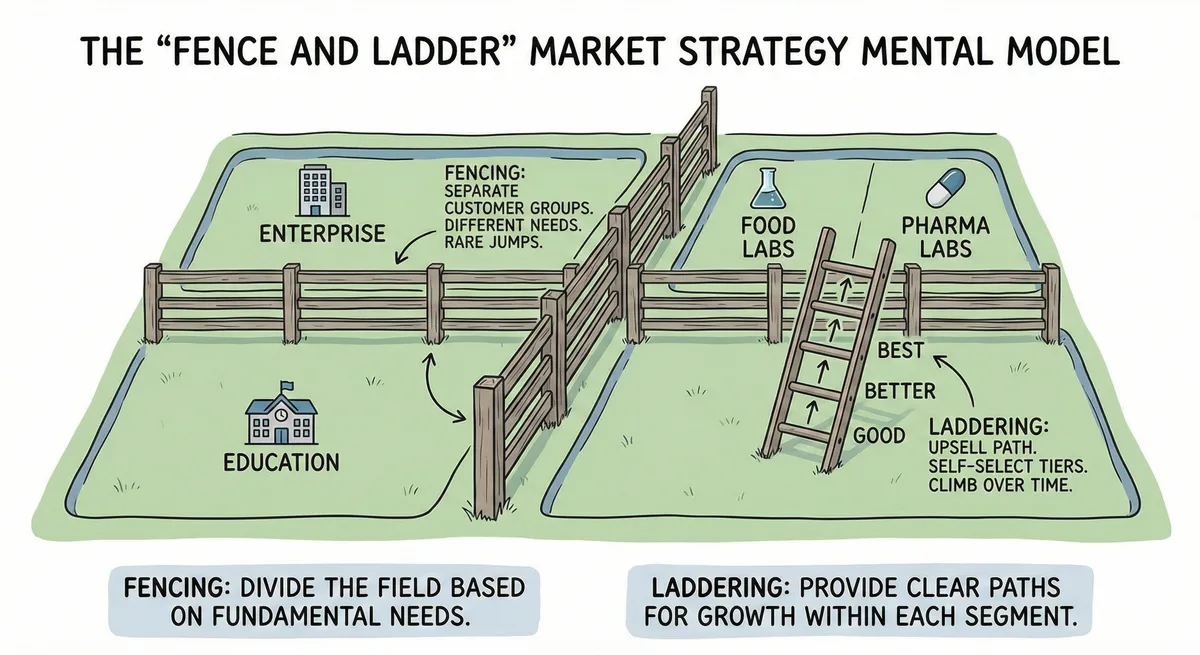
The "Fence and Ladder" Think of your market strategy as a field:
-
Fencing: You build fences to separate distinct groups of customers who have fundamentally different needs (e.g., "Enterprise" vs. "Education" or "Food Labs" vs. "Pharma Labs"). Customers should rarely jump over these fences.
-
Laddering: Within each fenced area, you build a ladder (Good/Better/Best tiers). This allows customers to self-select their price point based on the specific features or volume they need to get their job done, encouraging them to climb up (upsell) over time.
Rules of thumb#
- The Golden Rule of Segmentation: You should only segment your market if you can act differently toward each group. If you cannot offer different products, prices, or service levels, the segmentation is a theoretical exercise with no ROI.
- Value = Perceived Benefits – Perceived Price: Customers buy when this equation is positive relative to their next best alternative. Segmentation aligns this equation for different groups.
- The 3-Tier Standard: Start with 3 to 4 segments. Fewer than three usually fails to capture the demand curve's breadth; more than four adds operational complexity that often outweighs the revenue gains.
Why does Segmentation by WTP/Use Case matter?#
-
Maximizing Profitability: A single price point inevitably leaves money on the table (for high-WTP customers) and shuts out viable volume (from low-WTP customers). In a linear demand curve, a single price creates two zones of waste:
- The Under-priced Zone: Customers who would have paid $1,000 but were charged $100.
- The Un-served Zone: Customers who would have paid $50 but found the $100 price prohibitive.
-
Preventing Commoditization: By identifying specific use cases (e.g., "urgent repair" vs. "preventative maintenance"), companies can charge premiums for high-value contexts rather than competing solely on cost.
Key Facts
+80% profit
Charging separate prices to five distinct segments can lift profit contribution ~80% vs. a single price.
Nagle et al., The Strategy and Tactics of Pricing, Ch. 4Segments must differ in WTP, not just in description
A segmentation is only useful for pricing if the groups hold measurably different willingness to pay and can be separated by a fence buyers accept. Firmographic splits that fail the second test produce tiers customers simply route around.
Nagle et al., 2023<25%
81% of executives say segmentation is critical, but <25% say their companies use it effectively.
Bain & Company via HBRWorked example: what each additional price point is worth#
Take 10,000 prospects whose willingness to pay is spread evenly between $0 and $100, with negligible marginal cost. Total available surplus is $500,000.
A single price cannot capture most of it. Charge $50 and 5,000 buyers convert:
| Price points | Prices charged | Profit | vs. single price |
|---|---|---|---|
1 | $50 | $250,000 | — |
2 | $66.67 / $33.33 | $333,333 | +33% |
3 | $75 / $50 / $25 | $375,000 | +50% |
4 | $80 / $60 / $40 / $20 | $400,000 | +60% |
5 | $83.33 … $16.67 | $416,667 | +67% |
Under this demand shape, profit with n price points converges on $500,000 × n/(n+1) — which is the real argument for segmentation, and also the argument against overdoing it. Going from one price to two adds $83,333. Going from four to five adds $16,667, for a fifth tier you have to build, document, train on, and defend.
Nagle and colleagues report roughly +80% for a five-segment structure; the gap between that and the 67% here is entirely down to demand shape. Evenly spread WTP is the conservative case. The more your buyers cluster into genuinely distinct groups, the more segmentation is worth — which is the whole reason to measure the distribution rather than assume it.
The condition this math hides. Every row above assumes buyers cannot move between price points. A structure with five prices and no working fence does not earn $416,667 — it earns close to the lowest price times everyone, because the high-WTP segment simply buys the cheap tier. Build the fence first, then add the tier.
How do you implement segmentation by WTP/Use Case step-by-step?#
Inputs you need#
- JTBD/use-case map from interviews and shadowing (n≈15–30 per persona is often enough to pattern): Qualitative discussions to uncover why customers hire your product. (e.g., Is it for "safety" or "compliance"? These are different values with different WTP).
- Max-Diff analysis: A survey method to determine which features different segments value most and least. This helps you bundle the right features into the right tiers.
- Van Westendorp Price Sensitivity Meter: A survey technique asking four questions (too cheap, cheap, expensive, too expensive) to map the acceptable price range for different segments.
- Usage telemetry: frequency, intensity, seat counts, API calls, workspace size, time-to-value.
- Competitor Benchmarking: Analyzing where competitors draw their "fences" and their reference prices.
Step-by-step
Define target outcomes and use cases (2–4 max)
15–30 interviews/persona; write JTBD statements; define success metrics & acceptance tests.
Measure WTP by persona/use case
Van Westendorp + Gabor‑Granger (4–6 prices) + small A/B price tests.
Cluster customers into actionable segments
Features to cluster on: normalized usage (seats, API calls, projects), capability needs (SSO, audit, SLA), firmographics, WTP metrics (OPP/elasticity).
Design fences
Determine how you will separate these groups. Common fences include:
• Product Configuration: Bundling premium support or advanced security only for the high-WTP segment.
• Metrics: Charging per seat vs. per transaction to align with how different segments grow.
• Time/Location: Charging more for rush delivery or prime-time access.
Construct the Offer Structure
Good/Better/Best or SMB/Business/Enterprise with clear outcome-based value stories.
Create tiered packages where the "Good" plan meets the minimum needs of price-sensitive buyers (Killers/Fillers removed), and the "Best" plan includes the high-value features (Leaders) that insensitive buyers demand.
Validate with Data
Use Max-Diff and Van Westendorp surveys to confirm that the features in your "Pro" plan are actually the ones valued by high-WTP customers. If low-WTP customers care more about a feature than high-WTP customers, that feature belongs in the base plan or as an add-on.
Metrics to monitor
Take Rate by Tier
Ideally, ~30% should choose "Good," ~50% "Better," and ~20% "Best." If everyone chooses "Best," you are underpriced. If everyone chooses "Good," your upsell value proposition is weak.
Net Revenue Retention (NRR)
Are customers climbing the ladder (expanding) over time?
Discounting Variance
If sales teams constantly discount the "Enterprise" tier, your segmentation criteria may be flawed or the price-to-value alignment is off.
Risks & anti-patterns (and fixes)#
| Pitfall | Fix |
|---|---|
Leaky fences: Creating a discount segment (e.g., "Student Edition") without strict verification, allowing high-value corporate customers to buy the cheaper version. | Tighten thresholds, move must-have features up, add SLA/performance fences. |
Over‑segmentation: Creating too many tiers (e.g., 10 different plans) creates "decision paralysis" for the customer and operational nightmares for your team. | 3 core plans + add‑ons; use a "Contact Us" for the high end. |
The "Gold-Plating" Trap: Adding features to a premium tier that the segment doesn't actually value, just to justify a higher price. This leads to churn when customers realize they are paying for shelfware. | Conduct a "Relative Preference" survey to ensure premium features solve high-stakes pain points for that specific segment. |
References & Links#
Sources:#
- Nagle, T. T., Müller, G., & Hogan, J. (2023). The Strategy and Tactics of Pricing: A Guide to Growing More Profitably (7th ed.). Routledge.
- Ramanujam, M., & Tacke, G. (2016). Monetizing Innovation: How Smart Companies Design the Product Around the Price. Wiley.
- Lehrskov-Schmidt, U. (2021). The Pricing Roadmap: How to Design B2B SaaS Pricing. Independently published.
- Monroe, K. B. (2012). Pricing: Making Profitable Decisions (3rd ed.). Routledge.
- Hinterhuber, A., & Liozu, S. M. (2013). Innovation in Pricing: Contemporary Theories and Best Practices. Routledge.
- Christensen, C. M., Hall, T., Dillon, K., & Duncan, D. S. (2016). Competing Against Luck: The Story of Innovation and Customer Jobs to Be Done. HarperBusiness.
Frequently asked questions
01How many segments should we start with?
Usually three packages (Good/Better/Best) plus add-ons; expand when data shows a persistent, monetizable niche.
02Should I segment by company size (SMB vs. Enterprise)?
Only if size correlates with value. Often, a small hedge fund has a higher WTP than a large non-profit. Segment by needs and value first; use size only if it's a good proxy for those needs.
03Can I offer the same product at different prices?
Yes, if you use a "Fence." For example, airlines sell the same seat at different prices based on when you buy (Time Fence) or whether you stay a Saturday night (Segmentation by behavior). Without a fence, customers will feel cheated.
04How do I know if my segments are right?
Ask your sales team. If they can easily categorize a lead into one of your segments within a few minutes of conversation, and the customer accepts the logic of that package, your segments are practical. If they struggle, your fences are too complex or irrelevant.
05Is this legal/ethical?
Price segmentation is generally legal when based on value/usage and disclosed; avoid targeting protected classes; consult counsel for your markets.
06How often should I change my segments?
Review every 6 months. Early-stage startups often find new high-WTP use cases they didn't expect.
Author
Dr. Sarah Zou
Independent economist · EconNova
Commercial strategy for technical products, with a focus on pricing, unit economics, and the operating choices behind the model.
About SarahTopics
Cite this page
Suggested citation
Zou, S. (2026). Segmentation by Willingness to Pay (WTP) / Use Case. In Understanding Value & Customers. Pricing & Monetization Wiki. https://sarahzou.com/wiki/pricing/value-and-customers/customer-segments
Open license
Reuse with attribution
This content is available for reuse. When referencing or republishing it, please credit Dr. Sarah Zou and link back to the original source.
Licensed under Creative Commons Attribution 4.0 International. You may share and adapt the material with appropriate credit.