Pricing Wiki
Jobs to Be Done (JTBD)
A demand lens that defines customers' 'progress' in context, so you can shape messaging, onboarding, packaging, and pricing around real switching triggers.
Snapshot
What it is
JTBD describes why customers buy or churn by identifying the job they "hire" a product to do in a specific situation.
Why it matters
- Predictable demand: Jobs already exist; you're aligning to a current of demand rather than inventing one.
- Faster sales + fewer discounts: Job-aligned packaging makes value obvious and reduces explanation.
- Cleaner product lines: Avoid monoliths (overbuilt bundles) and hydras (unmanageable module sprawl) by bundling around jobs.
When to use
- Early: shaping a value proposition, positioning, or category story
- Growth stalls: diagnosing churn, low conversion, or heavy discounting
- Pricing & packaging: designing plans, picking a pricing metric, or adding tiers/fences by stakes/context
- Product direction: deciding what to build next based on real switching triggers
Key takeaways
Context is Queen: The "when" and "where" matter more than the "who"; People with different titles can share the same job.
Competition is broader than your category: You're competing with spreadsheets, agencies, internal hacks, and "do nothing," not just direct rivals.
Switching is emotional + rational: The Push/Pull/Habit/Anxiety forces explain why customers stall—even when value is obvious.
Packaging and pricing follow the job: Align tiers, fences, and the pricing metric to the customer's unit of progress; then validate willingness-to-pay.
On this page9 sections
What is Jobs to Be Done (JTBD)?#
The Jobs to Be Done (JTBD) theory, pioneered by Clayton Christensen, a Harvard Business School professor, asserts that customers do not buy products; they "hire" them to perform a specific "job".
A "job" is distinct from a mere "problem." While a problem is a situation a user doesn't want to be in, a job requires intentionality—a clear desire to move from a current state "A" to a desired state "B". To have effective demand, the customer must be actively searching for a solution or have an intention to get the task done.
Key definitions#
- Job executor: The person who experiences the struggle and decides to "hire" a solution (may differ from payer/admin in B2B).
- Job statement (functional core): Help [actor] [make progress] in/when [circumstance] despite [constraints].
- Job story (format): When ___, I want to ___, so I can ___.
- Desired outcomes (ODI lens): Metrics the customer uses to judge success (speed, effort, reliability, risk, compliance).
Mental model#
The Forces of Progress
To understand why a customer "hires" your startup, you must look at the four forces acting on them at the moment of purchase:
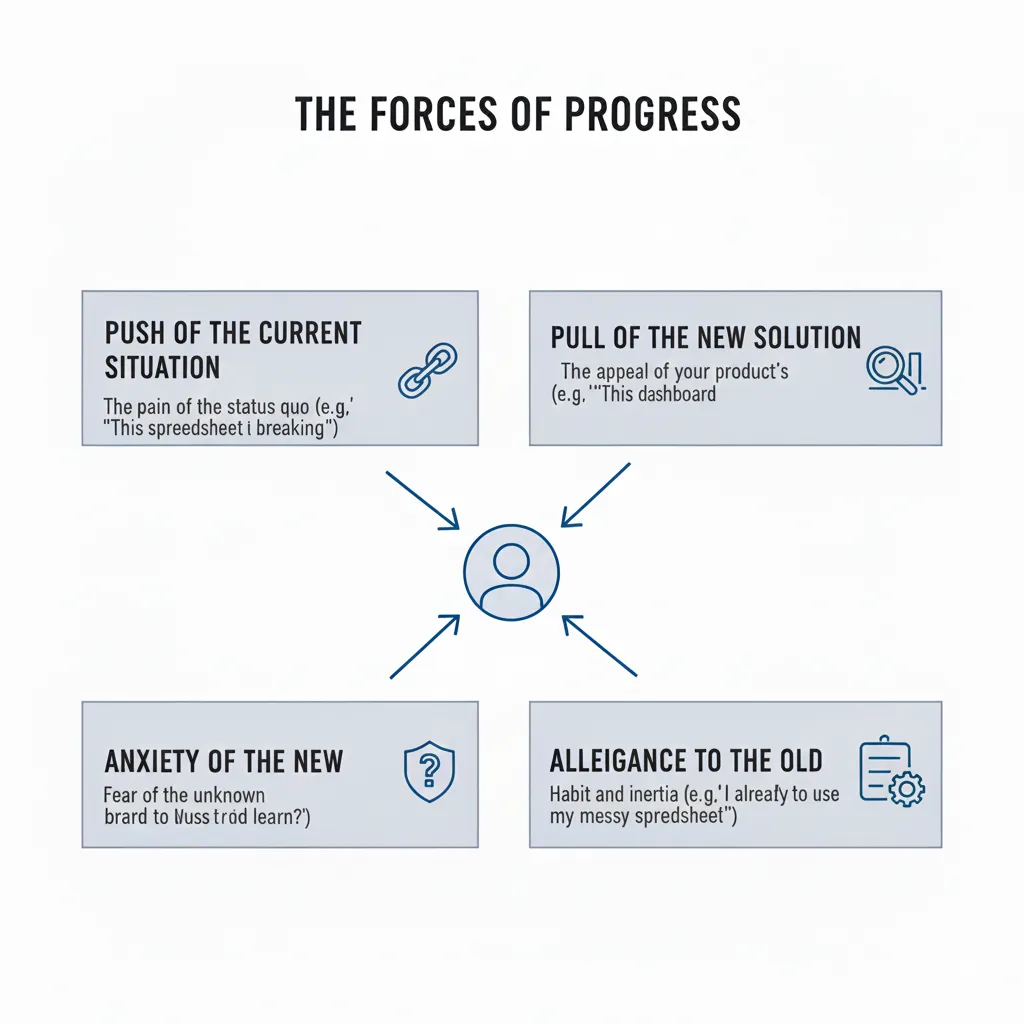
- Push of the Current Situation: The pain of the status quo (e.g., "This spreadsheet is breaking").
- Pull of the New Solution: The appeal of your product's promise (e.g., "This dashboard looks effortless").
- Anxiety of the New: Fear of the unknown (e.g., "Will this be hard to learn?").
- Allegiance to the Old: Habit and inertia (e.g., "I already know how to use my messy spreadsheet").
Rules of thumb#
Interview count
Approximately 90% of key customer needs can be identified by conducting just 10–12 in-depth interviews per market segment. (source: The Strategy and Tactics of Pricing)
The Drill/Hole Maxim
"People don't want a quarter-inch drill; they want a quarter-inch hole."
The "Workaround" Rule
If you see people using a tool for something it wasn't intended for (e.g., using Excel as a CRM), there is a massive JTBD opportunity there.
Why do Jobs to Be Done matter?#
For startup founders, JTBD is the bridge between understanding customer demand and designing products, pricing, and messaging that align with real switching triggers.
-
Predictable Demand: A package built around a job taps into a pre-existing stream of demand. As one entrepreneur noted, it is like "holding your cup out—the water was already running".
-
Efficiency in Sales: Aligning packaging with specific jobs makes the product instantly understandable to the buyer, which reduces sales cycles and minimizes the need for heavy discounting.
-
Portfolio Integrity: Using JTBD prevents the creation of "Monoliths" (overengineered products that deliver too much functionality for most users, leading to under-monetization) and "Hydras" (products that grow in unmanageable complexity because every new feature is spun out as a new module).
Key Facts
86% vs. 17%
Across 43 Strategyn client companies, 18 of 21 ODI-driven launches (86%) were rated successful by the sponsoring company, against an industry-average launch success rate of roughly 17% compiled from 12 independent sources.
Ulwick, Why do innovation projects fail?The job is the segment
Two buyers with identical firmographics can be hiring your product for different jobs — and will hold different willingness to pay as a result. This is why JTBD segmentation often cuts across the demographic segments a marketing team already uses.
Christensen et al., HBRLess Pricing Sensitive
In B2B software, value drivers and specific jobs are more important than price which is typically only the third to seventh most important factor in a purchase decision.
Price to ScaleWorked example: identical firmographics, 10x different WTP#
Two prospects for the same data-observability product. On every filter a normal ICP uses — Series B, ~300 employees, fintech, US, modern data stack — they are indistinguishable.
| Company A | Company B | |
|---|---|---|
Job hired for | "Pass SOC 2 without hiring a compliance analyst" | "Stop the 2am pipeline pages" |
What they'd do otherwise | Hire an analyst | Absorb it in on-call time |
Cost of that alternative | $140,000/year | 120 hrs × $110 = $13,200/year |
Anchor for WTP | ~$140,000 | ~$13,200 |
Who signs | Compliance / CFO | Eng lead, existing tools budget |
Same segment on paper. A 10x spread in willingness to pay, because WTP is set by the alternative the buyer is comparing against, and the job determines the alternative.
What this changes. One tier priced somewhere in the middle loses both: too expensive for B, and it leaves roughly $100,000 on the table with A. The structure the jobs imply instead:
- A reliability base tier priced against engineer hours — alerting, lineage, incident routing.
- A compliance module priced against the analyst — audit-ready evidence export, retention policies, access attestation.
The module is also the fence. Company B has no use for audit evidence and will not buy up to reach it, so the two prices hold without either buyer feeling penalised.
Why firmographics missed this. Firmographics describe who the buyer is. The job describes what they are trying to get done, and only the second one has a price attached. This is why JTBD segments routinely cut across the personas a marketing team has already built.
How do you implement Jobs to Be Done step-by-step?#
Inputs you need#
- 10–15 recent "hired" or "fired" customers (bought or churned in the last ~90 days)
- A place to observe real work (screenshare, ride-along, session replays) to see where they struggle
- Context notes: team setup, stakes (deadlines/risk), constraints (security/compliance), who approves (B2B)
- Light product data: time-to-first-value, retention, key activation events
Step-by-step
Identify the Struggle
Ask: "What happened that made you realize you needed a change?" Note the context, stakes, and current workaround.
Write the Job Statement
Use the formula: [Action] + [Object] + [Context]
- Example: "Organize (Action) my team's tasks (Object) when we are all working remotely (Context)."
Map the Forces
Identify what is pushing them toward you and what is keeping them stuck.
- Push: what's broken now?
- Pull: what's attractive about the new?
- Habit: what keeps the old?
- Anxiety: what scares them about switching?
Design for the Job
Align your features, marketing copy, and onboarding specifically to address that "Progress."
- Product: prioritize what removes struggle and improves outcomes.
- Messaging: lead with context + progress (not features).
- Onboarding: get them to the first job-complete moment fast.
- Packaging/pricing: pick a pricing metric that matches the job; add fences for higher-stakes contexts.
Metrics to monitor
Time-to-value (TTV)
How quickly does the user realize the "progress" they were looking for? (time from signup to first job-complete moment)
Job completion rate / Success Rate
How often can the user complete the "job" using your tool?
Retention by job segment
Cohort retention by primary job
Risks & anti-patterns (and how to fix them)#
| Pitfall | Fix |
|---|---|
Treating jobs like personas: Segmenting by titles or company size instead of context and stakes. | Segment by context + stakes + constraints (and job frequency). Titles/company size are secondary. |
Writing solution-y job statements: Using product words in job statements (e.g., "Use dashboards to…"). | Rewrite to [Action] + [Object] + [Context] with no product words; validate against workarounds and "do nothing." |
Skipping the forces: Hearing "looks great" but deals stall without understanding why. | Always map Push / Pull / Habit / Anxiety and design proof to reduce anxiety (templates, ROI calc, security docs, references). |
Interviewing only happy customers or power users: Missing insights from customers who didn't succeed. | Include recent churn, lost deals, and recent switchers; switching reveals real criteria and fears. |
Packaging by feature buckets, not jobs: Organizing plans by features like "Analytics," "Automation," "Integrations." | Bundle around jobs and stakes; put "must-have to complete the job" features in the tier where that job lives. |
Calling every loss "too expensive": Assuming price is always the issue when deals are lost. | Diagnose the quality of the no: was it the wrong job fit, unclear proof, wrong pricing metric, or missing fence (e.g., SSO/SLA/audit logs)? |
References & Links#
Sources:#
- Christensen, C. M., Hall, T., Dillon, K., & Duncan, D. S. (2016a, September). Know your customers' jobs to be done. Harvard Business Review.
- Christensen, C. M., Dillon, K., Hall, T., & Duncan, D. S. (2016b). Competing against luck: The story of innovation and customer choice. HarperBusiness.
- Ghuman, A., & Pasternak, J. (2021). Price to scale. Paget Publishing.
- Lehrskov-Schmidt, U. (2023). The pricing roadmap. (Self-published).
- Moesta, B., & Dander, G. (2019). Demand-side sales 101: Stop selling and help your customers make progress. Re-Wired Group.
- Ramanujam, M., & Tacke, G. (2016). Monetizing innovation: How smart companies design the product around the price. Wiley.
- Ulwick, A. W. (2005). What customers want from your products. Harvard Business Review, 83(1), 70–82.
- Ulwick, A. W. (2016). Jobs to be done: Theory to practice. Idea Bite Press.
Frequently asked questions
01How do I know if I have a "job" or just a "problem"?
A job has intentionality. If you look at your market and people are already spending money or significant time trying to solve it, it's a job.
02Is JTBD just another name for personas?
No. Personas describe who; JTBD explains why now (context + progress + tradeoffs).
03Can JTBD work in B2B with multiple stakeholders?
Yes—model executor, buyer, approver separately and map their anxieties (security, risk, budget).
04How does JTBD connect to pricing?
Jobs reveal the customer's unit of progress → informs pricing metric, packaging, and fences; then quantify with WTP research.
05Should I put my newest, most advanced features in my highest tier?
06What's a quick sign we picked the wrong job?
Your "competition" list looks narrow (only direct rivals) and your messaging is feature-heavy rather than outcome/constraint-driven.
Author
Dr. Sarah Zou
Independent economist · EconNova
Commercial strategy for technical products, with a focus on pricing, unit economics, and the operating choices behind the model.
About SarahTopics
Cite this page
Suggested citation
Zou, S. (2026). Jobs to Be Done (JTBD). In Understanding Value & Customers. Pricing & Monetization Wiki. https://sarahzou.com/wiki/pricing/value-and-customers/jobs-to-be-done
Open license
Reuse with attribution
This content is available for reuse. When referencing or republishing it, please credit Dr. Sarah Zou and link back to the original source.
Licensed under Creative Commons Attribution 4.0 International. You may share and adapt the material with appropriate credit.