Pricing Wiki
Customer Use Cases
Structured descriptions of the problem, persona, context, and outcomes that define how customers get value from your product and how you should price.
Snapshot
What it is
Customer use cases are structured descriptions of a specific problem, target persona, context, and success metrics that define how and why a customer "hires" your product.
Why it matters
- Turns pricing into a "price-your-customer" decision grounded in jobs and outcomes, not internal feature lists.
- Reduces product failure and "feature shock" by focusing on a few high-value jobs instead of many low-value features.
- Aligns product, sales, and marketing around a shared, testable view of where value actually comes from.
When to use
- Defining or redesigning plan structure (good–better–best, add-ons, or enterprise tiers).
- Evaluating new segments or verticals and deciding whether they justify a distinct plan or price point.
- Choosing or revisiting your core pricing metric (seats, usage, outcomes, revenue processed, etc.).
- Prioritizing roadmap and GTM investments by impact on your top 3–7 revenue-driving use cases.
- Cleaning up a cluttered catalog of legacy plans that no longer map to real customer jobs.
Key takeaways
A use case is a combination of problem + persona + context + outcome, not a feature list, persona label, or industry.
Most SaaS companies should optimize pricing and roadmap around 3–7 primary use cases (1–2 at seed stage) that drive the majority of revenue.
Each plan should map clearly to one anchor use case (or at most two), expressed in plain, outcome-oriented language.
Frequency and intensity of the problem are core inputs to your pricing metric and willingness-to-pay.
On this page8 sections
What is Customer Use Cases?#
A Customer Use Case is a foundational monetization strategy that defines a specific problem a product solves, the target persona facing that problem, and the context in which they seek a solution. It moves beyond technical features to focus on the Jobs to Be Done (JTBD)—the specific outcome a customer is trying to achieve.
In B2B SaaS, this is the first "price-your-customer" decision, categorizing users by how they derive value from your capability.
- Example: "RevOps manager at a 50–200 person SaaS company uses our platform weekly to identify at-risk deals and reduce pipeline slippage by 15%."
- Job-to-be-done (JTBD): The underlying problem or "job" the customer hires your product to do (e.g., "get a clean, deduped customer list"), independent of your feature names. See Jobs to Be Done (JTBD) for more details.
- Use case vs. segment: Segment = group of customers with similar characteristics (company size, industry, budget, etc.). Use case = what those customers actually do with the product to create value. A segment can contain multiple use cases; a use case can appear across multiple segments.
- Primary vs. secondary use case: Primary use case = the main job that justifies the purchase and drives willingness to pay. Secondary use cases = additional jobs that are nice-to-have but usually not the core reason to buy.
Mental model#
Think of customer use cases as a structured card:
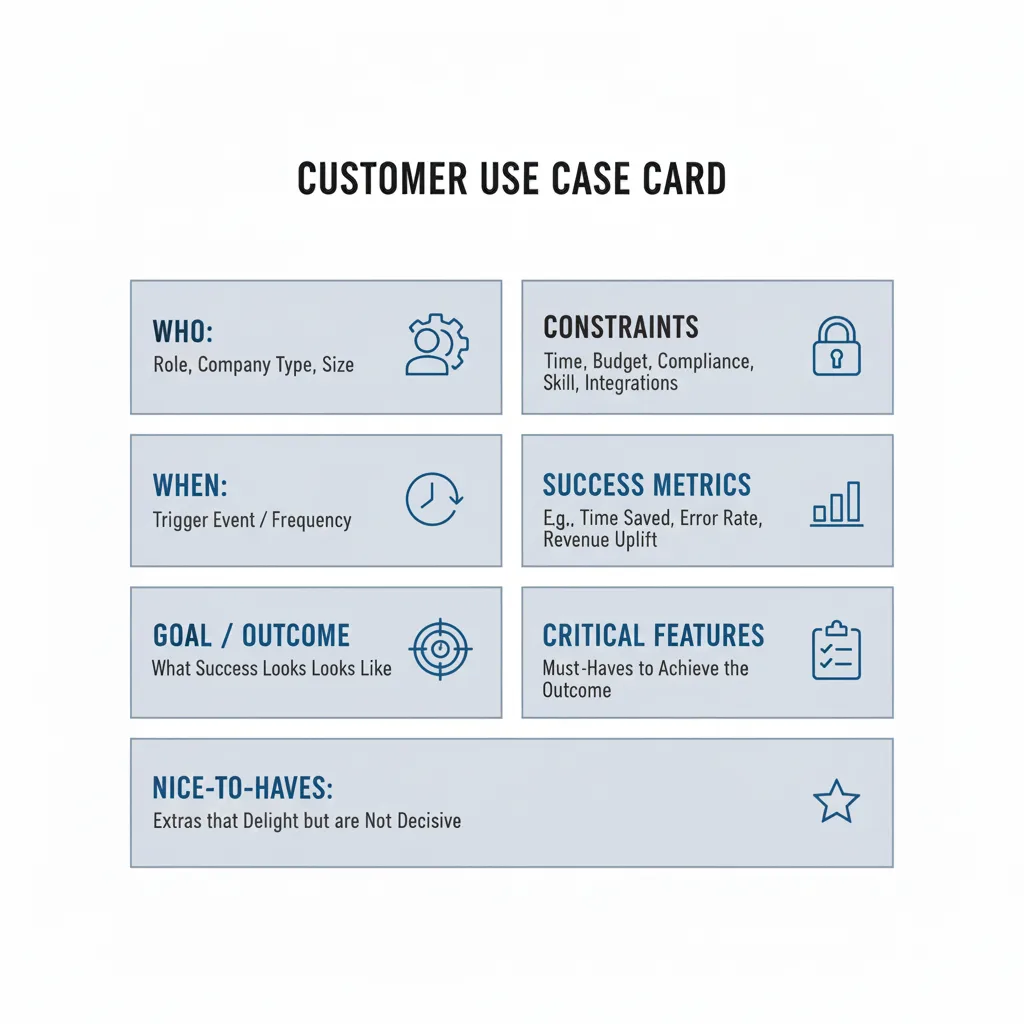
Pricing uses these cards to make choices about:
- Which use cases to optimize for (anchor plans, headline messaging).
- Which to serve but not optimize (add-ons, upsells, manual workarounds).
- Which to say no to (edge cases that distract your roadmap).
Rules of thumb#
Revenue coverage rule
Aim for 3–7 primary use cases that together account for ≥70–85% of current and target revenue.
Dedicated plan threshold
If a distinct use case represents ≥20–30% of revenue and has materially different WTP or feature needs, consider a dedicated plan or bundle.
Use case profitability (simplified)
[Use case profit] ≈ (Average WTP per customer × # of addressable customers) − (Incremental cost-to-serve). Focus on use cases where this is clearly positive and defensible.
Plan clarity rule
If sales reps or customers cannot articulate in one sentence which plan is for which use case, your packaging is too abstract.
Why do Customer Use Cases matter?#
For startup founders, customer use cases are the bridge between product features and pricing strategy. Approximately 72% of new products fail because they are the "wrong answer to the right question" or an answer to a question no one was asking. Mapping use cases prevents "Feature Shock," where a company overengineers a product with "nice-to-haves" that increase costs without increasing willingness-to-pay (WTP).
- Avoids "Undead" Products: Focuses development on jobs customers actually need done, not features that look good on paper.
- Efficiency: Prevents overengineering by identifying which features are must-haves vs. nice-to-haves for each use case.
- Scalability: Aligning your product with specific use cases leads to shorter sales cycles, less discounting, and higher Net Retention Rates (NRR).
Key Facts
72% of new products
miss their revenue and profit goals — most commonly because they answer a question nobody was asking, i.e., they were built without validating the use case and its willingness-to-pay.
Monetizing Innovation (2016)80% of features are rarely or never used
Pendo's analysis of product usage data found roughly 80% of features in the average software product see little to no use — the direct cost of building for imagined rather than validated use cases.
Pendo, Feature Adoption Report (2019)Revenue coverage benchmark
healthy B2B SaaS pricing typically concentrates on 3–7 primary use cases covering 70–85% of revenue; plans anchored to more use cases than that stop being explainable in one sentence (see rules of thumb below)
How do you implement customer use cases step-by-step?#
Inputs you need#
- Basic persona data: Role, company type/size, team, budget authority.
- 10–20 recent customer conversations: Wins, losses, churn with raw notes.
- Call notes, support tickets, and onboarding feedback: With verbatim problem statements.
- High-level product usage data: To approximate frequency and intensity of the problem.
- Competitive Analysis: Identifying "gaps" where competitors fail to address specific workflows.
Step-by-step
Use this flow to define a customer use case in a way that directly feeds your monetization model.
Identify the problem your product solves (in customers' words)
Review interviews, support tickets, and sales calls to pull verbatim problem statements. Write a simple problem sentence: "When [trigger], I struggle to [job], which leads to [negative outcome]." Sanity check: a non-expert in your product should still understand the problem.
Define the target persona who has this problem
Specify role, seniority, company type/size, and team context (e.g., "RevOps manager at 50–200 person SaaS company"). Capture why this persona owns the problem (KPIs, responsibilities, incentives). Note any constraints that affect willingness-to-pay (budget authority, procurement, risk tolerance).
Identify alternative solutions (including non-consumption)
List realistic alternatives: competing tools, spreadsheets, manual processes, internal builds, "do nothing". For each alternative, capture: cost (time/money), reliability, and key limitations. Use this to highlight adjacent customer problems that could become future monetization opportunities (e.g., services, add-ons, higher tiers).
Understand why users choose your product over alternatives
Ask directly: "Why did you choose us instead of X?" and "What almost stopped you from choosing us?" Distill 2–3 value drivers (e.g., speed, accuracy, compliance, collaboration) that matter most for this use case. Translate these value drivers into pricing levers: higher tiers for premium outcomes, add-ons for specialized capabilities, usage metric aligned to the value driver.
Determine the frequency and intensity of the problem
Estimate how often the persona encounters the problem (e.g., hourly, daily, weekly, quarterly). Assess intensity: what happens if they don't solve it (lost revenue, fines, churn, reputational risk)? Use frequency × intensity to choose pricing metrics and tiers: High frequency + high intensity → strong case for higher ACV and/or usage-based pricing. Low frequency + moderate intensity → better fit for project-based, feature-gated, or add-on pricing.
Draft the use case card and link it to pricing/packaging
Fill out a standard use case card: Who, When, Goal/outcome, Constraints, Success metrics, Critical features, Nice-to-haves. Decide how this use case maps to your monetization model: Which plan or bundle is the natural home for this use case? Which pricing metric reflects how value scales (seats, usage, revenue processed, etc.)? Which features must be included vs. sold as add-ons?
Quantify and prioritize across use cases
Tag existing customers with their primary use case using the above definition. For each use case, estimate: revenue today, growth potential, discounting levels, and support cost. Prioritize 3–7 primary use cases to optimize for in your pricing; treat others as secondary or out-of-scope.
Metrics to monitor
Plan / use case mix
Share of revenue and customers by primary use case and plan.
ARPU / ACV by use case
Are high-value use cases paying meaningfully more?
Win rate by use case
Where does your value proposition resonate most?
Discount rate by use case
Are some use cases only closing with heavy discounting (sign of poor fit or wrong metric)?
Expansion and NRR by use case
Which use cases drive expansions, seats, or usage growth over time?
Feature adoption by use case
Are must-have features actually used by the intended use case cluster?
Risks & anti-patterns (and how to fix them)#
| Pitfall | Fix |
|---|---|
Selling "Tools," Not "Jobs": Offering a list of features (e.g., "Analytics") rather than a solution (e.g., "Predictive Maintenance"). | Repackage features around the outcome they enable. |
Confusing use cases with personas or verticals: Defining segments like "marketing" or "healthcare" without understanding what those customers actually do. | Force each use case to include a specific job, trigger, and success metric. |
Overfitting to edge cases: Building plans or features for noisy but low-revenue use cases. | Quantify revenue and growth by use case before committing; set a minimum revenue threshold for new plans. |
Too many use cases: A long list (10–20+) that no one can remember or act on. | Group related use cases; keep an executive version (3–7 primary) and move the rest to sub-variants. |
References & Links#
Sources:#
- Christensen, C. M., Hall, T., Dillon, K., & Duncan, D. S. (2016). Competing against luck: The story of innovation and customer choice. Harper Business.
- Nagle, T. T., Hogan, J. E., & Zale, J. (2016). The strategy and tactics of pricing: A guide to growing more profitably. Routledge.
- Hinterhuber, A., & Liozu, S. M. (Eds.). (2012). Innovation in pricing: Contemporary theories and best practices. Routledge.
- Ramanujam, M., & Tacke, G. (2016). Monetizing innovation: How smart companies design the product around the price. Wiley.
- Lehrskov-Schmidt, U. (2023). The pricing roadmap: How to design B2B SaaS pricing models that your customers will love. Author.
- Ghuman, A. (2021). Price to scale: Practical pricing for your high-growth SaaS startup. Independently published.
- Maurya, A. (2012). Running lean: Iterate from plan A to a plan that works. O'Reilly Media.
Frequently asked questions
01How many customer use cases do we actually need?
Most startups and scale-ups should aim for 3–7 primary use cases that cover the majority of revenue, plus a handful of secondary variants documented for context. For a seed-stage startup, ideally 1–2; focus is your greatest competitive advantage against incumbents.
02Are use cases the same as personas or segments?
No. Personas describe who your customers are; segments define groups for targeting. Use cases describe what they do with your product and why it matters. You need all three, but use cases are the best bridge to pricing.
03What if a customer fits multiple use cases?
Pick a primary use case that best explains their reason to buy and WTP, price for that, and treat other jobs as bonus value or upsell opportunities.
04Does this approach work for PLG / self-serve products?
Yes. Even in PLG, you should design plan names, feature gates, and upgrade prompts around clear use cases (e.g., "team collaboration" vs. "advanced automation"), not arbitrary feature counts.
05How often should we refresh our use case map?
At least annually, or whenever you launch major new capabilities, enter a new market, or see big shifts in who is buying and why.
06Can we start small?
Yes. Start by tagging new opportunities in your CRM with an informal use case label. After 2–3 months, review patterns, refine definitions, and then invest in a full use-case-driven pricing redesign if warranted.
07Is a "User Story" the same as a "Use Case"?
No. A user story is for developers to build a feature; a use case is for the business to define how value is delivered to the customer.
08When should we create a new use case?
Only when you have evidence of a repeatable segment of users using your product for a purpose you didn't originally intend.
Author
Dr. Sarah Zou
Independent economist · EconNova
Commercial strategy for technical products, with a focus on pricing, unit economics, and the operating choices behind the model.
About SarahTopics
Cite this page
Suggested citation
Zou, S. (2026). Customer Use Cases. In Understanding Value & Customers. Pricing & Monetization Wiki. https://sarahzou.com/wiki/pricing/value-and-customers/customer-use-cases
Open license
Reuse with attribution
This content is available for reuse. When referencing or republishing it, please credit Dr. Sarah Zou and link back to the original source.
Licensed under Creative Commons Attribution 4.0 International. You may share and adapt the material with appropriate credit.