Pricing Wiki
Seat-based pricing
A monetization model where customers pay a fixed recurring fee for each individual user (license) granted access to the software.
Snapshot
What it is
A pricing model, the most common in B2B software (e.g., Salesforce, Zoom), where the total contract value is determined by the number of individual users (seats) authorized to access the software.
Why it matters
Seat-based pricing is easy to sell, forecast, and budget (tied to headcount), but it can discourage adoption and—especially for AI products—reduce revenue as customers need fewer seats.
When to use
When value scales with the number of users, access is the natural unit (identity/permissioning matters), usage is hard to meter fairly, and enterprise buyers demand predictable budgets tied to headcount.
Key takeaways
Predictability > Innovation: Enterprise buyers often reject "innovative" usage-based models in favor of seat-based pricing because they need to map costs to fixed departmental budgets.
The "Active" Filter: To prevent churn from "shelfware" (paying for unused seats), successful companies like Slack charge only for active users. This increases Metric Density and perceived fairness.
The Collaboration Trap: If your value comes from data volume or automation/AI rather than human interaction, seat-based pricing can actually hurt your growth.
Incentive Alignment: Best used for tools that users "live in" daily (e.g., CRM, Design, Coding).
On this page7 sections
What is seat-based pricing?#
Seat-Based Pricing (Per-User / License) is a "Capability" pricing model where the unit of value is the individual human login.
Key definitions#
- Seat: A unit of access. Usually a person with permission to use the product.
- Named User / Seat: A license tied to a specific individual (cannot be shared). This is the modern SaaS standard.
- Concurrent seat: A license allowing X users to be logged in simultaneously (less common in modern SaaS; more common in legacy licensing).
- Active seat: A seat that meets a usage threshold (e.g., logged in ≥1 day in last 30 days).
- Light/guest user: Limited permissions (view-only, approve-only, external collaborator).
- Provisioned vs paid seats: People invited/provisioned vs the seats the customer pays for.
- Metric Density: A measure of how uniform the value is across users. If one user logs in once a month and another logs in daily, the "seat" value metric has low density (high variance in value), often leading to friction.
Mental model#
The "Office Chair" Analogy
Think of seat-based pricing like selling office chairs. A company buys 50 chairs because they have 50 "butts in seats."
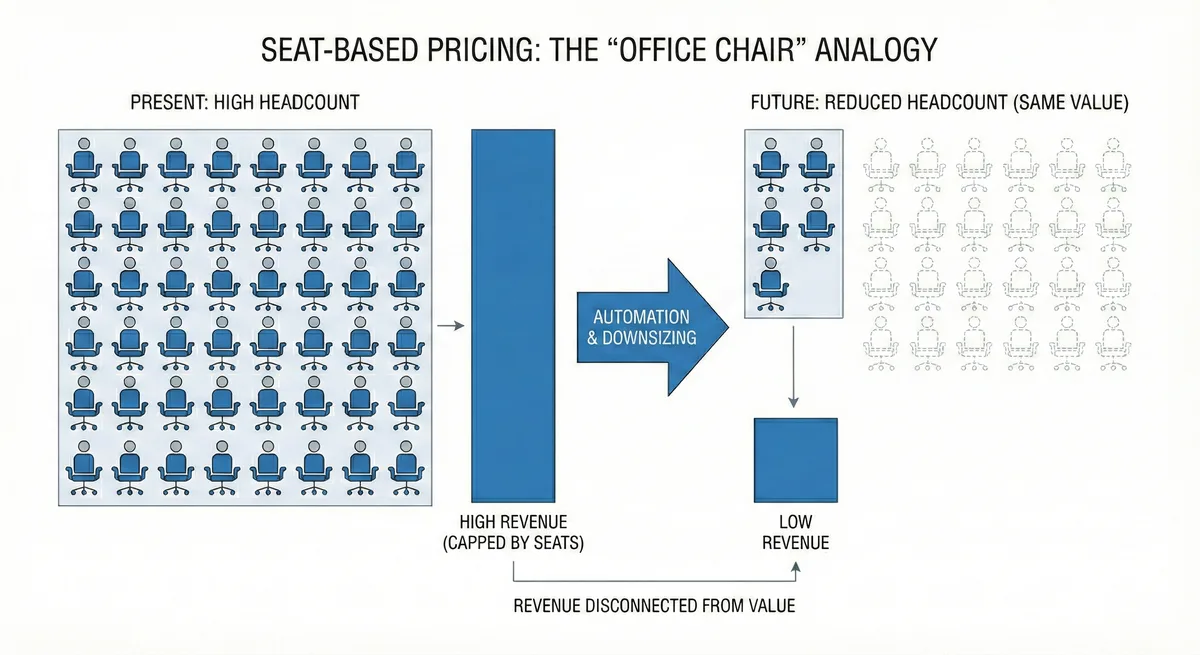
- The Concept: You are charging for the presence of a user.
- The Limit: The price of the "chair" is fixed. It doesn't matter how hard the employee works or how much ROI they generate while sitting in it; your upside is capped by the headcount.
- The Conflict: Revenue is coupled with hiring, not value. If the company moves toward automation and downsizes to 20 highly productive employees, they stop buying 30 chairs. Your revenue drops even if their output stays the same.
When should you use seat-based pricing?#
Decision criteria#
| Seat-based works best when… | If this isn't true, use… |
|---|---|
Value scales with # of users: SoR workflows and/or strong team network effects; adding teammates materially increases outcomes | Outcome-based or workflow-based (per pipeline, per project) when value is not headcount-driven |
Access is the natural unit: every relevant employee needs an identity for permissioning, audit, or governance; “who can use it?” matters | Platform / org-based fee + limited admin seats, or per-asset / per-endpoint when value scales with objects, not people |
Usage is hard to meter fairly: collaboration, viewing, approvals—event counting would feel punitive or gameable | Tiered plans or workspace-based; usage-based only if value event is clear |
Buyers demand predictable budgets: spend should map to hiring plans; annual commits + true-ups are acceptable | Hybrid (platform + seats + usage) so spend tracks headcount and volume |
Equations & rules of thumb#
- Monthly price (simple): MRR = Price_per_seat × Billable_seats
- Monthly price (common hybrid): MRR = Base_fee + (Price_per_seat × Billable_seats)
- Billable seats (with commit): Billable_seats = max(Min_commit, Measured_seats)
- Seat utilization: Utilization = Active_seats / Paid_seats
- Prefer annual commits + quarterly true-ups for mid-market/enterprise; prefer monthly self-serve for SMB.
- In a healthy seat-based model, ~20–30% of New MRR should come from existing customers adding seats.
- If utilization < 60–70% for a sustained period, expect renewal pressure ("we're paying for shelfware").
- If your product has many occasional participants, define 2–3 user roles (Admin / Full / Light) before raising list price.
Why does seat-based pricing matter?#
Seat-based pricing grows naturally with headcount: when customers hire and onboard more people, revenue expands in a predictable way. That predictability is why procurement often prefers it.
The downside is the same coupling: customers may gate access to control costs (hurting adoption and value). More importantly, for products that automate work (like AI), it can be a "suicide metric" because as your product succeeds in making teams more efficient, your customers fire people, and your revenue shrinks.
Key Facts
80% Dominance
More than 80% of sampled B2B SaaS companies use some sort of seat-based pricing metric.
SBI/Price Intelligently, 202580% not suitable
About 8 out of 10 companies using per-user pricing should use a different value metric—because value often doesn't rise with each added user.
SBI/Price Intelligently, 2024Headcount risk, quantified
Bessemer tracked net dollar retention falling from 120% (Q2 2022) to 112% (Q2 2023), naming reduced customer headcount as a direct drag on seat-based expansion.
Bessemer, 2023The retention gap vs. usage
OpenView's 2025 benchmarks put median NRR at 120% for usage-based companies against 110% for seat-based — a 10-point structural difference that compounds every renewal cycle.
OpenView SaaS BenchmarksHow do you apply seat-based pricing step-by-step?#
Inputs you need#
- Customer size: Typical headcount in the buying org, org charts, and how many people truly need access for the workflow to function.
- User Role: Admin vs Full vs Light/Guest users, plus expected frequency (DAU vs occasional) to gauge seat utilization risk.
- Usage patterns: Active users by role, critical actions, and collaboration behavior (to decide named vs active seats and seat thresholds).
- Budgeting constraints: Whether customers budget per head or per project, and who pays/uses/enforces (budget owner, end users, procurement/IT).
- Market context: Category "market price" per user and competitor value metrics (per seat vs workspace vs usage) to anchor packaging.
- Unit economics: Marginal cost drivers tied to users and orgs (support, storage, compute) to validate profitability as seats scale.
Step-by-step
Define the "Seat" (The Unit)
Decide what's free vs paid.
- Example: Charge for "Editors/Admins" (High WTP) and make "Viewers" free. This creates a "viral loop" where free viewers eventually convert to paid editors (e.g., Figma, Airtable).
- Choose how you measure seats: Named (simplest), Active (reduces shelfware fights), or Concurrent (rare in modern SaaS).
Choose the Commit Structure
Package for how teams adopt and set a floor.
- Monthly: Higher price, flexibility (good for SMB).
- Annual: Discounted price, upfront payment (good for Enterprise cash flow; lock in "headcount" revenue regardless of churn).
- Hybrid: "10 seats included in Base Platform Fee, additional seats $50/mo." This protects your downside.
Set the per-seat price
Because seat pricing is easy to compare, you are anchored by competitors.
- If you replace a tool: expect competitor anchoring.
- If you create a new capability: sanity-check price vs buyer salary/productivity (e.g., ~1–2% of monthly salary for the primary user).
Automate Provisioning
Ensure that adding a seat is a self-service "one-click" action for the admin.
- In-product seat counts by role; alerts as customers approach commit; controls to prevent accidental over-provisioning.
Metrics to monitor
Seat utilization
Active ÷ paid (overall and by customer segment). If this drops below 50–70%, your customer is at high risk of churning or downsizing at renewal (the "Shelfware" risk).
Net Revenue Retention (NRR)
Are customers adding more seats over time? If not, your seat-based model relies entirely on new logo acquisition.
NRR / NDR
revenue expansion vs contraction in existing accounts.
Risks & anti-patterns (and fixes)#
| Pitfall | Fix |
|---|---|
Account / login sharing (seat evasion) | Enforce named users with SSO/SCIM, MFA, device/session controls, and clear contract language. |
Seat tax slows adoption (invite gating) | Add Light/Guest roles, free viewers/approvers, or move to workspace-based for broad read access. |
Shelfware / empty seats → renewal pressure | Offer active-seat or fair billing policies, seat reclaim automation, visibility dashboards, and flexible true-down rules. |
Value–price misalignment (automation penalty / upside capped by headcount) | |
Procurement friction (minimum commits, audits, true-ups) | Make rules auditable (definitions, windows), use smaller commits with quarterly true-ups, and offer role-based seats to reduce sticker shock. |
References & Links#
Sources:#
- Nagle, T. T., Hogan, J. E., & Zale, J. (2016). The strategy and tactics of pricing (6th ed.). Routledge.
- Ramanujam, M., & Tacke, G. (2016). Monetizing innovation: How smart companies design the product around the price. Wiley.
- Ghuman, A. (2021). Price to scale: Practical pricing for your high-growth software startup. Independently published.
- Lehrskov-Schmidt, U. (2023). The pricing roadmap: How to design B2B SaaS pricing models that your customers will love. The Pricing Roadmap.
Frequently asked questions
01Should I charge for "Read-Only" users?
Generally, no. Free read-only users act as "distribution"—they spread your product to other departments. Charging for them adds friction to your growth loop. Monetize the creators (Editors), not the consumers.
02Can I combine Seat-Based with Usage-Based pricing?
Yes, this is often the best model for AI/Tech startups. Charge a "Platform Fee" (which includes X seats) to cover fixed costs, and then charge "Consumption" (e.g., credits, GBs, API calls) for the actual work done. (See hybrid pricing.)
03How do I stop customers from churning unused seats?
You can't stop them, but you can preempt the surprise. Monitor utilization rates. If a customer has 20 unused seats, proactively reach out before renewal to suggest swapping those seats for credits or "Training"—keeping the revenue but changing the value delivery.
04Should I offer a "Free Tier" with limited seats?
Yes. Usually, 1–3 seats for free is a great way to "land" inside a company before "expanding." (See freemium.)
05What if my product is for the whole company, not just a department?
Consider "Site Licenses" or "Employee Range" pricing (e.g., $1k/mo for up to 50 employees) to avoid the friction of counting every single head.
06How do I handle "Admin" seats?
Usually, admins count as paid seats unless their only function is billing and they don't use the core product features.
07How do we know if seat-based is hurting growth?
Look for rising product-qualified interest but flat seat expansion, low utilization, and customers restricting invites.
Author
Dr. Sarah Zou
Independent economist · EconNova
Commercial strategy for technical products, with a focus on pricing, unit economics, and the operating choices behind the model.
About SarahTopics
Cite this page
Suggested citation
Zou, S. (2026). Seat-based pricing. In Monetization Models & Metering. Pricing & Monetization Wiki. https://sarahzou.com/wiki/pricing/models-and-metering/seat-based-pricing
Open license
Reuse with attribution
This content is available for reuse. When referencing or republishing it, please credit Dr. Sarah Zou and link back to the original source.
Licensed under Creative Commons Attribution 4.0 International. You may share and adapt the material with appropriate credit.