Pricing Wiki
Pricing Metric (Value Metric)
The pricing unit you charge on (seats, GB, transactions) that ensures your revenue grows as your customers succeed.
Snapshot
What it is
The unit of consumption or value that determines how much a customer pays.
Why it matters
Choosing the wrong metric leads to "ghost churn" and capped expansion revenue.
When to use
Any time you're designing tiers, switching from seat-based to usage-based, launching PLG, seeing churn/expansion issues tied to packaging, or when the cost to serve varies significantly across customers.
Key takeaways
"How" Trumps "How Much": The decision of how you charge (the metric) is more consequential than the price point itself. A wrong metric creates friction that no amount of discounting can fix.
Alignment is everything: If the customer gets more value, they should pay more.
The "Goldilocks" Metric: It must be easy for the customer to understand, easy for you to measure, and perfectly correlated with value.
Avoid "Seat-Tax" traps: In the era of AI and automation, products often reduce the need for human users. Per-user pricing often disincentivizes adoption; if your value isn't collaborative, don't charge by the seat.
On this page9 sections
What is a pricing metric (value metric)?#
Pricing Metric (Value Metric) is the specific unit of value by which you charge for your product or service (e.g., per user, per gigabyte, per transaction, per successful lead). It defines the terms of exchange between buyer and seller.
Key definitions#
- Metric Density: The degree to which the value of one unit of your metric is identical to the next. High density (e.g., $1 of revenue processed) implies uniform value; low density (e.g., "per patient" in a hospital) implies high variance in value, which makes pricing difficult.
- Expansion Revenue: Revenue generated from existing customers as their usage of the value metric increases.
Common value metrics by category#
| Product type | Common value metrics |
|---|---|
Collaboration/work management | seats, projects, automations run |
Data/analytics | events tracked, queries, compute hours |
API/devtools | API calls, seats, build minutes |
Communications | messages sent, contacts, minutes |
Security/IT | endpoints, devices, logs ingested |
Fintech/payments | $ processed, transactions, invoices |
AI features | tokens, credits, minutes, generations |
Mental model#
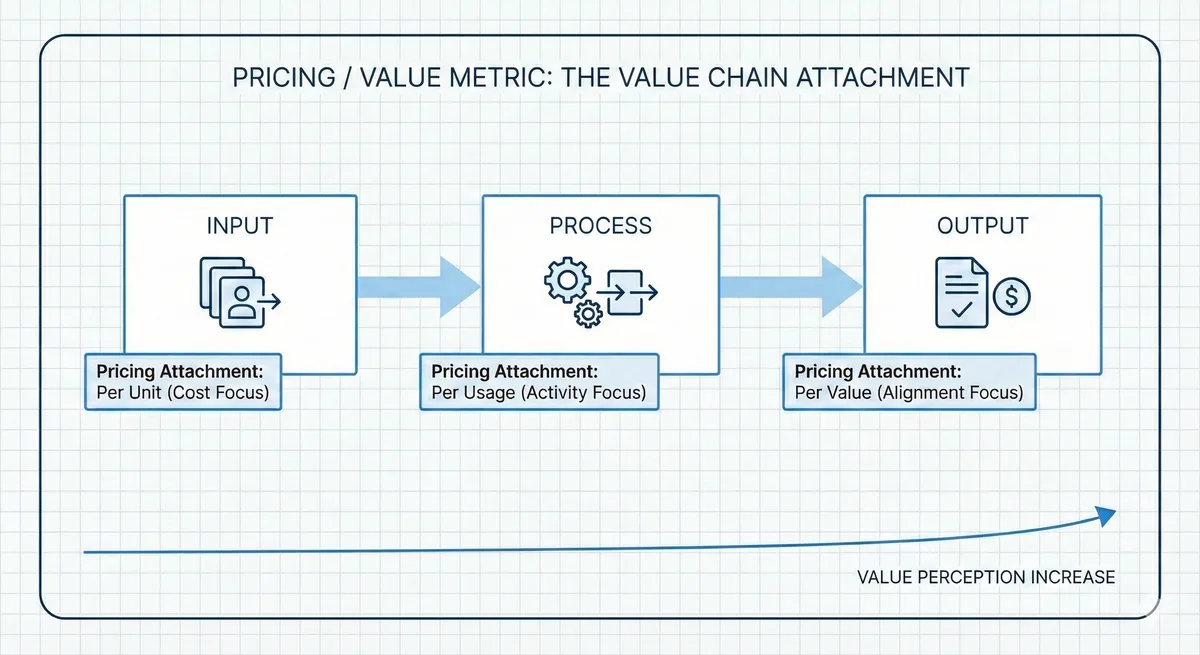
The Value Chain Attachment
Visualize your customer's workflow as a chain from Input → Process → Output. You must strategically choose where to "attach" your price along the workflow.
-
The Input (Input Metrics): Charging for what goes into the system (e.g., "Per User," "Per Server").
- Psychology: Customers view this as an investment or overhead they want to minimize. This creates friction against adoption.
-
The Action (Process Metrics): Charging for the activity within the system (e.g., "Per GB Processed," "Per API Call").
- Psychology: This is better as it tracks usage directly. It feels "fairer" than input pricing but doesn't yet guarantee success.
-
The Outcome (Output Metrics): Charging for the final result (e.g., "Per Qualified Lead," "Per Tax Return Filed").
- Psychology: This creates the highest alignment. The customer views this as "Value Sharing" rather than a cost.
Strategy: Always attempt to attach your pricing as close to the Output as possible. If the output is too hard to measure or too volatile, move one step back to Process. Avoid Input unless your product is purely collaborative.
When should you use which pricing metric?#
Decision criteria#
| If your value scales mostly with… | Strong metric candidates | Notes |
|---|---|---|
# of people collaborating | Seats, active users | Define "active" carefully to avoid gaming. |
Volume processed (data/transactions) | Events, API calls, GB, minutes | Use included bundles + alerts to prevent bill shock. |
Organizational footprint | Accounts, locations, endpoints | Good for enterprise; watch for "all-you-can-eat" abuse. |
Business outcomes you can measure | % of savings, $ influenced, conversions | Needs trust, attribution, and often contracts. |
Mixed drivers | Hybrid: base + usage, or seats + usage | Most common compromise: budgetable base + fair variable. |
Rules of thumb#
-
The SMP Test: A viable pricing metric must pass the SMP test:
-
Simple: Can you explain it in an elevator ride?
-
Measurable: Can you count it unambiguously without disputes?
-
Predictable: Can the customer estimate their bill in advance?
-
-
Proxy close to value: Charge on what customers care about (outcome) or a tight proxy (usage that predicts outcome).
-
Predictable variance: Prefer metrics with stable month-to-month usage—or wrap variability with bundles/caps.
-
The Correlation Rule: If a customer's usage of a metric doubles, their ROI should increase by at least double.
-
One primary growth lever: Keep one "main" metric; add a second only if necessary (e.g., seats + usage).
Why does the pricing metric matter?#
For a startup, the value metric is the most powerful lever for Net Revenue Retention (NRR). If you charge $100/month flat, your growth is limited by your ability to find new logos. If you charge $0.10 per transaction, your revenue grows automatically as your customer's business grows, often without a single sales call.
- Expansion engine: The right metric allows revenue to grow automatically as the customer grows (Net Revenue Retention), without requiring a new sales cycle. If your metric is flat (e.g., a one-time license), you must constantly resell the customer to capture more value.
- Alignment: A good metric aligns your incentives with the customer's success. If you charge "per hour" for a service that should be fast, you are penalized for efficiency. If you charge "per outcome," you are rewarded for efficiency. Customers accept paying more when they clearly get more value.
- Churn Reduction: Products with value-based metrics experience lower churn because customers can scale down their spend during slow periods rather than canceling the subscription entirely.
Key Facts
4x Efficiency
It costs 4x less to acquire $1 of revenue through upsells/expansion (driven by a scaling metric) than to acquire $1 from a new customer.
OpenView, 202338% Faster Growth
Public SaaS companies utilizing usage-based pricing grew 38% faster year-over-year compared to those with traditional models.
OpenView, 202370-85% using
Over 70-85% of SaaS companies now use some form of usage or value-based metric rather than flat monthly fees.
Metronome, 2025How do you choose and implement a pricing metric step-by-step?#
Inputs you need#
- Segmentation: who buys, who uses, who budgets (SMB vs enterprise).
- Value drivers: what outcomes matter (time saved, revenue, risk).
- Usage telemetry: distribution by account (p50/p75/p90), seasonality, outliers.
- Cost-to-serve: variable costs tied to usage (cloud, support, third-party APIs).
- Competitor Benchmarks: Are you disrupting the category? (e.g., Slack disrupted by charging for active users, not total seats).
Step-by-step
Audit Current Value
Identify the top 3 actions users take in your product that lead to their success.
Brainstorm 6–10 candidate metrics
List options across the value chain. For a marketing platform, this might be:
• Input: Per User, Per Campaign.
• Usage: Per Email Sent, Per Contact Stored.
• Outcome: Per Click, Per Lead Generated
Filter with the "5 Criteria"
Score each metric (1–5) on these dimensions:
• Aligned: Does it grow as the customer gets value?
• Predictable: Can the customer budget for it?
• Measurable: Do you have the telemetry to track it?
• Scalable: Does it work for SMBs and Enterprises?
• Acceptable: Is it fair? (e.g., charging for "Per Login" is usually deemed unfair)
Test for Density
Analyze the variance in value. If you choose "Per Report," is a report for a small client worth the same as a report for a Fortune 500 client? If the value variance is massive (low density), do not use it as a linear metric; use it as a tier differentiator instead
Simulate Revenue
Run your historical data through the new metric and measure the impacts.
Metrics to monitor
NRR (Net Revenue Retention)
Should increase as the metric scales. Is the metric naturally driving NRR > 100%?
Overage Contribution
If overages are >20% of revenue, customers may be suffering "bill shock." If <5%, your included buckets are too generous
Usage Churn
Are customers using less of the metric over time? This is a leading indicator of churn
Downgrade Rate
High rates suggest the metric is too volatile or unpredictable.
Invoice disputes / credits issued
Leading indicator of metric friction
Gross margin by segment
Especially for usage-heavy cohorts
Risks & anti-patterns (and fixes)#
| Pitfall | Fix |
|---|---|
Metric doesn't track value → Customers feel "taxed." | Switch to a tighter value proxy; pair with a base fee. |
Risk: The Taxi Meter Effect. Customers stop using the product because they see the "meter running" and fear costs. | Use generous "included buckets" so day-to-day usage feels free, and only heavy usage incurs marginal costs. |
Risk: Complexity. customers can't explain the bill due to too many metrics or too technical. | One primary metric + optional add-ons. Translate the technical metric into a business metric for the sales conversation (e.g., "1,000 tokens ≈ 750 words"). |
Risk: Bill shock / Unpredictability. Enterprise procurement hates variable bills. churn spikes. | Provide bundles, caps, alerts, annual commit with true-up. Offer a credits / drawdown model where they pre-purchase a large bucket of credits annually for a discount. |
References & Links#
Sources:#
- Ghuman, A. (2021). Price to scale: Practical pricing for your high-growth software startup. Independently published.
- Lehrskov-Schmidt, U. (2023). The pricing roadmap: How to design B2B SaaS pricing models that your customers will love. The Pricing Roadmap.
- Poyar, K. (2023, February 2). The state of usage-based pricing: 2nd edition. OpenView Partners.
- Nagle, T. T., Muller, G., & Gruyaert, E. (2023). The strategy and tactics of pricing: A guide to growing more profitably (7th ed.). Routledge.
- Ramanujam, M., & Tacke, G. (2016). Monetizing innovation: How smart companies design the product around the price. Wiley.
Frequently asked questions
01Can I have more than one pricing metric?
Ideally, no. Multiple metrics (e.g., charging for Users AND Storage AND Features) create "billing friction." Use one primary. Usually, it is better to have one "primary" metric for the price (e.g., $ per user) and use others to differentiate tiers (e.g., Basic has 5GB, Pro has 50GB).
02What if my customers prefer "flat pricing" but I want "usage pricing"?
This is a common conflict between "Predictability" (Customer want) and "Value Alignment" (Vendor want). The solution is the Tiered Usage model: Sell flat tiers (Small/Medium/Large) that come with usage caps. This gives the customer a flat bill (predictability) but forces an upgrade when they grow (alignment).
03When is outcome-based pricing a bad idea?
When you can't measure the outcome reliably, customers don't trust attribution, or you can't control key drivers that affect results. (See outcome-based pricing.)
04What if my competitors all charge by seat, but I want to charge by value?
This is a massive opportunity for disruption. Ensure you market it as "Paying for what you use" rather than "Paying for access." (See seat-based pricing.)
05Is "Usage-Based" the same as "Value-Based"?
Not quite. Usage-based is a tactic (charging per unit). Value-based is the strategy (ensuring that unit represents success). If you charge for "logins," that's usage-based, but it's rarely value-based.
06What's the fastest way to validate a value metric?
Pilot it in one segment (or a new plan) and watch: invoice disputes, discounting, expansion rate, and churn reasons.
07How do I change my pricing metric for existing customers?
This is difficult. You generally must grandfather existing customers for a set period (e.g., 12 months) or map them to the new metric and offer a discount to keep their price flat for the first year. Force-migrating customers to a new metric without a transition period triggers high churn.
Author
Dr. Sarah Zou
Independent economist · EconNova
Commercial strategy for technical products, with a focus on pricing, unit economics, and the operating choices behind the model.
About SarahTopics
Cite this page
Suggested citation
Zou, S. (2026). Pricing Metric (Value Metric). In Monetization Models & Metering. Pricing & Monetization Wiki. https://sarahzou.com/wiki/pricing/models-and-metering/pricing-metric-value-metric
Open license
Reuse with attribution
This content is available for reuse. When referencing or republishing it, please credit Dr. Sarah Zou and link back to the original source.
Licensed under Creative Commons Attribution 4.0 International. You may share and adapt the material with appropriate credit.