Pricing Wiki
Hybrid pricing
A pricing model that combines fixed subscription fees with variable usage charges to stabilize revenue while capturing upside value.
Snapshot
What it is
A pricing model that blends capability pricing (flat recurring fees) with Consumption Pricing (variable fees based on usage)—typically customers pay a base subscription fee (for access/platform) plus a variable fee based on consumption (for value).
Why it matters
It solves the "Predictability vs Upside" dilemma: the fixed fee covers your costs and ensures steady cash flow, while the variable component allows you to capture revenue growth as your customer succeeds and scales.
Key takeaways
Risk Mitigation: Hybrid models distribute risk. Pure subscriptions risk leaving money on the table; pure usage exposes the vendor to revenue volatility. Hybridizing them balances these risks for both parties.
The "Whale" Defense: Pure linear pricing (e.g., $50/user) often fails with large enterprise customers ("whales") because the total cost becomes astronomical. Hybrid models allow you to charge a higher platform fee with a lower per-unit rate, securing the deal.
Lower Entry Barrier: Allows startups to land customers with lower initial needs while keeping the upside for high-volume users.
Value Alignment: Customers feel they are paying for exactly what they use, reducing "shelfware" resentment.
On this page9 sections
What is hybrid pricing?#
Hybrid pricing (also called the "three-part tariff" or "base + overage" model) is a monetization model that combines a fixed component—such as a platform or subscription fee—with a variable component based on measured consumption.
Unlike pure usage-based pricing (where revenue can swing dramatically with usage) or a pure seat-based/flat subscription (where revenue is capped regardless of value delivered), hybrid pricing gives you both: a stable revenue floor from the base fee and an uncapped ceiling from the usage component.
Key definitions#
- Platform fee (base): Fixed recurring charge for access + baseline value.
- Included allowance: Usage bundled into the base fee.
- Overage (metered usage): Per-unit (or tiered) charges only for usage above the allowance.
- Variable component: The usage-priced part of the bill (units like API calls, GB, transactions, seats-as-usage).
- Commitment: Contracted minimum spend or prepaid credits (often annual) that reduce buyer risk and improve predictability.
- Prepaid credits / drawdown: Customer prepays a "wallet"; usage burns down the balance (sometimes with volume discounts).
Mental model#
"The Club + Utility Model"
Think of it like a high-end gym. You pay a monthly membership (Subscription) to keep the lights on and use the equipment, but you pay extra for personal training or juice bar items (Usage).
This framework creates two distinct value layers:
- The Club (Membership): This is the psychological anchor. By paying the base fee, the customer gains "membership status." This covers your fixed costs (hosting, R&D, support) and creates a "sunk cost" incentive for the user to actually log in and use the tool. It ensures they are "in the ecosystem."
- The Utility (Consumption): This is the scalability engine. Just like an electric bill, this captures the specific value extracted during a period. If the customer has a high-volume month, your revenue scales automatically. If they have a slow month, they don't feel "ripped off" by a massive flat fee, which prevents churn during down cycles.
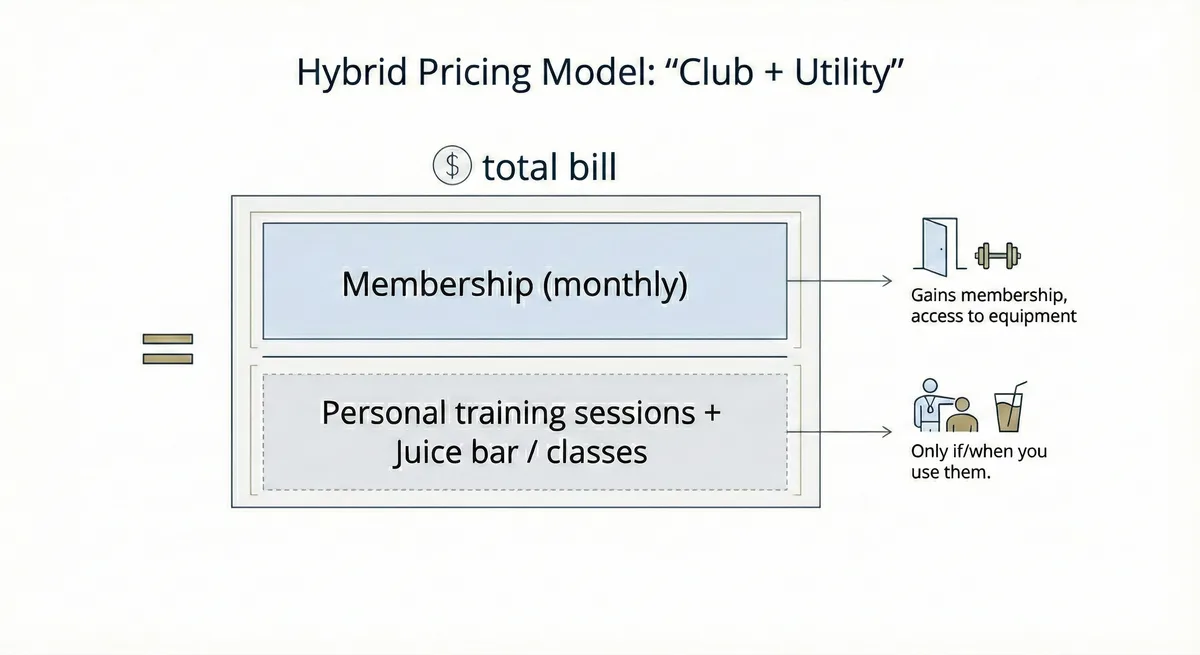
This structure allows you to monetize access, commitment, and flexibility simultaneously. Done well, hybrid pricing delivers predictability + upside: the base fee stabilizes revenue; usage captures expansion without forcing everyone into a high fixed price.
By separating the "right to use" from the "volume of use," you align your incentives with the customer: you want them to use the product more because it benefits both their business and your bottom line.
When should you use hybrid pricing?#
Decision criteria#
| Situation | Better default | Why |
|---|---|---|
Marginal costs scale per unit (AI/SMS/storage) | Hybrid (base + usage) | Pass-through variable costs; protect gross margin |
Usage is highly seasonal/volatile | Hybrid or prepaid drawdown | Handles peaks/troughs without contract churn |
Baseline value is high, 10–100× value variance across customers | Hybrid (base + usage) | Captures upside from heavy/value-rich users |
PLG motion (land small, expand) | Hybrid or pure usage | Low adoption friction + natural expansion |
Usage is the only value driver (no baseline) | Pure usage | Minimizes barrier to start; pay only when used |
Value is tied mainly to number of people | Seats (maybe + usage/add-ons) | Easy to explain and forecast |
Usage is noisy and hard to explain | Seats or flat subscription (temporarily) | Reduce billing confusion while you improve metering/metric |
Equations & rules of thumb#
-
Total monthly bill:
Bill = Base fee + max(0, Usage − Included) × Overage rate + Add-ons
(Add-ons = optional modular items.)
-
Rule of thumb for setting the base fee: Set the base fee to cover fixed costs + target margin at the median customer's baseline usage.
-
Rule of thumb for included allowance: Include enough to make the base feel worthwhile (often near the 25th–50th percentile of baseline usage), then charge overages to capture heavy-user value.
-
The 80/20 Rule of Stability: Aim for the base subscription to cover roughly 60–80% of your expected revenue per customer. This keeps your valuation high (investors love predictability) while leaving 20–40% for "alpha" growth via usage.
Why does hybrid pricing matter?#
Hybrid pricing reduces "shelfware" because customers aren't forced to pay a high flat fee in slow months—yet you still get paid when heavy users drive real infrastructure and support load. It's a practical bridge between finance and product: the fixed subscription creates budgetable predictability (and supports enterprise procurement), while the usage piece monetizes growth as customers expand.
You avoid the "one size fits none" trap. Light users can start and stay without overpaying, and power users fund the extra value (and cost) they create—without you having to guess the perfect flat price for everyone.
Key Facts
Strongest growth
Across 316 companies surveyed with Benchmarkit, those on hybrid models (subscription + usage) reported the highest median growth rate at 21%, ahead of both pure subscription and pure usage-based peers.
Maxio, 2025 SaaS Pricing Trends Report46% Adoption
Approximately 46% of SaaS companies now utilize some form of usage-based or hybrid pricing versus 15% with largely pure usage models, up from 34% in 2020.
OpenView Partners, 2023The Costco split
Membership fees are about 2% of Costco's revenue but roughly two-thirds of its operating income — the platform fee carries the profit while transaction margins stay deliberately thin. It is the clearest large-scale demonstration of what a hybrid model's fixed component is actually for.
Costco FY2025 Q3 10-QHow do you implement hybrid pricing step-by-step?#
Inputs you need#
- Value metric: 1–3 candidate metrics, what counts, and how customers can verify it (auditable usage logs).
- Usage distribution by segment: p10/p50/p90 usage (and seasonality) by customer type to size the included allowance and predict bill ranges.
- Unit economics: COGS per unit (infra, AI, SMS, storage, support) to set a price floor and protect gross margin.
- Customer segmentation: Clear separation of light vs. power users and what drives expansion (so plans map to real needs).
Step-by-step
Pick the value metric
Choose a usage metric that tracks value and cost (e.g., transactions, messages, GB, tokens). Define what counts and how customers verify it. Ensure it is Simple, Measurable, and Scalable.
Define the base
Price the base to at least cover fixed costs (and help recover CAC) and include a meaningful allowance buffer (often around p25–p50 baseline usage). Set the allowance high enough to cover the average user, pushing only heavy users into overage.
Design usage charges and upgrade paths
Set overage rates (flat, tiered, or credits) to protect margin; make overage intentionally less attractive than upgrading to the next tier.
Package for segments with 2–4 tiers
Create tiers where the main differences are allowance, overage rate, and a small set of high-value features/add-ons (e.g., SSO, advanced reporting, support).
Operationalize, pilot, then codify policies
Stand up metering + billing UX (dashboards/alerts/caps), pilot on new deals, then finalize rules for rounding, proration, credits, refunds, and dispute SLAs.
Metrics to monitor
Overage Contribution
What % of revenue comes from overages? If it's too high (>20%), customers may feel nickel-and-dimed and churn; if too low, you aren't capturing upside.
Expense Predictability
Monitor customer complaints regarding bill shock. If customers cannot forecast their spend, they may downgrade to a fixed competitor.
Churn by Usage Decile
Are your lowest-usage customers churning? They might need a lower base fee.
Risks & anti-patterns (and fixes)#
| Pitfall | Fix |
|---|---|
Bill shock & distrust: Unpredictable invoices create churn and disputes. | Included allowance, real-time dashboards, alerts (e.g., 50/80/90%), calculators/forecasts, and caps or prepay options. |
Complexity overload: Charging for storage and API calls and seats simultaneously confuses buyers. | Pick one primary value metric and bundle the rest. |
"Double charge" perception: A high base fee and a high unit price feels like double-dipping. | Position the base as a membership discount that lowers the unit rate; show effective blended rates by tier. |
The "penalty" feeling: If the overage fee is punitive, customers will actively suppress usage. | Implement "rollover" credits or "true-up" periods where customers can adjust their tier retroactively without penalty. |
Incentive misalignment (sales & CS): Reps oversell low base, then customers get surprised by usage; expansion becomes contentious. | Comp on committed base + expected usage, add expansion accelerators, and align success plans to usage growth. |
References & Links#
Sources:#
- Ghuman, A., & Pasternak, J. (2024). Price to scale. Independently published.
- Howatson, A. (2024). The usage economy: Strategies for growth, smart pricing, and effective technology management. Usage Economy Publishing.
- Mohammed, R. (2005). The art of pricing: How to find the hidden profits to grow your business. Crown Business.
- Nagle, T. T., Hogan, J. E., & Zale, J. (2016). The strategy and tactics of pricing (6th ed.). Routledge.
- Poyar, K. (2023, February 2). The state of usage-based pricing: 2nd edition. OpenView Partners.
- Raju, J., & Zhang, Z. J. (2010). Smart pricing: How Google, Priceline, and leading businesses use pricing innovation for profitability. Wharton School Publishing.
Frequently asked questions
01How do I handle customers who hate variable costs?
Offer a credits / drawdown model. They pay a fixed $50k/year budget upfront (predictable for them) and draw usage against it (variable for you).
02Can I use hybrid pricing if my costs are near zero?
Yes. Even with low COGS, hybrid pricing segregates customers by willingness to pay. The base fee filters for serious buyers, while the usage fee captures value from power users.
03What if my competitors are all flat-fee?
This is your "disruption" opportunity. You can market yourself as the "fair" alternative where customers don't pay for what they don't use.
04Should I offer an "Unlimited" tier?
Generally, no. "Unlimited" is a margin killer in the long run. If you must, price it at the 95th percentile of your power users' consumption.
Author
Dr. Sarah Zou
Independent economist · EconNova
Commercial strategy for technical products, with a focus on pricing, unit economics, and the operating choices behind the model.
About SarahTopics
Cite this page
Suggested citation
Zou, S. (2026). Hybrid pricing. In Monetization Models & Metering. Pricing & Monetization Wiki. https://sarahzou.com/wiki/pricing/models-and-metering/hybrid-pricing
Open license
Reuse with attribution
This content is available for reuse. When referencing or republishing it, please credit Dr. Sarah Zou and link back to the original source.
Licensed under Creative Commons Attribution 4.0 International. You may share and adapt the material with appropriate credit.