Pricing Wiki
Monetization model
The way a business turns delivered value into revenue—who pays, for what unit, and how the money scales.
Snapshot
What it is
Monetization model is the strategic framework a company uses to convert the value it provides to customers into revenue. It is distinct from "pricing" (the dollar amount); it is the "how" and "why" of your revenue engine.
Why it matters
72% of new products failed because they didn't build around pricing/monetization. Done well, your product, sales motion, and costs can align to capture value sustainably as customers scale.
When to use
During the transition from Seed to Series A, or when launching a new product line, or redesigning unit economics.
Key takeaways
Monetization > Pricing: The model (SaaS, Usage-based, etc.) often dictates success more than the price point.
Alignment is King: The most critical decision is what you charge for. Your model must align with how the customer perceives value (e.g., if they save time, charge by the hour; if they make money, take a cut).
Don't Default to Subscription: While subscriptions are popular, they are not always optimal. If your product has high variable costs (e.g., AI tokens, SMS) or variable usage patterns, a flat subscription can kill your margins or force you to underprice high-volume users.
Treat "how you get paid" as a product feature: simplicity beats cleverness at early stage.
On this page9 sections
What is a monetization model?#
Monetization model is the mechanism of how a business generates revenue. It answers how you charge (e.g., Subscription, Dynamic, Usage-based, Freemium), whereas price setting answers how much you charge. It is the architectural blueprint for revenue generation.
Key definitions#
- Pricing Metric (Value Metric): The specific unit of value the customer pays for (e.g., per user, per gigabyte, per transaction). This is the engine inside the monetization model.
- Price Structure: The tactical arrangement of the price, such as flat fees, tiered bundles, or multi-part tariffs (e.g., base fee + overage).
- LTV/CAC Ratio: The relationship between the lifetime value of a customer and the cost to acquire them—this is the "health check" for any monetization model.
Mental model#
The Monetization Triangle (Risk vs. Commitment)
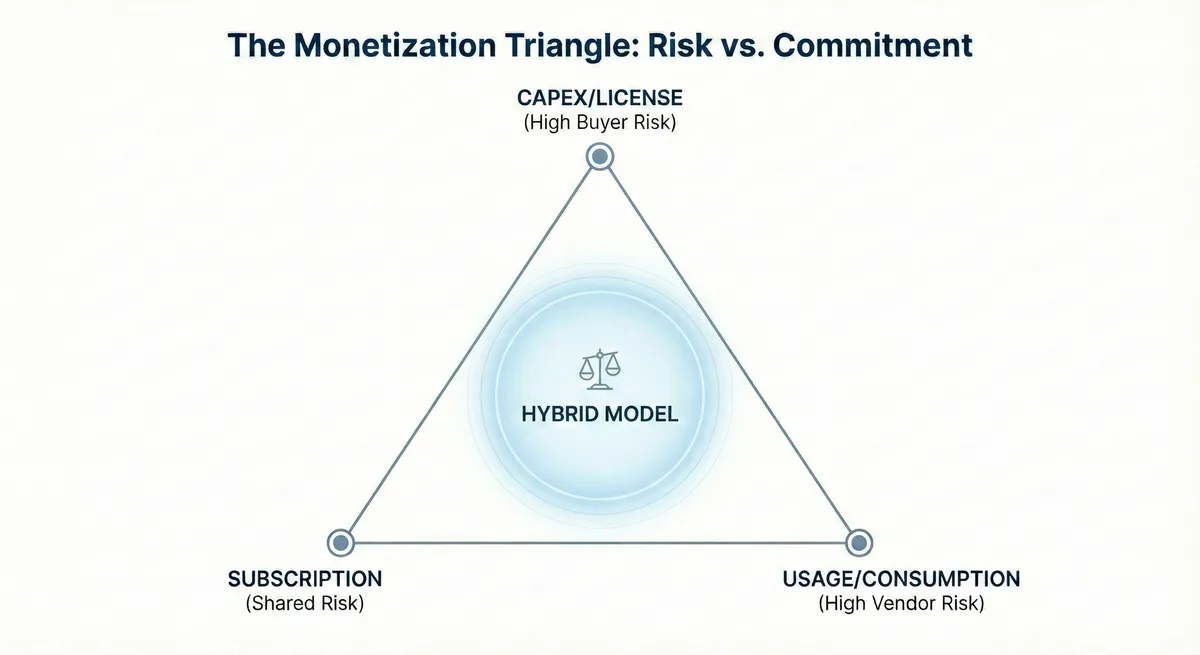
Visualizing monetization models based on who holds the risk:
- Capex/License (High Buyer Risk): The customer pays a massive upfront fee (e.g., buying a server). If they don't use it, they lose money.
- Subscription (Shared Risk): The customer pays a recurring flat fee (e.g., Netflix). They risk paying for idle time; the vendor risks churn if value isn't delivered.
- Usage/Consumption (High Vendor Risk): The customer pays only for what they consume (e.g., AWS, Uber). The vendor takes the capital risk of building the infrastructure and only gets paid if the customer succeeds in using it. (See usage-based pricing.)
- The Sweet Spot is in the center—where the model feels fair to the user but is sustainable for the business. Most successful B2B startups move toward the middle—a Hybrid Model.
Worked example (generic)#
Product: B2B workflow automation tool
Hypotheses:
- H1: $/seat/month (predictable; aligns to team size)
- H2: $/workflow run (aligns to usage; may spike)
- H3: Hybrid: base + included runs + overages (best of both)
Pick the model:
- If usage varies 10× between customers and compute cost scales with runs → choose hybrid.
- Keep tiers simple:
- Starter: $49/mo includes 2,000 runs
- Pro: $199/mo includes 15,000 runs
- Business: $499/mo includes 60,000 runs + SSO
- Overages: $X per 1,000 runs (priced above marginal cost)
Sanity check:
- If variable cost is $0.002/run and overage is $0.01/run, you have room for support, payment fees, and margin.
When should you use which model?#
Decision criteria#
| Situation | Best-fit monetization patterns | Why |
|---|---|---|
B2B product with clear seats (collaboration, CRM) | Matches org structure; predictable; easy procurement | |
High usage variance (API, data, infra, AI) | Aligns to value and COGS; reduces cross-subsidy | |
Marketplace connecting buyers/sellers | Take rate (% of GMV) + optional SaaS tools | Revenue scales with volume; leverages network effects |
Consumer attention product (media/social) | Ads + optional premium subscription | Users "pay" with attention; premium removes friction |
Hardware + recurring service | Razor-and-blades (hardware margin + subscription) | Lowers adoption barrier; monetizes ongoing value |
Outcome is measurable and attributable | Outcome-based (success fee) + minimum | Strong alignment; harder to measure/finance |
Rules of thumb#
- The "3-Second Rule": A visitor should understand how you charge within 3 seconds of looking at your pricing page. Prefer simple, explainable pricing until you hit strong product-market fit.
- The Payback Period Rule: Ideally, your monetization model should allow you to recover your CAC in < 12 months.
- Expansion Revenue Goal: A healthy model should allow for "Negative Churn"—where existing customers pay you more over time (e.g., through usage tiers).
Why does monetization model matter?#
In the early stages, founders often treat monetization as an afterthought ("we'll figure it out after we get users"). However, if you align your product features, sales motion, and operating costs with your chosen model from day one, you ensure that every dollar spent on development is geared toward a sustainable value-capture engine rather than a product that is "too expensive to sell" or "too cheap to support." This concept is also known as "building around the price."
- Strategic Leverage: "How you charge trumps what you charge." A superior monetization model can differentiate a product more effectively than features alone. For example, Michelin shifted from selling tires (product) to charging per kilometer driven (outcome), aligning their incentives perfectly with fleet operators.
- Growth Acceleration: Companies using usage-based monetization models grow 38% faster than their peers (OpenView) because they better align cost with value, reducing barriers to entry and enabling automatic expansion revenue (NRR).
- Profit Sensitivity: A 1% improvement in monetization (price/model) generates a 12.7% increase in operating profit, making it the most efficient lever for profitability compared to acquisition or cost reduction.
Key Facts
72% failure
The failure rate of new products, often attributed to postponing monetization discussions until after the product is built. (Ramanujam & Tacke, Monetizing Innovation)
12.7%+ profit
A 1% improvement in monetization results in a 12.7% increase in bottom-line profit, compared to only 3% for volume improvements.
Price Intelligently2x higher ARPA
Companies that review their monetization every 6 months see a 2x higher ARPA (Average Revenue Per Account) than those that do it annually.
ProfitWellHow do you apply it step-by-step?#
Inputs you need#
- Customer segments: Who has budget authority, who uses, who benefits.
- Willingness to Pay (WTP) Data: Not what people say they'll pay, but what they do pay for alternatives.
- Usage Telemetry: Historical data on consumption patterns (e.g., heavy users vs. light users) to simulate revenue under different models.
- Cost structure: Variable costs per unit (cloud, support, refunds, payment fees, and third-party APIs).
- Competitive context: Common models in category + switching costs.
Step-by-step
Map the Value Exchange Frequency
Determine how the customer experiences value. Is it a continuous utility (Subscription), a discrete event (transactional), or a platform benefit (Marketplace)? Match the billing cadence to this.
Align with Distribution Strategy
Your model must at least cover your COGS per unit. Low-ARPU models (Freemium, $10/mo) require viral or SEO-driven self-service. High-ARPU models ($50k+/yr) require a model that supports sales commissions and long procurement cycles.
Choose the risk split that fits the buyer
- Buyers who hate uncertainty → subscription (or base fee).
- Buyers with spiky usage → base + usage (hybrid).
- Marketplaces → take rate (and maybe SaaS tools).
- Clear attributable outcomes → success fee (often with a minimum).
Simulate and Validate
Simulate 2–3 models on real/expected usage and pick the simplest model that passes the checks.
- Revenue impact analysis: Revenue per customer at P50/P90 usage; Gross margin per customer; "Fairness" check: do heavy users pay more, and do they cost more?
- For each model, review: One primary value metric; 2–3 tiers; A single upgrade path (limit hits → upgrade).
- Validate the model with customers using Van Westendorp surveys or Conjoint Analysis to test fairness and willingness to accept the model.
Metrics to monitor
Revenue quality
Gross margin (ensure your monetization model doesn't hide high operational costs), refunds/chargebacks, discounting.
Retention/expansion
Usage churn (Are customers using the product less, even if they haven't cancelled?), net revenue retention (NRR), expansion rate.
Growth efficiency
CAC, CAC payback, LTV/CAC.
Risks & anti-patterns (and fixes)#
| Pitfall | Fix |
|---|---|
Misaligned value metric: Charging per user when the value is generated by automation, or customers pay more when they use less (or vice versa). | Re-anchor to a metric tied to value delivered (see pricing metric / value metric). |
Consolidate. Periodically bundle popular add-ons back into the core tiers to simplify the offering (re-bundling). (See packaging.) | |
COGS surprise (especially AI/infra): Usage grows faster than revenue. | Add base fee, minimum commits, or price per unit linked to cost. |
Unpredictable Revenue: Investors and FP&A teams struggle to forecast consumption revenue. | Use the credits / drawdown model. Customers buy a bucket of credits upfront (booking revenue), providing cash flow certainty while retaining usage flexibility. |
References & Links#
Sources:#
- Ramanujam, M., & Tacke, G. (2016). Monetizing innovation: How smart companies design the product around the price. Wiley.
- Ghuman, A. (2021). Price to scale: Practical pricing for your high-growth software startup. Independently published.
- Howatson, A. (2024). The usage economy: Strategies for growth, smart pricing, and effective technology management. Usage Economy Publishing.
- Osterwalder, A., & Pigneur, Y. (2010). Business model generation: A handbook for visionaries, game changers, and challengers. Wiley.
- Teece, D. J. (2010). Business models, business strategy and innovation. Long Range Planning, 43(2-3), 172-194.
- Anderson, C. (2009). Free: The future of a radical price. Hyperion.
Frequently asked questions
01What's the difference between a business model and a monetization model?
A business model covers how you create/deliver value; monetization is specifically how you capture revenue from that value.
02Is "Freemium" a monetization model?
Yes, but be careful. It is primarily an acquisition strategy. Freemium works as a monetization model only if you have a clear "Land and Expand" path where your product has a natural "viral loop" or very low marginal costs. Otherwise, it's just a "Free" model that burns cash.
03When should I switch from self-serve to sales-led monetization?
When contract sizes justify sales cost (CAC), buyers need security/compliance, or buying requires procurement/legal.
04How do I avoid pricing that destroys margins?
Model contribution margin per unit and stress-test the 90th percentile customer (heavy usage). If it breaks, redesign.
05What's a "good" monetization model?
One that is simple, aligned to customer value, resilient to cost shocks, and improves unit economics as you scale.
06How often should I change my monetization model?
Pricing is a process, not a one-time event. You should evaluate it quarterly and likely make structural adjustments every 12–18 months as your product and market evolve. Startups often start with simple subscriptions and evolve into hybrid/usage models as they scale.
Author
Dr. Sarah Zou
Independent economist · EconNova
Commercial strategy for technical products, with a focus on pricing, unit economics, and the operating choices behind the model.
About SarahTopics
Cite this page
Suggested citation
Zou, S. (2026). Monetization model. In Monetization Models & Metering. Pricing & Monetization Wiki. https://sarahzou.com/wiki/pricing/models-and-metering/monetization-model
Open license
Reuse with attribution
This content is available for reuse. When referencing or republishing it, please credit Dr. Sarah Zou and link back to the original source.
Licensed under Creative Commons Attribution 4.0 International. You may share and adapt the material with appropriate credit.