Pricing Wiki
Usage-based pricing
Charge customers based on measured consumption so price scales with value, improving adoption and expansion.
Snapshot
What it is
A pricing model (often called "pay-as-you-go") where customers pay based on their consumption of a specific metric (e.g., API calls, data stored, transactions processed) rather than a flat monthly fee.
Why it matters
It lowers the barrier to entry for customers while ensuring the revenue scales with the value the customer receives.
Key takeaways
Value Alignment: Risk shift from customers to you, as they pay only when consumption happens. You win when your customer wins.
The "Unit" is King: Success depends entirely on choosing the right value metric.
Low Friction: UBP allows customers to start small with minimal upfront risk, ideal for PLG (Product-Led Growth).
Net Retention Power: UBP is the primary driver of 130%+ Net Revenue Retention (NRR).
Audit for "The Taxi Meter Effect": If customers are afraid to use your product because they see the "meter running," you will kill adoption.
On this page9 sections
What is usage-based pricing?#
Usage-Based Pricing, often called "pay-as-you-go", is a monetization model where customers are charged based on their consumption of a product or service (e.g., gigabytes stored, API calls made, messages sent, transactions processed, bookings confirmed) rather than a flat fee or per-user license. It aligns the price paid directly with the volume of value received.
The emergence of UBP fits within the context of The Usage Economy, which refers to the broader economic shift from ownership (buying an asset) to access (paying for the utility of an asset). It relies on atomic-level tracking of value delivery.
Key definitions#
- Pricing Metric (Value Metric): The specific measurable action you charge for (e.g., per "active user," per "booking," per "compute hour," per "payment processed"). Selecting the right metric is the single most consequential decision in UBP.
- Metric Density: The degree to which the value is the same across all units of a given pricing metric. High density (e.g., payment processing) supports UBP.
- Rate card: The price per unit (often tiered).
- Allowance: Included usage (free or bundled) before overage charges.
- Overage: The variable bill above allowance.
- Hybrid pricing: A base fee (platform access / SLA / minimum) plus usage charges.
- Commit-to-consume (committed spend): Customer commits to a minimum spend/units for a discount; usage burns down the commitment.
- Minimum Commit: A floor price customers pay to ensure a baseline of revenue for the vendor.
Mental model#
"The Taxi vs. The Car"
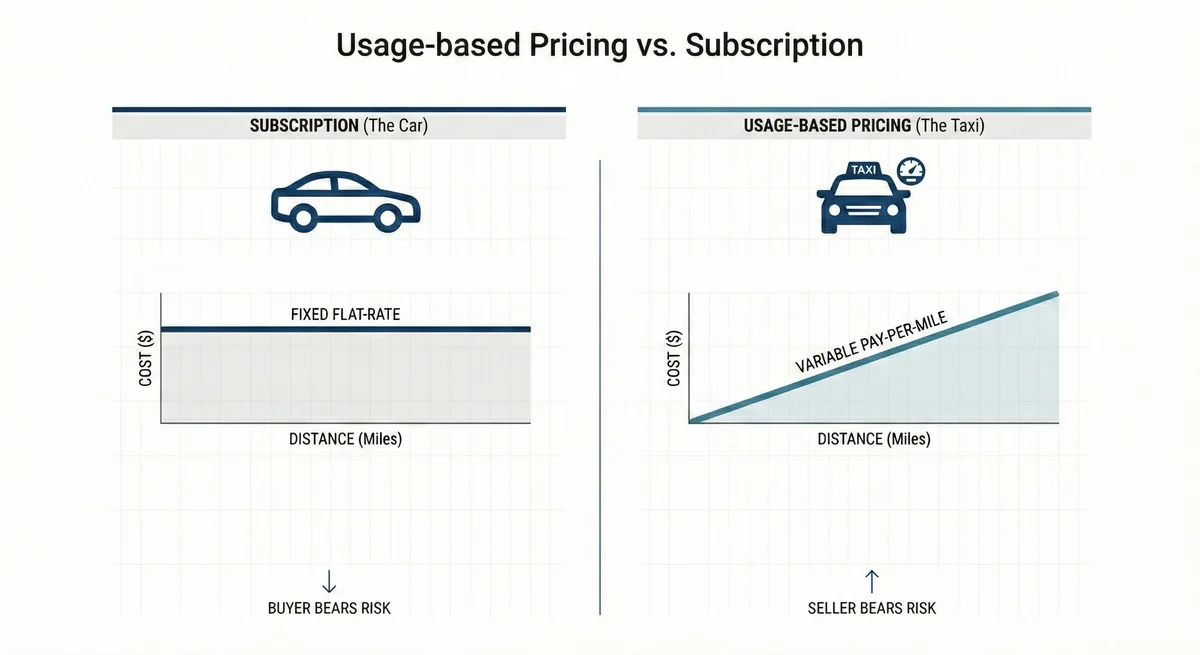
- Subscription/License (The Car): You buy the car (or lease it flat-rate). You pay the same amount whether you drive it 100 miles or 0 miles. It sits idle 95% of the time, representing wasted efficiency for the buyer.
- Usage-Based (The Taxi): You pay only for the specific distance traveled. If you don't travel, you pay zero. The risk of asset utilization shifts from the buyer to the seller.
- Hybrid (The Cell Phone Plan): The most common successful B2B model. You pay a base fee for a "bucket" of usage (e.g., 5GB data), and pay extra (overage) only if you exceed it. This creates predictability while capturing upside.
Usage-based vs. transaction-based pricing#
Transaction-based pricing is a specific subset or implementation of usage-based pricing. Both sit under consumption pricing (pay for what you use), contrasted with capability pricing (pay a flat fee for the ability to use, like a subscription). In practice, the terms are often used interchangeably—but here we distinguish them by (1) whether the metric is continuous vs. discrete and (2) whether it prices an input vs. an outcome.
Usage-based pricing is like an electric meter that runs in the background based on intensity/duration (GB stored, compute minutes), while transaction-based pricing is like a turnstile that charges each time a customer passes through a gate (payment processed, booking confirmed). Transaction metrics often feel fairer because they're closer to a business "win," but they only work when the unit is cleanly countable and customers can predict (or control) spend.
| Dimension | Usage-based pricing | Transaction-based pricing |
|---|---|---|
Metric nature | Continuous flow / accumulation (minutes, GB, MAU, records processed) | Countable events (payments, bookings, rides, calls, downloads) |
Value alignment | Often input-oriented (provider effort/cost proxy) | Often outcome-oriented (charged when a result is delivered) |
Predictability | Lower. Customers may struggle to estimate how many GBs or minutes they will use, potentially leading to bill shock | Higher (Per Unit). The cost is tied to a specific business event (e.g., "I only pay if I make a sale"), making it easier to justify internally |
Barrier to Entry | Low. Removes upfront costs (CapEx), shifting risk from buyer to seller. | Lowest. Often zero cost until value is realized (e.g., no fee until a ride is booked or payment processed) |
Revenue model | Often a Hybrid Model: A base fee (committed usage) + overage fees for exceeding limits | Often a Linear Model: A flat fee or percentage per event (e.g., $0.30 + 2.9% per transaction) |
Churn Risk | If customers overbuy capacity/tier, value feels poor → churn | Spend naturally drops to near-zero if they stop transacting |
When should you use usage-based pricing?#
Decision criteria#
| If your product… | Usage-based pricing is a good fit when… | Watch-outs |
|---|---|---|
Value grows with activity (compute, data, transactions) | More usage = more customer value | Bill shock; heavy-user discounts may be expected |
Has measurable, auditable events | Metering is accurate and hard to spoof | Metering disputes; instrumentation gaps |
Serves developers / automated workflows | Seats don't reflect value (APIs, agents, pipelines) | Harder to sell "budget certainty" |
Has significant variable cost | You need price to scale with cost and avoid margin compression | Must model worst-case usage/margin |
Has wide customer size variance | You want low-friction entry + organic expansion | Revenue forecasting becomes usage forecasting |
Rules of thumb#
- Pick a "value meter" first, then design packaging. If your unit doesn't track value, UBP becomes "taxation," not alignment.
- Customers must be able to estimate the next bill within a rough band (or feel safe via caps/alerts/commits).
- Prefer metrics customers can influence (avoid charging for things that feel outside their control).
- Design for procurement: Offer predictable options (commits, annual prepay, or capped plans) alongside pay-go.
Why does usage-based pricing matter?#
In traditional seat-based SaaS, a company might pay for 100 seats but only use 10. This creates "shelfware," leading to churn during budget cuts. In UBP, if the customer doesn't use the product, they don't pay.
- Lower Barrier to Entry: UBP allows customers to start small with minimal upfront risk. This "land and expand" dynamic often reduces Customer Acquisition Cost (CAC) and accelerates adoption. Ideal for PLG (Product-Led Growth).
- Built-in Expansion (NRR): As a customer's usage grows, revenue grows automatically without requiring a sales interaction to upsell a new tier. This maximizes Net Revenue Retention (NRR).
- Fairness & Churn Reduction: Customers perceive it as fair because they only pay for what they value. Unlike flat subscriptions where low-usage customers might churn because they feel they are "overpaying," UBP allows them to scale costs down during quiet periods without leaving the platform.
Key Facts
38% Faster Growth
Public SaaS companies utilizing usage-based pricing grew 38% faster year-over-year compared to those with traditional models.
OpenView, 202338% adoption and rising
38% of SaaS companies use some form of usage-based pricing, up from 27% in 2021 — with most successful implementations being hybrid (base + overage).
OpenView2/3 use UBP
80% of customers said usage-based pricing better aligns with value; ~2/3 of software companies using it said it increases revenue with existing customers.
BainHow do you implement usage-based pricing step-by-step?#
Inputs you need#
- Telemetry Data: What you can meter reliably (and the cost drivers behind them)? You need historical data on how customers actually use the product (e.g., how many "events" does an average user trigger?) and the distribution by segment (P50/P90/P99), seasonality, growth curves.
- Customer Interviews: Test for "Predictability Bias" and ask about ROI. Ask customers: "Would you rather pay $1,000 flat, or an estimated $800 that varies between $600 and $1,200?" "At what point would this bill feel too expensive relative to the value you got?"
- Unit economics: Calculate the marginal cost of delivering one unit of value (e.g., one AI query). Your price floor must cover marginal cost per unit + target gross margin.
- Competitive landscape: Common metrics and price points customers have anchored on.
Step-by-step
Select the Pricing Metric/Value Metric (and validate it)
List 3–5 potential metrics (e.g., Storage, API calls, Active Users) and choose 1 primary metric (pricing-page headline) + 0–2 secondary meters (only for major cost/value drivers).
- Must be: value-aligned, measurable, predictable, controllable, non-gameable, and easy to explain.
- Examples: "per payment captured," "per booking completed," "per shipment label purchased."
Choose the pricing structure (start simple)
Create a rate card with 2–4 volume bands (linear or volumetric discounts).
- Ensure the unit price (or minimum) covers marginal cost + target gross margin.
- Often use Hybrid Model: base fee (includes allowance) + overage fee
- Add at least 2 predictability controls: allowance, caps/limits, alerts, commits, or annual prepay drawdown.
Build the Billing Infrastructure
Connect your product's telemetry to your billing system (e.g., Stripe, NetSuite). This "metering" plumbing is the #1 technical hurdle. Ensure customers have a dashboard to view their real-time usage (units, trend, forecast) with clear definitions (what counts, rounding rules, windows) + exportable audit logs.
Pilot, iterate, then launch
Run a "Shadow Billing" period (pilot with one segment; monitor churn/expansion and pricing-related support tickets). Show customers what they would have paid under UBP before switching them over (a simple narrative + calculator/example bills).
Worked example (generic)#
You sell an API that processes "events."
- Base: $200/month includes 1M events.
- Overage: $0.00025 per event (= $250 per additional 1M).
- Customer uses 3.4M events.
Bill = $200 + $0.00025 × (3.4M − 1.0M) = $200 + $0.00025 × 2.4M = $200 + $600 = $800/month
Add predictability option: "Commit $1,500/month for up to 8M events at an effective $0.0001875/event."
Metrics to monitor
Usage Churn
Are customers using less over time? This is a leading indicator of cancellation.
Net Revenue Retention (NRR)
In UBP models, this should naturally exceed 110–120% as successful customers grow. The gold standard for UBP.
Usage Adoption Rate
% of customers increasing usage month-over-month.
Revenue predictability
% of revenue committed vs. purely variable.
Risks & anti-patterns (and fixes)#
| Pitfall | Fix |
|---|---|
The "Taxi Meter" effect: Customers feel punished for using the product, so they throttle usage or churn—even when usage creates value. | Try to reduce per-event pain: include a baseline (bundled units), price closer to outcomes, or add success-based components so "more value" doesn't feel like "more penalty." |
The "Bill Shock" Crisis. Customers get a massive, unexpected invoice. | Implement Circuit Breakers and auto-alerts at 50%, 80%, and 100% of usage limits. Offer one-time forgiveness for accidental overages to build goodwill. Provide clear forecasting in-product. |
Misaligned Incentives. If you charge "per hour" but your software becomes faster (saving time), your revenue drops while value rises. | Price on Outcomes (e.g., "per successful audit") rather than inputs (time/data). |
Wrong value metric: The value metric is not the customer's value moment, so the bill feels arbitrary (and gets gamed/disputed). | Bill on completed value (e.g., "successful payment processed"), publish crisp counting rules (retries/refunds/duplicates), and provide an auditable "what counted" log. |
Unpredictable Revenue. Investors hate revenue volatility. | Use the credits / drawdown model. Customers buy $10k worth of credits upfront (booking revenue today) and consume them over the year. |
References & Links#
Sources:#
- Heap, S., & Brar, S. (2022). Is consumption-based pricing right for your software?. Bain & Company.
- Nagle, T. T., Muller, G., & Gruyaert, E. (2023). The strategy and tactics of pricing: A guide to growing more profitably (7th ed.). Routledge.
- Poyar, K. (2023, February 2). The state of usage-based pricing: 2nd edition. OpenView Partners.
- Hinterhuber, A., & Liozu, S. M. (2020). Pricing strategy implementation: Translating pricing strategy into results. Routledge.
- Howatson, A. (2024). The usage economy: Strategies for growth, smart pricing, and effective technology management. Usage Economy Publishing.
- Ghuman, A. (2021). Price to scale: Practical pricing for your high-growth software startup. Independently published.
Frequently asked questions
01What's the biggest reason UBP fails?
A bad metric: if customers don't see it as value-aligned and controllable, they'll resist or churn.
02Should we include free usage?
Often yes—use a small allowance to reduce adoption friction and provide a predictable "floor." (See freemium.)
03Can I combine subscription and usage pricing?
Yes, this is the Hybrid Model and is the industry standard for B2B. You charge a platform fee (subscription) for access and a usage fee for volume. Large enterprises often prefer a predictable "Unlimited" tier or a credits / drawdown model to satisfy their procurement departments.
04Does usage-based pricing hurt company valuation?
It can complicate it. Investors love predictable ARR. Pure usage models (pay-as-you-go) are harder to forecast. However, because UBP companies typically grow faster (38% vs. peers), the growth premium often outweighs the predictability penalty. Also, at scale, the aggregate usage of 1,000 customers is highly predictable. Investors actually prefer the higher NRR that comes with UBP.
05How do we forecast revenue with UBP?
Forecast leading indicators of usage (active projects, data volumes, API calls) by cohort/segment, then convert to revenue via the rate card.
06What if my competitors are all seat-based?
That is your opportunity. You can "land" in their accounts by offering a low-cost, usage-based entry point for teams that can't justify a full seat-based license for everyone.
07How do I transition existing customers to usage pricing?
Do not force it overnight. Introduce the new model for new customers first. For existing customers, grandfather them for a set period (e.g., 12 months) or offer a "shadow bill" showing what they would pay under the new model to acclimate them before switching.
08Is transaction-based pricing the same as usage-based pricing?
Transaction-based pricing is usually a subset of usage-based pricing. Both charge based on utilization, but usage-based often meters continuous/aggregate consumption (e.g., GB stored, compute minutes), while transaction-based charges for discrete, countable events (e.g., payment captured, booking confirmed).
Author
Dr. Sarah Zou
Independent economist · EconNova
Commercial strategy for technical products, with a focus on pricing, unit economics, and the operating choices behind the model.
About SarahTopics
Cite this page
Suggested citation
Zou, S. (2026). Usage-based pricing. In Monetization Models & Metering. Pricing & Monetization Wiki. https://sarahzou.com/wiki/pricing/models-and-metering/usage-based-pricing
Open license
Reuse with attribution
This content is available for reuse. When referencing or republishing it, please credit Dr. Sarah Zou and link back to the original source.
Licensed under Creative Commons Attribution 4.0 International. You may share and adapt the material with appropriate credit.