Pricing Wiki
Credits / drawdown model
Customers prepay credits upfront, then draw down balances as they consume usage across products, features, and billing meters.
Snapshot
What it is
A pricing and billing model where customers pre-purchase a balance of credits (or prepaid dollars) that is deducted as they consume the product.
Why it matters
You get revenue certainty and upfront cash flow, while customers get flexibility to spend budget across usage as needs evolve.
Key takeaways
Balances predictability and flexibility: Combines subscription-like budget certainty with usage-based fairness.
Working-capital advantage: Cash is collected before service is rendered, improving operating flexibility.
Handles volatile usage: Works especially well when consumption is seasonal, spiky, or hard to forecast month-to-month.
Mitigates overage shock: Prepaid balances plus alerts/caps reduce fear of runaway bills.
Accounting complexity: Requires disciplined deferred-revenue treatment under ASC 606.
On this page10 sections
What is a credits / drawdown model?#
The credits / drawdown model is a monetization model that sits between pure usage-based pricing and fixed subscriptions. Customers prepay a commitment (in dollars or credits), then usage events consume that balance over time.
Instead of billing entirely in arrears like pure pay-as-you-go, you collect cash upfront while still charging in proportion to usage. This can reduce procurement friction (one PO funds a wallet), support multi-meter products, and improve revenue predictability without fully flattening value into seats.
Key definitions#
- Credit: A prepaid unit that authorizes consumption of defined value (for example, 1 credit = 1,000 tokens, 1 API call, or weighted usage units).
- Wallet / balance: The prepaid pool where purchased credits live.
- Commitment: The prepaid amount (in dollars) or prepaid quantity (for example, 10M credits/year).
- Drawdown (burn): The mechanism/rate by which usage deducts credits from the wallet.
- Overage: Usage above committed credits, handled via auto top-up, pay-as-you-go fallback, or throttling.
- Auto-reload (top-up): Automatic credit purchase when balance falls below a threshold.
- Breakage: Purchased credits that expire unused.
Mental model#
"The Prepaid Transit Card"
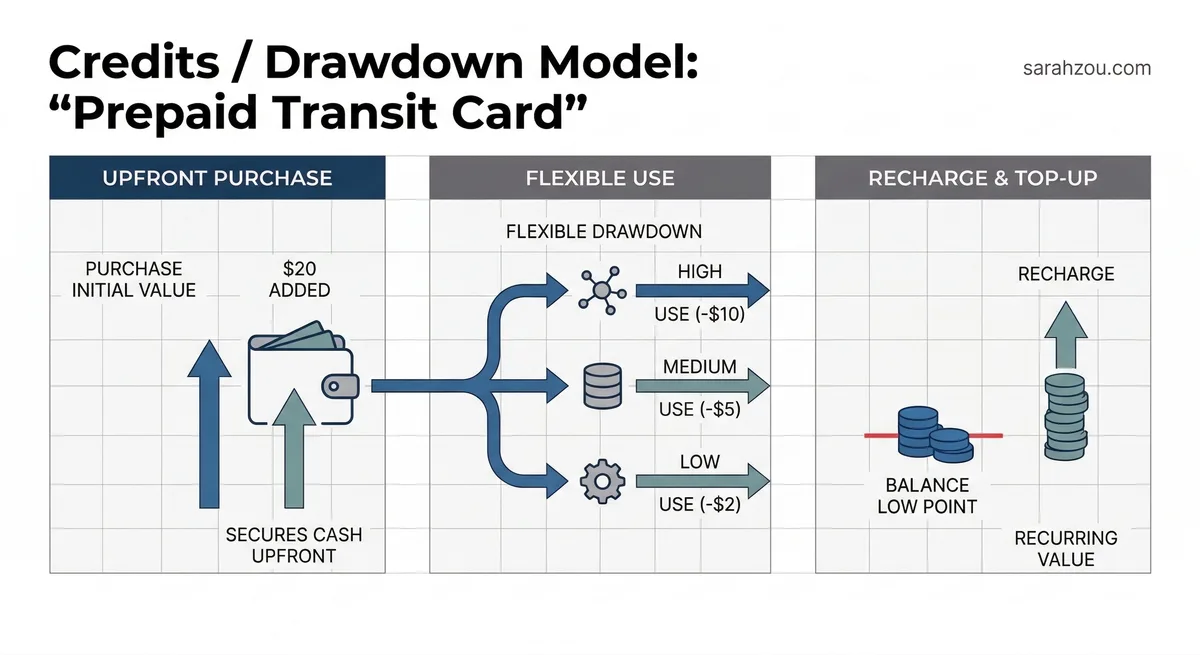
Think of drawdown like a prepaid MetroCard: you load $20 first, then spend that value as you ride. You are not renegotiating each trip, and you are not locked into a flat monthly amount regardless of use. You keep flexibility on what/when you consume; the seller gets committed cash upfront.
When should you use a credits / drawdown model?#
Decision criteria#
| When credits / drawdown is a strong fit | Consider alternatives when... |
|---|---|
Usage is spiky/seasonal but customers retain over time | Usage is steady and headcount maps to value; subscriptions may be simpler |
Buyers want budget certainty without rigid fixed seats | Buyers require hard "never exceed" controls you cannot technically enforce |
Usage can be metered accurately and explained clearly | Metering is noisy or hard to explain, causing frequent disputes |
Per-event amounts are tiny, making per-event billing expensive/frictional | You can package value in simple plans without metering |
Cost-to-serve varies materially by feature/action | Costs are flat across actions, so credits add unnecessary complexity |
You bear real variable COGS (cloud/LLM/API) | Marginal cost is near zero and value is mostly feature access |
Customers use multiple meters and want one budget wallet | Credit mapping feels opaque; direct meters are clearer |
Equations and rules of thumb#
- Recognized revenue:
(Credits consumed x price per credit) + recognized breakage - Effective unit price:
$/unit = pack price / units represented by that pack - Discounting rule: Keep credit-to-usage mapping stable. Offer discounts by changing pack price/commitment size, not by changing what one credit buys.
- Expiration baseline: A 12-month expiry window is common in B2B because it limits open liabilities while remaining customer-reasonable.
Why does a credits / drawdown model matter?#
Credits/drawdown shares risk better than either extreme model:
- Versus pure pay-as-you-go: You avoid full vendor cash-flow risk from postpaid billing.
- Versus pure subscriptions: Customers avoid paying fixed fees unrelated to actual usage.
This makes it useful for products with variable demand and meaningful per-use costs:
- Budget plus flexibility: Customers commit spend once, then allocate it dynamically.
- Improved cash flow: You collect earlier, often before costs are fully incurred.
- Enterprise-friendly buying motion: One commitment can be easier for procurement than many variable invoices.
- Usage alignment: Heavy users fund more value/cost; light users are not forced into oversized fixed subscription plans.
Tradeoff: the model only works when metering, wallet transparency, policy terms (expiry/rollover/refunds), and accounting controls are robust.
Key Facts
Breakage is an estimate you must defend
Under ASC 606, unused credits can only be recognized as revenue in proportion to actual redemption, and only where you hold enough historical data to predict the unredeemed share. There is no industry benchmark to borrow — you have to measure your own cohorts, and a rising figure is a value-delivery warning, not a margin win.
ASC 606 breakage guidanceA 10-point NRR gap
OpenView's benchmarks place median net revenue retention at 120% for usage-based companies versus 110% for seat-based peers, with usage-based companies growing 29.9% year over year against 21.7%.
OpenView SaaS BenchmarksWhy commit-to-consume is valued
The structure books a contracted floor like a subscription while leaving consumption upside uncapped — which is why public-market analysts treat remaining performance obligation, not just ARR, as the headline number for these companies.
Monetizely on Snowflake's modelWorked example: the discount that wasn't#
A customer signs a $120,000 annual commitment. List is $0.10 per credit; the commit earns a 20% volume discount, so credits are granted at $0.08 — 1,500,000 credits.
Actual consumption lands at 85,000 credits/month, or 1,020,000 for the year:
Credits granted | 1,500,000 |
Credits consumed | 1,020,000 (68% utilization) |
Credits expired | 480,000 |
Realized price per consumed credit | $120,000 ÷ 1,020,000 = $0.1176 |
The customer negotiated 20% off and ended up paying 18% above list for every credit they actually used. Nobody notices this in year one. Everybody notices it at renewal, and the conversation you get is not about price — it is about trust.
What this does to revenue recognition. Under ASC 606 you cannot book the $38,400 of expired credits when the contract is signed. If your cohort history supports a 68% redemption estimate, you recognize breakage in proportion to redemption — roughly $1.47 of revenue per $1.00 of credits redeemed. Estimates get revised: if utilization improves to 90% next year, you reverse breakage you already recognized.
The design lesson. Utilization is the number that decides whether this model builds a durable account or a one-year one. Two guardrails cost nothing and prevent most of the damage:
- Size the commit to observed usage, not to the discount tier the customer wants. If the pilot burns 85,000/month, sell 1,020,000 — not 1,500,000.
- Publish utilization back to the customer monthly. A buyer who watches their own burn rate renews; a buyer who discovers 32% waste at renewal churns or demands the whole overage back.
How do you implement a credits / drawdown model?#
Inputs you need#
- Value metric: The exact usage events you will bill (tokens, API calls, minutes, GB, etc.).
- Unit economics by event: Marginal cost per event/feature (including stress scenarios).
- Usage curves and seasonality: Historical burn by segment to size commitments and alert thresholds.
- Segment and procurement context: SMB vs. mid-market vs. enterprise tolerance for variance, approvals, and budget controls.
Step-by-step
Pick what you charge for
Choose 1-3 billable events customers understand and you can meter/audit reliably.
Define the credit system (keep it simple)
Decide between dollar-wallet and abstract credits; publish a transparent rate card.
Design commitments and packs
Create 3-4 commitment options based on historical usage, with better effective rates for larger/longer commitments.
Add guardrails
Configure balance alerts, spend caps, approval flows, and explicit overage behavior (auto-reload, pay-go fallback, or throttling).
Operationalize trust and accounting
Provide real-time balances, burn history, and explainable invoices; treat prepaid balances as deferred revenue and recognize as consumed.
Metrics to monitor
Drawdown velocity
Burn rate over time by account/cohort; leading indicator of renewal timing and engagement.
Top-up/reload rate
Share of accounts buying additional credits; split manual vs. auto-reload behavior.
Overage share
Revenue mix from commitments vs. top-ups/overages (predictability vs. volatility signal).
Breakage rate
Unused credits by aging bucket; high persistent breakage can precede churn.
CAC payback and CLTV health
Compare credit customers vs. non-credit customers using cash collected and recognized revenue views.
Risks and anti-patterns (and fixes)#
| Pitfall | Fix |
|---|---|
Runaway-cost fear: Buyers worry one bad script drains budget overnight. | Hard caps, approval gates, and proactive threshold alerts (for example 50/80/95%). |
Wallet anxiety: Customers become hesitant when they constantly see balances drop. | Offer starter grants, clean forecasting, and optional auto-reload to reduce friction. |
Breakage trap: Profit depends on credits customers never use. | Add conditional rollover/true-up policies tied to active renewals and focus CS on usage success. |
References and links#
Sources#
- Lehrskov-Schmidt, U. (2023). The Pricing Roadmap: How to Design B2B SaaS Pricing Models That Your Customers Will Love. Houndstooth Press.
- Howatson, A. (2024). The usage economy: Strategies for growth, smart pricing, and effective technology management. Usage Economy Publishing.
- Nagle, T. T., Hogan, J. E., & Zale, J. (2016). The strategy and tactics of pricing (6th ed.). Routledge.
Frequently asked questions
01How does a drawdown model differ from pure consumption pricing?
Pure consumption is postpaid pay-as-you-go with no upfront commitment. Drawdown requires upfront prepayment that is consumed over time, so cash-flow risk is shared differently.
02Why use credits instead of a flat monthly [subscription](/wiki/pricing/models-and-metering/subscription-model)?
Credits fit variable/seasonal usage and variable COGS better than flat plans, while still supporting procurement-friendly committed budgets.
03How do we avoid customer frustration when credits run out faster than expected?
Use transparent dashboards, burn forecasting, threshold alerts, and clear top-up/cap policies so depletion becomes an expected workflow rather than a surprise invoice.
04How long should credits last before expiry?
In B2B, 12 months is a common default. It balances liability management with customer fairness; consider rollover options to reduce resentment.
05How do we avoid breakage backlash?
Make spend visible, alert early, allow limited rollover or renewal true-ups, and avoid punitive expiration mechanics that feel like gotchas.
06What if a customer requests a refund for unused credits?
Set clear non-refundable terms by default, then define exception governance for strategic accounts to protect trust and long-term value.
Author
Dr. Sarah Zou
Independent economist · EconNova
Commercial strategy for technical products, with a focus on pricing, unit economics, and the operating choices behind the model.
About SarahTopics
Cite this page
Suggested citation
Zou, S. (2026). Credits / drawdown model. In Monetization Models & Metering. Pricing & Monetization Wiki. https://sarahzou.com/wiki/pricing/models-and-metering/credits-drawdown-model
Open license
Reuse with attribution
This content is available for reuse. When referencing or republishing it, please credit Dr. Sarah Zou and link back to the original source.
Licensed under Creative Commons Attribution 4.0 International. You may share and adapt the material with appropriate credit.