Pricing Wiki
Subscription model
A pricing model where customers pay repeatedly (monthly/annual) for ongoing access, usage, or replenishment—optimizing predictability and lifetime value.
Snapshot
What it is
A shift from "ownership" to "access." Customers pay a recurring fee to receive continued access, ongoing value, or periodic delivery.
Why it matters
It transforms high upfront capital expenditures (Capex) into manageable operating expenses (Opex) for buyers, while providing predictable recurring revenue (ARR/MRR) and higher valuations for founders.
When to use
When your product has a high natural frequency of usage (e.g., daily or weekly), provides ongoing value, requires regular updates, or solves a persistent pain point (e.g., SaaS, media, consumables).
Key takeaways
Frequency is Destiny: Only use subscriptions if the "natural frequency" of your user's problem is recurring. If users only need you once a quarter, they will resent a monthly fee.
Predictability is King: Monthly Recurring Revenue (MRR) allows for better financial planning and higher valuation multiples.
Retention > Acquisition: In this model, losing a customer (churn) is more expensive than not gaining one.
Value Realization: You must provide value every month, not just at the point of sale.
Data-Driven: The model provides a constant stream of usage data to inform product development.
Term Length Trade-off: Monthly subscriptions lower the friction to buy (higher conversion) but increase churn. Annual subscriptions increase the friction to buy (lower conversion) but improve retention and cash flow.
On this page9 sections
What is the subscription model?#
Subscription model is a monetization model where the price is charged at regular intervals (monthly/annual). It is distinct from Perpetual/License (one-time buy) and Usage/Consumption (usage-based pricing/pay-as-you-go).
Key definitions#
- Natural Frequency: The inherent rate at which a user experiences the problem your product solves (e.g., Slack is daily; tax software is yearly). High natural frequency is an important prerequisite for the subscription model.
- Capex to Opex Shift: Moving from a large upfront Capital Expenditure (buying a server/software license) to a monthly Operating Expense (subscribing to AWS/SaaS). This lowers the barrier to entry.
- MRR / ARR: Monthly / Annual Recurring Revenue. The lifeblood of the model.
- LTV (Lifetime Value): The total revenue expected from a single customer over their entire relationship with the company.
- CAC (Customer Acquisition Cost): The total cost (sales + marketing) to acquire one new customer.
- Churn Rate: The percentage of lost customers or lost revenue from downgrades/cancellations within a given period.
- GRR / NRR:
- GRR = (Starting recurring revenue − contractions − churn) / Starting recurring revenue
- NRR = (Starting recurring revenue − contractions − churn + expansions) / Starting recurring revenue
Mental model#
The "Leaky Bucket"
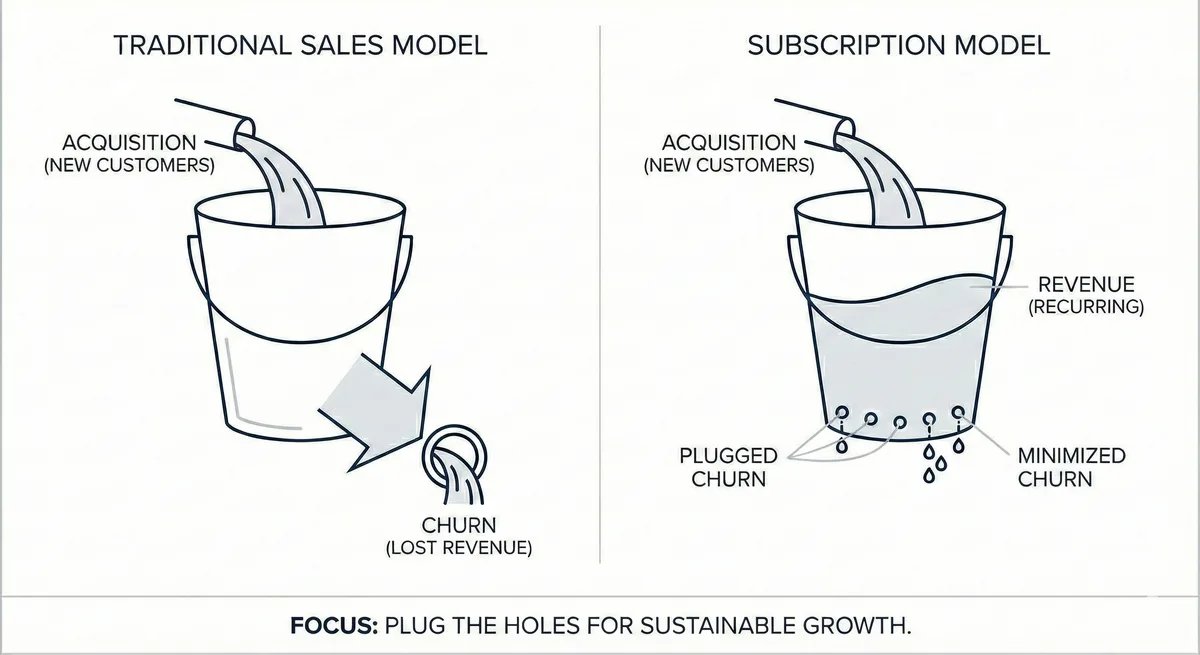
Imagine your customer base as a bucket. New customers are water being poured in (acquisition). Churn is a hole in the bottom.
- Traditional Sales: You fill the bucket, then dump it out to sell again.
- Subscription: You try to plug the holes so the water level (revenue) constantly rises as you pour more in.
Worked example (simple)#
- Plan: $30/user/month, average 8 users = $240 MRR/account.
- Monthly logo churn = 2%.
- Rough average lifetime ≈ 1 / churn = 1 / 0.02 = 50 months.
- Gross LTV (very rough) ≈ $240 × 50 = $12,000 (before gross margin/support).
- If gross margin is 80%, LTV contribution ≈ $9,600.
- If CAC is $3,200, then LTV:CAC ≈ 3.0 (healthy if retention is real and payback is acceptable).
When should you use the subscription model?#
Decision criteria#
| Criterion | Subscription is a good fit when… | Consider instead when… |
|---|---|---|
Repeatability | The customer's need recurs reliably (ongoing workflow, continuous access, recurring replenishment). | The need is episodic or one-off (single project, monthly/quarterly/annual event, infrequent maintenance). |
Product evolution | You can ship meaningful improvements over time and customers benefit without repurchasing. | The product is mostly "finished" at purchase; value doesn't expand materially over time. |
Margin structure | Marginal cost per customer is low/predictable; support/service scales. | Costs scale linearly with usage/delivery (materials, heavy human labor) without a clean overage model. |
Usage variance | Consumption is stable month-to-month or can be tiered with clear limits. | Consumption is high-variance (seasonal/bursty) → favor usage-based or hybrid (base + overage). |
Customer preference | Buyers want budgeting simplicity and predictable spend. | Buyers demand pay-as-you-go or strongly prefer one-time purchases. |
Operational readiness | You can run billing hygiene (renewals, dunning, proration, invoicing/tax). | Billing ops are immature; risk of leakage, disputes, and compliance issues is high. |
Rules of thumb#
- If customers don't get clear value within the first 1–2 billing cycles, churn spikes.
- CAC Payback Period: In subscriptions, you collect cash slowly. You must ensure your Customer Lifetime Value (CLTV) exceeds Customer Acquisition Cost (CAC) by at least 3:1 (if 1:1, you're losing money; if 5:1, you aren't spending enough on growth), and you recover CAC in <12 months.
- Use annual billing to reduce churn and improve cash flow only if the value is continuous and measurable.
Why does the subscription model matter?#
For founders, subscriptions move the needle on Capital Efficiency.
- Predictability: Subscription revenue is easier to forecast than transactional sales, smoothing out cash flow.
- Lock-in: Subscriptions help lock out competitors. Once a customer subscribes, they stop looking for alternatives, whereas transactional customers re-evaluate their choice with every purchase.
- Access vs. Ownership: It aligns with the modern shift from "owning assets" (which rust in the driveway) to "accessing utility" (using the car when needed).
Key Facts
3.4× Growth
Subscription-based companies in Zuora's SEI grew 3.4× faster than the S&P 500 over 12 years
Zuora, 2024100%+ NRR
In private B2B SaaS, median Net Revenue Retention (NRR) ~102% and median Gross Revenue Retention (GRR) ~91%
SaaS Capital, 202325–95%+ profit
A +5% retention improvement is associated with ~25%–95% profit increase in many contexts
HBRHow do you implement subscription pricing step-by-step?#
Inputs you need#
- Customer research: jobs-to-be-done, willingness to pay, cancellation reasons, value metric preference.
- Unit economics: CAC, gross margin, support cost per account, retention curves, expansion likelihood.
- Usage data (if applicable): distribution of usage showing how many days per month users are active. (If the mode is 1–2 days, subscription will likely fail.)
- Competitor models: Are they charging per user, per feature, or flat-rate? Are customers used to buying this as an asset (Capex)? If so, you need to explain the "premium" benefits of the subscription (e.g., automatic updates, cloud access).
Step-by-step
Determine the "Why"
Why should they subscribe instead of buy? You cannot just charge monthly for a static product. You must offer continuous value, such as content updates (Netflix), software maintenance (SaaS), or "evergreen" hardware refreshes (Rubrik).
Set the recurrence
Short term, long term, or both.
- Short term (monthly): Low friction to sign up, but high churn risk. Best for new customer acquisition.
- Long term (annual/multi-year): High friction to sign up, but locks in retention and cash flow. Best for enterprise or established products.
- Strategy: Offer both. Use monthly to "land" and annual discounts (e.g., 2 months free) to "expand/retain."
Pick the subscription type
Access (SaaS/content), Membership (benefits/community), Replenishment (consumables), Maintenance (service), Curation (bundles).
Choose a value metric
Will the subscription be flat (e.g., $99/mo) or scaled (e.g., $30/user/mo)?
- Flat: Simple, but leaves money on the table for large users.
- Per user/seat: The standard for B2B SaaS (seat-based pricing). Scales with customer size. (See pricing metric / value metric.)
Establish billing & revenue hygiene
Implement automated systems for dunning, retries, proration, invoicing, tax/VAT compliance, chargebacks, and refunds.
Operationalize retention
Set up automated "drip" campaigns for onboarding and "win-back" flows for failed payments or churn signals.
Monitor & iterate
Review churn and expansion revenue monthly. Adjust pricing based on usage data and customer feedback.
Metrics to monitor
MRR/ARR (Monthly/Annual Recurring Revenue)
The holy grail of subscription health.
Churn rate
The percentage of subscribers who cancel. In subscriptions, retention is more important than acquisition.
Net Revenue Retention (NRR)
Revenue from existing customers (including upsells) minus churn. Target >100%.
Risks & anti-patterns (and fixes)#
| Pitfall | Fix |
|---|---|
The "Gym Membership" Fallacy: Hoping customers pay but don't use the product to save costs. In B2B, low usage is the #1 predictor of churn. | Use retention driven by outcomes; build win-back flows and pause options. |
Subscription Fatigue: Customers are scrutinizing recurring bills. | Ensure "time-to-value" is short. If you cannot prove ongoing value, you will be the first to be cancelled during a budget cut. |
Misaligned value metric: Customers feel "taxed" as they succeed → switch to competitors. | |
High churn hidden by high growth. | Cohort analysis. Track users by the month they joined. |
The "Down-Sell" Risk: When moving from expensive licenses (Capex) to cheap subscriptions (Opex), revenue might dip temporarily (the "fish" curve) before volume makes up for it. | Manage cash flow carefully during this transition. |
References & Links#
Sources:#
- Ramanujam, M., & Tacke, G. (2016). Monetizing innovation: How smart companies design the product around the price. Wiley.
- Ghuman, A. (2021). Price to scale: Practical pricing for your high-growth software startup. Independently published.
- Lehrskov-Schmidt, U. (2023). The pricing roadmap: How to design B2B SaaS pricing that wins. The Pricing Roadmap.
- Einav, L., Klopack, B., & Mahoney, N. (2025). Selling subscriptions. American Economic Review, 115(5), 1650-1671.
- Gallo, A. (2014). The value of keeping the right customers. Harvard Business Review.
- Reichheld, F. F., & Markey, R. (2001). The loyalty effect. Harvard Business School Press.
Frequently asked questions
01Monthly vs annual—what should I choose?
Offer both. Monthly lowers the barrier to entry for new customers (low friction). Annual secures cash flow and retention (high commitment). A common tactic is to price the monthly plan higher to incentivize the annual commitment.
02Should I offer a lifetime deal (LTD) to get early cash?
Only for "initial spark" capital. LTDs create technical and support debt without recurring revenue to pay for it. Use sparingly.
03What's a good churn target?
It depends on segment and price. Anchor on cohort curves and NRR/GRR; "good" means CAC payback and LTV stay healthy.
04Can I combine subscription with usage pricing?
Yes, this is the Hybrid Model (or 3-Part Tariff) and is often superior. You charge a base subscription fee (platform fee) for access and stability, plus usage fees for heavy consumption. This gives you predictability + upside. (See hybrid pricing.)
05How do I move customers from a one-time purchase to a subscription?
Do not just change the billing frequency; you must add value. Offer "subscription-only" benefits like cloud storage, automatic hardware refreshes, or exclusive features to justify the recurring relationship.
06When should I raise prices?
When you have added significant features that have measurably increased the "Value Ceiling," or if your LTV/CAC ratio is unsustainably low despite high retention.
07Is it okay to make cancellation hard?
Don't do it. Short-term gains can turn into chargebacks, bad reviews, and regulatory exposure; build retention on value instead.
Author
Dr. Sarah Zou
Independent economist · EconNova
Commercial strategy for technical products, with a focus on pricing, unit economics, and the operating choices behind the model.
About SarahTopics
Cite this page
Suggested citation
Zou, S. (2026). Subscription model. In Monetization Models & Metering. Pricing & Monetization Wiki. https://sarahzou.com/wiki/pricing/models-and-metering/subscription-model
Open license
Reuse with attribution
This content is available for reuse. When referencing or republishing it, please credit Dr. Sarah Zou and link back to the original source.
Licensed under Creative Commons Attribution 4.0 International. You may share and adapt the material with appropriate credit.