Pricing Wiki
Bundling
Selling multiple complementary products together at one price to increase total revenue and customer stickiness.
Snapshot
What it is
A pricing/packaging tactic where multiple products are sold together, often at a discount compared to buying each item individually.
Why it matters
Bundling can increase revenue by making willingness-to-pay (WTP) more "predictable" (reduce the variance) across customers and by allowing you to capture more consumer surplus than individual pricing.
When to use
Multi-product businesses with heterogeneous buyers; especially when customers value different items differently and marginal cost per extra item is low (e.g., software).
Key takeaways
Mixed Bundling Wins: Usually, you should allow customers to buy the bundle or the individual items (bundle + à la carte). The bundle price should be lower than the sum of the parts to incentivize the upsell, but the standalone prices should remain high to act as a "price anchor."
Bundle for Value, Not Just Volume: Don't just bundle to dump inventory. Bundle to solve a complete "Job to be Done." If the bundle creates a seamless workflow, charge premium for that convenience.
Bundling is most effective when customer preferences are negatively correlated (Customer A loves Feature 1; Customer B loves Feature 2).
On this page8 sections
What is bundling?#
Bundling: The practice of selling multiple distinct products or services together as a single bundle, often at a price different (discount or premium) from the sum of their individual prices.
Key definitions#
- Pure Bundling: The products are only available as a bundle; they cannot be bought separately (e.g., a fixed menu at a restaurant, no à la carte option).
- Mixed Bundling: The products are available both as a package and as separate items (e.g., a McDonald's Value Meal vs. buying a burger and fries separately). This is generally the most profitable strategy. "Mixed Bundling" is almost always superior to "Pure Bundling."
- Integrated Bundling: When the combination of products creates a unique value that the parts do not have alone (e.g., seamless data flow between a CRM and an email tool), allowing for a price premium rather than a discount.
- Unbundling / à la carte: Items are sold separately (bundle absent).
- Price bundling vs. product bundling:
- Price bundling = discounting a bundle relative to sum of parts.
- Product bundling = designing/combining products/services into a single "offer" (may or may not be discounted).
Packaging vs Bundling#
While Packaging and Bundling are used interchangeably in some cases, in a rigorous pricing strategy context, they serve different functions: Packaging is a vertical strategy for product configuration (combining features to form a product for a specific customer), whereas Bundling is a horizontal strategy for sales aggregation (combining distinct products to capture more revenue).
Note: Sometimes people use Packaging & Bundling (package & bundle, feature & product) interchangeably. On this site, we strictly distinguish them.
- Packaging (product configuration) = deciding which features go together to form an offer for a segment (usually Good/Better/Best), to match needs and WTP by tiering so you don't over-serve low-end users or under-charge high-end users.
- Bundling (aggregation) = combining distinct products/services into one unit (a suite / bundle deal), often to increase share of wallet, drive cross-sell, and make the overall purchase feel easier (and sometimes to blur individual price points).
- Similarities (Why they are confused):
- Both reduce "Nickel-and-Diming": Both strategies aim to simplify the decision-making process.
- Technically, a "Package" is a "Bundle" of features: A "Better Plan" is technically a "bundle" of specific features (e.g., SSO + Analytics + Priority Support). However, in B2B SaaS, we treat this as Packaging because the features are rarely sold as standalone products.
- Both increase profit: When done correctly, both strategies allow companies to capture more area under the demand curve—Packaging by segmenting customers by WTP, and Bundling by averaging out price sensitivity across multiple items.
- Practical rule: Do packaging first (define what you are selling to whom, and create your GBB tiers), then use bundling for growth once you have multiple distinct products or meaningful add-ons.
Mental model#
The core of bundling is Variance Reduction.
Imagine a graph where the X-axis is "Value of Product A" and the Y-axis is "Value of Product B."
- If your customers are clustered along a line that slopes downward (negative correlation), bundle immediately.
- If they are clustered in the top right (high value for both), price high individually.
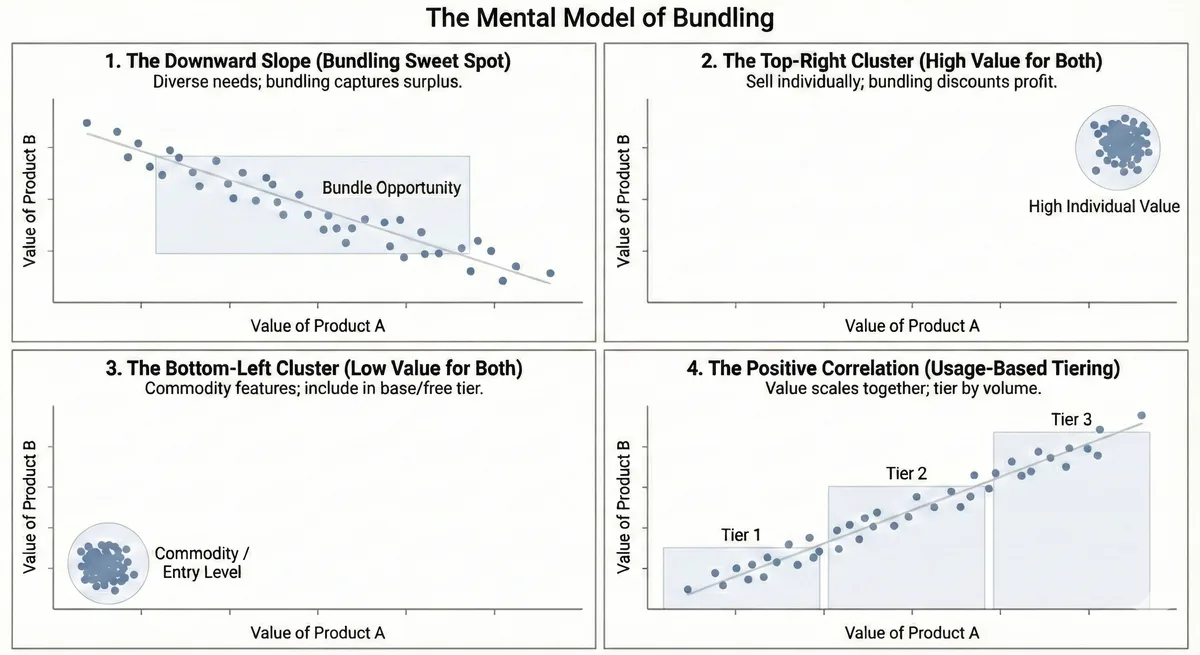
The Downward Slope (Negative Correlation)
This is the "sweet spot" for bundling. It represents a market where customers have diverse needs:
- The Scenario: Customer A values your "Analytics Engine" at $100 but only values the "Reporting Dashboard" at $20. Customer B is the opposite—they value the Dashboard at $100 but the Engine at $20.
- The Problem with Individual Pricing: If you price both at $100, each customer only buys one item (Revenue: $200). If you lower the price to $20 to get everyone to buy both, you leave a massive amount of money on the table (Revenue: $80).
- The Bundle Solution: By bundling them for $120, both customers see the total value ($120) as equal to the price. You capture the "surplus" from both (Total Revenue: $240).
- Key Insight: Bundling "levels out" the differences in how much people value individual parts of your product, creating a more predictable willingness to pay across your whole user base.
The Top-Right Cluster (High Value for Both)
This scenario is common with Leader (must-have) features or "killer" apps that everyone values highly.
- The Scenario: Most of your customers value both Product A and Product B very highly (e.g., both are worth $100 to almost everyone).
- The Logic: If everyone is already willing to pay top dollar for both items separately, bundling them at a discount actually reduces your potential profit.
- The Strategy: Price them high and sell them individually (or as high-tier add-ons). You don't need the "incentive" of a bundle to convince them to buy the second product because the utility is already clear.
The Bottom-Left Cluster (Low Value for Both)
- The Strategy: These are your "commodity" products. They shouldn't be sold individually or even be the "stars" of a bundle. Usually, these are included in a "Free" tier or a "Basic" bundle to reduce friction for new users.
The Positive Correlation (Upward Slope)
- The Scenario: Customers who like Product A also like Product B in equal measure (e.g., if I value a larger database, I also value more API calls).
- The Strategy: This is where usage-based pricing works better than bundling. You should scale your price based on the volume of usage across both products.
Rules of thumb#
- The Negative Correlation Rule: Bundling works best when customer preferences are negatively correlated. If Customer X loves Product A but cares less about Product B, and Customer Y loves Product B but cares less about Product A, a bundle price allows you to sell both products to both customers.
- 1 + 1 = 3: If the products work better together (integration value), you should charge a premium, not a discount. Do not discount a bundle if the integration saves the customer time or money.
- Avoid bundling "two must-haves": If most buyers want both items strongly (high positive correlation), you may just be hiding separate pricing power.
Why does bundling matter?#
- Maximizing "Share of Wallet": Bundling allows companies to capture more revenue from each customer by encouraging them to buy items they might not have purchased individually.
- Smoothing Demand Curves: Different customers value different products differently. One might love Product A and feel lukewarm about Product B, while another feels the opposite. Bundling allows you to average out these differences and capture revenue from both.
- Simplification: It reduces the cognitive load for customers. Instead of making five distinct purchase decisions, they make one. This reduces sales friction and increases customer satisfaction.
Key Facts
The 33% Uplift
In both theoretical models and practical tech applications, mixed bundling can generate 33% more revenue than selling items only separately. (Adams & Yellen, 1976; )
QJE10–15% higher ARPU
Companies utilizing "Mixed Bundling" typically see a 10–15% higher ARPU than those relying solely on pure bundles, as it captures both high-value "suite" buyers and single-feature users.
ProfitWellPower of the bundling model
As of Fiscal Year 2025, Microsoft's Productivity and Business Processes segment—anchored by the Office 365 bundle—accounted for over 54% of the company's total operating profit ($69.8B of $128.5B).
MicrosoftHow do you implement bundling step-by-step?#
Inputs you need#
- Willingness to Pay (WTP) Data: Run Van Westendorp or conjoint analysis for individual features. You need to know how much different segments are willing to pay for Product A vs. Product B.
- Correlation Data: Check Feature Usage Logs to find which features are used together (correlation analysis). Do customers who buy A usually buy B? Or are they mutually exclusive audiences?
- Marginal Cost Analysis: For startups, this is usually near zero, but consider support and infrastructure costs.
- Competitive context: Are rivals bundling, and do buyers expect modularity?
Step-by-step
Identify Your Candidate Products for Bundling
Determine which product is the primary driver of the sale. Identify products that add value to the primary driver without increasing the "nuisance factor." (Look for items with low marginal cost but high perceived value.)
Correlation Analysis
Analyze Feature Usage Logs to investigate if the people who love Feature A are the same people who love Feature B. If they are different groups, you have a prime bundling opportunity.
Set the Bundle Price
Design a mixed bundle and set the price considering:
- If Integration Value exists: Price the Bundle > Sum of Parts (rare, but applies to high-value software integrations).
- Standard Approach: Set a bundle price that is lower than the sum of the parts but higher than any single item. The discount must be enough to motivate the buyer to "upsize" but not so deep to destroy margin.
Run a clean test and iterate
Run A/B testing on bundle menu vs. à la carte menu; track metrics and iterate.
Metrics to monitor
Bundle Take Rate
The percentage of customers choosing the bundle vs. à la carte items.
Average Revenue Per User (ARPU)
Bundling should increase ARPU. If ARPU drops, you are discounting too heavily.
Churn Rate
Does bundle create stickiness or regret? Bundled customers often churn less because they are "locked in" to more of your workflow.
Risks & anti-patterns (and fixes)#
| Pitfall | Fix |
|---|---|
The "Generosity Trap": Bundling items that customers would have bought anyway at full price. | Analyze purchase data. If 80% of customers already buy A and B together, do not discount the bundle. Only bundle if it changes behavior. |
Cannibalization: Customers switching from high-margin standalone purchases to the discounted bundle. | Use Mixed Bundling and ensure the standalone items are priced high enough to make the bundle look like a deal, but not so high that you lose the single-item buyer. Optimize via conjoint analysis. |
Hidden tying backlash: Adding so many low-value features that the perceived value of the bundle drops. Customers feel forced to buy extras. | Keep standalone option; explain bundle benefit; improve transparency; periodically "prune" the bundle or offer a "Lite" version. |
Revenue looks up, margin is down: High-support or high-cost items slip into the bundle. | Separate high-cost items; cap usage; add fair-use limits. |
References & Links#
Sources:#
- Ramanujam, M., & Tacke, G. (2016). Monetizing Innovation: How Smart Companies Design the Product Around the Price. Wiley.
- Nagle, T., Müller, G., & Gruyaert, E. (2018). The Strategy and Tactics of Pricing. Pearson.
- Ghuman, A. (2021). Price to Scale. Independently published.
- Adams, W. J., & Yellen, J. L. (1976). Commodity bundling and the burden of monopoly. The Quarterly Journal of Economics, 90(3), 475–498.
- McAfee, R. P., McMillan, J., & Whinston, M. D. (1989). Multiproduct monopoly, commodity bundling, and correlation of values. The Quarterly Journal of Economics, 104(2), 371–383.
- Derdenger, T., & Kumar, V. (2013). The dynamic effects of bundling as a product strategy. Marketing Science, 32(6), 827–859.
Frequently asked questions
01Should I always offer a discount for a bundle?
No. If the bundle provides integration value (e.g., the products work seamlessly together, saving the user time), you can charge a premium (1+1=3). Discounting is optional—some bundles are priced for simplicity, not cheaper. You only discount if the bundle is purely a volume play to get customers to buy things they otherwise wouldn't.
02When does bundling backfire?
When customers strongly value just one item and resent paying for extras, or when the bundle creates major complexity/support costs.
03Pure vs. mixed bundling—what should I start with?
Mixed bundling is a safer default: it captures "simplicity seekers" while preserving choice for high-WTP users.
04How do I know if valuations are correlated?
Look at co-purchase/usage correlations, segment interviews, and whether the same buyers consistently "want everything."
05How do I avoid cannibalizing my best-seller?
Keep the best-seller as a strong standalone anchor; put the bundle price high enough that it upgrades rather than replaces.
06Is bundling anti-competitive?
Generally no for startups. However, if you have dominant market share, "tying" (forcing a bundle) can attract regulatory scrutiny (e.g., Microsoft/Internet Explorer). It is a good practice to maintain a standalone option and document consumer benefits.
Author
Dr. Sarah Zou
Independent economist · EconNova
Commercial strategy for technical products, with a focus on pricing, unit economics, and the operating choices behind the model.
About SarahTopics
Cite this page
Suggested citation
Zou, S. (2026). Bundling. In Product, Packaging & Bundling. Pricing & Monetization Wiki. https://sarahzou.com/wiki/pricing/packaging-and-bundling/bundling
Open license
Reuse with attribution
This content is available for reuse. When referencing or republishing it, please credit Dr. Sarah Zou and link back to the original source.
Licensed under Creative Commons Attribution 4.0 International. You may share and adapt the material with appropriate credit.