Pricing Wiki
Freemium model
A customer acquisition strategy that uses a free-to-use version of a product to drive low-cost scale and upsell users into paid tiers.
Snapshot
What it is
A tiered pricing model (Free + Premium) where users can access a baseline product for free indefinitely, lowering the barrier to entry to drive rapid, widespread adoption.
Why it matters
Freemium turns your product into its own marketing engine, by helping users experience value directly, which builds trust and fuels viral growth loops.
When to use
When marginal cost per free user is near-zero, the product has strong network effects or viral loops, the total addressable market is large (millions of users), and time-to-value is short via self-serve.
Key takeaways
Free is a Marketing Expense: Do not view the free tier as a product; view it as a customer acquisition channel. The cost of supporting free users is part of your fully-loaded Customer Acquisition Cost (CAC).
Balance the "Giveaway": If your free tier is too good, no one upgrades; if it's too bad, no one stays. Give away enough to build a habit, but fence off the features that buyers are willing to pay for.
Growth Loops are Mandatory: Freemium only works if your free users actively help acquire more users (viral loops) or create content that attracts others. If the product is strictly single-player, a free trial is usually safer.
On this page9 sections
What is the freemium model?#
Freemium is a portmanteau of "Free" and "Premium"—a business model where basic services are provided free of charge while more advanced features, functionality, or usage limits require a paid subscription.
Unlike a free trial (which is time-bound), freemium is feature-bound or usage-bound indefinitely. The free tier is not a preview of the full product; it is a permanent, limited version designed to create value, build habit, and generate a natural upgrade trigger.
Key definitions#
- Free tier (forever free): A usable baseline offering with ongoing, indefinite access.
- Premium tier: Paid plans that unlock higher value—features, usage limits, control, support, or compliance.
- Land and Expand: The go-to-market motion inherent to freemium. You "land" the user with a free account, embed the product in their daily workflow, and "expand" revenue over time as they hit usage limits or require enterprise features.
- Paywall / upgrade trigger: The specific point where a user hits a limit and must pay to continue getting value (e.g., number of seats, storage limits, or advanced integrations).
- Free-to-Paid Conversion Motion: A user journey where adoption friction is removed, allowing the user to build high perceived value through actual product experience before ever encountering a paywall.
Mental model#
Think of free users not as "freeloaders," but as the fuel for your growth engine. In a standard funnel, non-paying users are a dead end. In a Freemium Growth Pipeline, a free user either becomes a paying user or contributes to network effects that bring paying users.
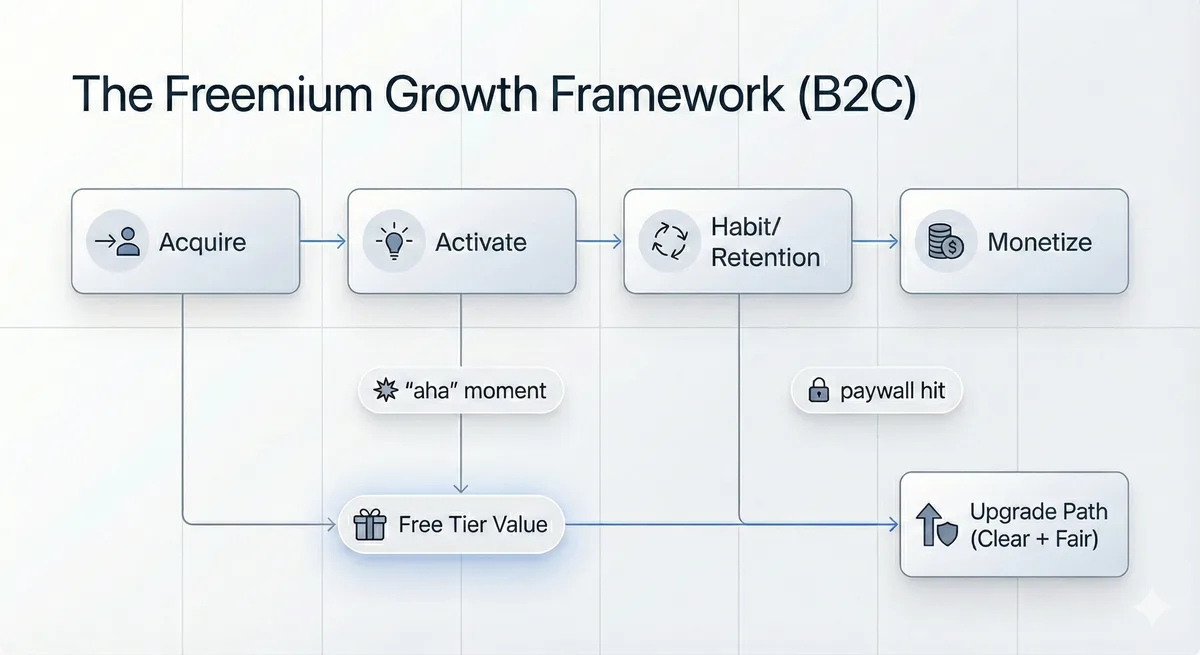
In a B2C setting, the Freemium Growth Framework operates as a product-led system: the free tier drives acquisition, activation and retention create compounding usage, and monetization happens when users hit natural limits or need higher-capability features.
In a B2B setting, free users serve as the primary infrastructure for your next enterprise sale.
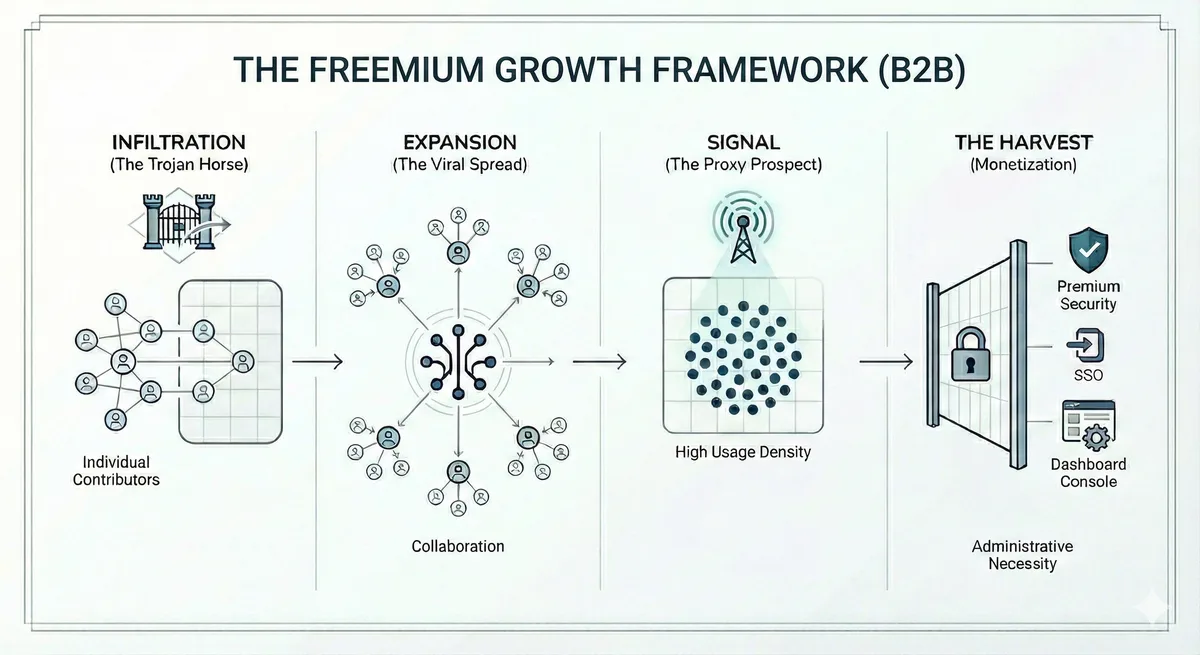
The B2B Freemium pipeline unfolds in four stages:
- Infiltration (The Trojan Horse): The free tier bypasses procurement and budget cycles. Individual contributors seed the tool inside departments without approval, establishing bottom-up adoption.
- Expansion (The Viral Spread): Collaboration is the catalyst. As free users invite teammates to sync, share, or edit, they act as unpaid acquisition agents. Each free seat reduces the friction of the next entry to zero.
- Signal (The Proxy Prospect): High usage density creates a "Proxy Prospect" effect. By the time a budget holder notices the tool, it is already mission-critical. Pre-proven value eliminates the perceived risk of purchase.
- The Harvest (Monetization): At a critical mass of users, the organization hits the "Value Fence." Conversion becomes an administrative necessity, driven by the need for premium security, SSO, and centralized management.
When should you use the freemium model?#
Decision criteria#
| Criterion | Red flag | Consider instead |
|---|---|---|
Near-zero marginal cost: Your cost to serve an additional free user (server, support) must be incredibly low | Cost grows fast with usage | Paid-only or free trial |
Short time-to-value: Minutes or hours via self-serve | Weeks of setup or onboarding | Sales-led demo + pilot |
Massive market size: Because conversion rates are low (<10%), your TAM must be huge (millions of potential users) | Narrow niche with low volume | Higher price point, targeted sales |
Network effects / virality: The product must naturally encourage users to invite others or share externally (e.g., Calendly links, Zoom invites) | Solo usage, low virality | Free trial (time-limited) |
Rules of thumb#
-
The Freemium Rule of 10: You generally need 10 free users to support the costs and economics of 1 paid user.
-
Unit economics check:
LTV of Paid User > (CAC of Paid User + Serving Cost of N Free Users)
Where N is your free-to-paid ratio.
-
Fully-Loaded CAC: CAC = Marketing/Sales Spend + Cost to Serve Free Users. Factor the server and support costs of your non-paying users into the acquisition cost of your paying users.
-
Design for one primary upgrade reason (the "why pay?"), not 10 minor feature gates.
-
The free tier should get users to the core job-to-be-done and the "aha!" moment, then make scaling the natural paid step.
Why does the freemium model matter?#
Freemium leverages low marginal distribution cost to remove adoption friction: users can start immediately on a free tier, with no sales call, no credit card, and no commitment.
- Solves the cold start: A free tier builds an initial user base, product usage data, and brand presence before you invest heavily in sales.
- Proof through experience: It shifts trust from "Trust our sales deck" to "Try our product." Early growth comes from self-serve experience rather than sales-generated conviction.
- Bottom-up adoption: Individuals try the free product, invite teammates, and usage expands organically inside organizations—enabling enterprise sales without top-down procurement.
Key Facts
90% failure rate
The "land-and-expand" approach fails for roughly 90% of companies because they fail to properly design the upgrade path or give too much away for free.
Monetizing Innovation, 2016<10% conversion
In typical software companies, fewer than 10% of free users convert to paid. Median freemium conversion ≈ 5% vs. ~17% for free trials.
OpenViewWorth 20%
A free user may be worth approximately 15–25% as much as a premium subscriber (through ads, referrals, and eventual upgrades).
Kumar, HBR, 2014How do you implement the freemium model step-by-step?#
Inputs you need#
- Cost-to-serve data: How much does one active free user cost per month in infrastructure and support? This sets the floor for how generous the free tier can be.
- Max-diff feature analysis: Survey data identifying which features users consider "nice-to-haves" (give these away) vs. "must-haves for business" (fence these behind the premium tier).
- Time-to-habit data: How long does it take a user to become reliant on your product? (Netflix research shows that 30 minutes of weekly viewing for 4 consecutive weeks builds a durable habit.)
- Competitor benchmarking: Are competitors hiding the product behind a "Book a Demo" button? If so, a free tier is your wedge into the market.
Step-by-step
Engineer the "Aha!" moment
Design the free tier specifically to get users to the core value as quickly as possible. For a design tool like Figma, this means letting users actually design and share a file—not just browse templates.
Build the paywalls
Determine what triggers the upgrade. Fences fall into three categories:
- Feature fences: Free users get the core tool; paying users get integrations, advanced reporting, or security features.
- Usage fences: Free users get 1,000 contacts or 3 active projects; paying users get unlimited.
- Capacity fences: Free users get 2 GB of storage; paying users get 1 TB.
Design the conversion motion
Monitor users as they approach limits. Use in-product messaging to educate on the value of the premium tier before they hit the hard limit. Offer seamless, self-serve credit-card checkout to capture upgrades instantly.
Segment support
Offer self-service (docs, bots) for free users and white-glove support for paid users. Never offer live human support to the free tier at scale.
Run pricing and packaging experiments
Test which paywall triggers conversion, where usage limits sit, messaging framing, annual vs. monthly billing, and bundle structures.
Metrics to monitor
Free-to-paid conversion rate
The golden metric. If it's 1–2%, your free product may be too generous. If it's 20%, it may be too restrictive, choking top-of-funnel growth. Target range: 3–10%.
Time to activate
How quickly a new free signup reaches the "Aha!" moment.
Viral coefficient (K-factor)
How many new users, on average, does each free user bring into the platform?
Paywall hit rate
% of activated users encountering a limit.
Upgrade success
% of paywall hits that convert to paid within N days.
Churn (free vs. paid)
High free-tier churn is manageable; high paid-tier churn is a crisis. Track separately.
Risks & anti-patterns (and fixes)#
| Pitfall | Fix |
|---|---|
The "Santa Claus" pitfall: The free version is so good that users never encounter a compelling reason to upgrade. You accumulate a massive user base but starve the company of revenue. | If conversion is <1%, your free tier is too generous. Move a "must-have" feature behind the paywall. Implement strict usage limits that naturally scale with a user's professional success. |
Unsustainable cost to serve: The free tier requires heavy human intervention, onboarding, or compute—bankrupting the company before users convert. | Ensure the free tier is 100% self-serve. Automate onboarding entirely. Restrict live customer support to premium tiers only. |
Disabling the growth loop: Placing the paywall exactly where users need to invite others, severing the viral mechanism that makes freemium work. | Never charge for the viral action. Zoom doesn't charge users to attend a meeting—only to host long ones. Keep sharing, inviting, and collaboration actions permanently free. |
The "Penny Gap" friction: Making the upgrade process complex or confusing, creating unnecessary drop-off at the most important conversion moment. | Implement one-click upgrades and transparent, self-serve pricing. Remove every unnecessary step from the checkout flow. |
References & Links#
Sources:#
- Ramanujam, M., & Tacke, G. (2016). Monetizing Innovation: How Smart Companies Design the Product Around the Price. Wiley.
- Ghuman, A., & Pasternak, J. (2024). Price to Scale: Practical Pricing for Your High-Growth SaaS Startup. Independently published.
- Koch, O. F., & Benlian, A. (2017). The effect of free sampling strategies on freemium conversion rates. Electronic Markets, 27(1), 67–76.
- Kumar, V. (2014). Making "Freemium" Work. Harvard Business Review.
- Rietveld, J. (2018). Creating and capturing value from freemium business models: A demand-side perspective. Strategic Entrepreneurship Journal, 12(2), 171–193.
- Seufert, E. B. (2014). Freemium Economics: Leveraging Analytics and User Segmentation to Drive Revenue. Morgan Kaufmann.
Frequently asked questions
01What is the difference between freemium and a free trial?
A free trial is limited by time (e.g., 14 days) but typically gives full access to the premium product. Freemium is limited by features or usage, but the user can stay on the free tier forever. Use free trials if your product lacks viral loops and you need to prove value quickly. Use freemium if your product relies on network effects.
02Should B2B enterprise software use freemium?
It depends on the buyer motion. If your software is bought top-down by a CIO (e.g., Workday), freemium will fail. If it is adopted bottom-up by individual contributors or small teams (e.g., Slack, GitHub, Figma), freemium is a powerful Trojan Horse to enter the enterprise.
03How do I account for the cost of free users in my metrics?
Do not ignore them. The cost of hosting, product development, and automated support for your free users must be calculated and added to the Customer Acquisition Cost (CAC) of your paid users. The free product is a marketing channel; treat its costs as marketing spend.
04What's a reasonable conversion target?
Start with directional expectations (often single-digit %) but manage to unit economics: gross profit per paid user must fund the free base. Industry median is ~5%; anything above 10% is excellent.
05When should I add sales to a freemium motion?
When product signals show high intent—multiple seats, repeated paywall hits, admin or security needs—and a sales team can accelerate the expansion deal.
06When should I kill the free tier?
If your marginal costs are rising faster than conversion revenue, or if you are moving exclusively into a high-touch, low-volume enterprise segment where free users are costly distractions.
Author
Dr. Sarah Zou
Independent economist · EconNova
Commercial strategy for technical products, with a focus on pricing, unit economics, and the operating choices behind the model.
About SarahTopics
Cite this page
Suggested citation
Zou, S. (2026). Freemium model. In Monetization Models & Metering. Pricing & Monetization Wiki. https://sarahzou.com/wiki/pricing/models-and-metering/freemium-model
Open license
Reuse with attribution
This content is available for reuse. When referencing or republishing it, please credit Dr. Sarah Zou and link back to the original source.
Licensed under Creative Commons Attribution 4.0 International. You may share and adapt the material with appropriate credit.