Pricing Wiki
Price fences / price discrimination
A strategic framework for charging different customers different prices based on their willingness to pay, without triggering a PR backlash.
Snapshot
What it is
Price discrimination is charging different effective prices for the same underlying value; price fences are the "criteria" or "hurdles" that separate customer segments to ensure high-value users don't "leak" into low-price buckets.
Why it matters
Once done well, price fences let you capture more consumer surplus (high-WTP customers pay more, low-WTP customers aren't priced out), maximize profitability by skimming high-value demand while driving volume, and serve diverse segments without cannibalizing enterprise revenue.
When to use
When WTP varies meaningfully across segments and you can (a) enforce eligibility or (b) design self-selection with low arbitrage.
Key takeaways
Don't discount; fence.
Use "self-selection fences" (let customers choose their fence) to avoid feeling "unfair."
Fences Must Be Enforceable: A fence is useless if customers can easily lie or arbitrage (buy low and resell high). You must have a way to verify the criteria (e.g., student ID, shipping address) or make the product inherently different.
Monitor leakage (who buys what) as closely as you monitor revenue.
On this page8 sections
What are Price Fences?#
Price Fences are the specific criteria, rules, or barriers that companies use to charge different prices to different customers for essentially the same product or service. They act as a mechanism to enforce Price Discrimination (often called differential pricing to avoid negative connotations), which is the strategy of capturing different amounts of value from customers with different levels of Willingness to Pay (WTP).
Key definitions#
Most price fences fall into four categories: Buyer Identification (Who they are), Purchase Location (Where they buy), Time of Purchase (When they buy), and Purchase Quantity (How much they buy). These fences work in conjunction with segmentation strategies to effectively separate customer groups.
-
Buyer Identification Fences: Charging differently based on verifiable characteristics.
◦ Examples: Student discounts, senior citizen rates, or industry-specific pricing (e.g., academic vs. commercial licenses).
◦ Requirement: You need unambiguous identification (IDs, tax forms) to prevent fraud.
-
Time of Purchase Fences: Charging based on when the buyer commits.
◦ Examples: Early-bird specials (for price-sensitive planners), peak-load pricing (Uber surge), or "priority pricing" (charging more for the newest fashion/tech).
◦ Logic: High-value customers often have high urgency and cannot wait for a sale or book months in advance.
-
Purchase Location Fences: Charging based on where the transaction happens or where the customer is.
◦ Examples: A dental procedure costs less in the suburbs than the city center; a ski lift ticket costs more slope-side than at a distant grocery store.
◦ Risk: Arbitrage (Grey Markets). If the price gap is too wide, customers will buy in the cheap location and resell in the expensive one.
-
Purchase Quantity Fences: Charging less per unit for larger volume.
◦ Examples: Volume discounts, two-part tariffs (membership fee + low usage fee), or order-size discounts.
◦ Logic: Large buyers are more price-sensitive and have more negotiating power; small buyers have fewer alternatives.
Degrees of price discrimination#
- 1st degree (perfect): Charging every individual their maximum willingness to pay (rare; approximated with auctions/custom deals).
- 2nd degree (self-selection): Customers choose their own price based on quantity or features (Good/Better/Best, usage tiers, seat packs).
- 3rd degree (segment-based): Pricing based on group attributes (e.g., Student discounts, Geography). This relies on segmentation to identify distinct customer groups.
Mental model#
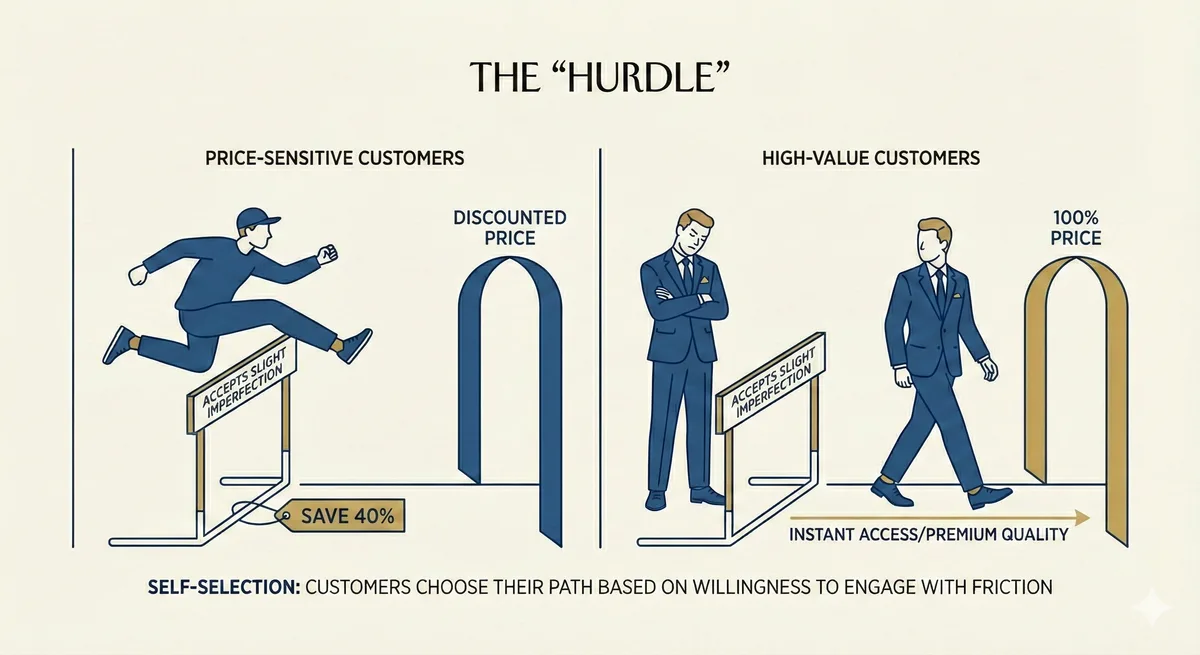
The "Hurdle"
Think of your pricing strategy as a track meet. You want to offer a low price to fill capacity, but you don't want your wealthy/high-urgency customers to take it.
You place a "hurdle" in front of the low price. This hurdle must be essentially effortless for the price-sensitive customer to jump (e.g., cutting a coupon, booking 3 weeks in advance, accepting a slightly uglier product) but annoying or impossible for the high-value customer to jump (e.g., a business traveler cannot book 3 weeks in advance; a luxury buyer refuses to use a "scratched" product).
Result: the segments self-select. The high-value customer pays the premium to avoid the hurdle; the low-value customer jumps the hurdle to get the discount.
Rules of thumb#
-
The Break-Even Rule: A price fence is only useful if:
- Arbitrage cost (time + risk + friction) must be greater than the price difference.
- Enforcement cost (operations + engagement + support) must be lower than the incremental profit.
-
The Cannibalization Check: If the "fence" is too low (easy to jump), high-value customers will trade down. You must practice "selective uglification"—intentionally stripping value from the lower tier to prevent this migration.
Why do Price Fences matter?#
-
Capture consumer surplus: A single price is inherently inefficient. It leaves money on the table from high‑value customers (who would pay more) while excluding low‑value customers who would buy above variable cost.
-
Maximize profitability: Segmentation lets you skim the "cream" of high willingness‑to‑pay while still driving enough volume at lower prices to cover fixed costs.
-
Serve diverse needs without cannibalization: Price fences allow you to serve budget‑constrained segments (students, SMBs) without eroding revenue from high‑budget segments (enterprises).
Key Facts
87% object without a fence
in the Annenberg Public Policy Center's national survey, 87% of online shoppers strongly objected to stores charging different people different prices based on collected data — and 64% didn't know the practice is legal. The lesson: unexplained differential pricing reads as exploitation; visible, rule-based fences are what make it acceptable.
Annenberg, "Open to Exploitation"36% dispersion on one plane
classic airline research found the expected fare difference between two random passengers on the same route averaged ~36% of the airline's mean ticket price — fenced discrimination (advance purchase, Saturday stay, refundability) at industrial scale.
Borenstein & Rose (1994)The 2x Growth
Companies that align their price fences with a value metric (usage-based or outcome-based) grow at least 2x faster than those using traditional seat-based flat pricing.
OpenViewHow do you implement price fences step-by-step?#
Inputs you need#
- Customer Segmentation Data: Who differs in WTP and why. Do they differ by age, industry, size, or location?
- Value Drivers: Why does one segment pay more? (use cases, risk tolerance, compliance needs, budgets) Is it urgency (Time Fence), convenience (Location Fence), or volume (Quantity Fence)?
- Competitive anchors: Market reference points, not to copy but to anticipate objections.
- Cost-to-Serve Data: Does it actually cost less to serve the low-price segment? (e.g., they require less support). Also check Operational constraints (billing system, entitlements, contract ops, fraud controls).
Step-by-step
Identify the "Leakage"
Identify 2–4 distinct buyer profiles with different value drivers.
Who are you losing because it's too high? (Potential low-end segment). Who is buying it happily who would have paid double? (Potential high-end segment)
Select the Fence
Choose a criterion that naturally separates these two groups.
- Most SaaS: start with packaging + time (annual); add usage as you scale.
Design a clean tier ladder
Define "entry" (self-serve), "growth" (team), "enterprise" (risk/compliance).
- Create a version for the low-price segment that is acceptable to them but unacceptable to the high-end segment.
Set price gaps intentionally
Price gaps should be large enough to monetize value, but small enough that legitimate upsell feels fair.
- Avoid giant jumps unless the fence is very hard to cross (e.g., legally required compliance).
-
Build enforcement + messaging
- Entitlements, audit logs, limit warnings, upgrade prompts.
- Public-facing story: "We charge less when we cost less to serve / when you commit / when you need less risk coverage."
Monitor Compliance
Ensure the low-price segment isn't reselling to the high-price segment (arbitrage) and that high-value customers aren't faking eligibility.
- Watch who buys low tiers but behaves like high-WTP customers.
Metrics to monitor
Unit Economics & Growth
Track ARPU and Gross Margin by tier. Monitor Net Revenue Retention (NRR) to ensure fences support long-term expansion rather than just initial bookings.
Funnel & Expansion Dynamics
Measure Conversion by Tier and Upgrade Rate. A high Add-on Attach Rate indicates your fences successfully encourage modular spending.
Fence Integrity (Leakage)
Track the Leakage Rate (high-value users using discount codes) and Downgrade Rate. Monitor unauthorized resale or "Grey Market" activity to ensure location/identity fences are holding.
Segment Health
Analyze Churn by Tier and Segment Profitability to ensure discounted tiers aren't burning resources (support tickets per $ revenue) at the expense of premium tiers.
Risks & anti-patterns (and fixes)#
| Pitfall | Fix |
|---|---|
Resentment & Unfairness. Customers hate feeling "gouged" if they see others paying less for the exact same thing | Tie fences to value (risk, scale, admin burden); Ensure the fence is transparent and publish consistent rules (e.g., everyone knows kids eat free; it's not a secret deal); Avoid sensitive segment targeting; prefer self-selection. |
Cannibalization (high-WTP downgrades) High-value customers trading down to the cheap option. | Move the fence to what high-WTP truly needs (compliance, reliability, governance), not cosmetic features. Ensure the cheap option lacks a feature that is critical to the high-value segment (e.g., speed, flexibility, integration) |
Arbitrage (The Grey Market). Customers buying low in one market (e.g., Thailand) and reselling in a high market (e.g., UK) | Use technical blocks (region-locking software), warranty restrictions (warranty only valid in country of purchase), or product variation (different packaging/plugs); reduce price gaps if needed. |
Legal/regulatory exposure | Avoid pricing tied to protected characteristics; be careful in B2B resale contexts (e.g., Robinson–Patman in the U.S.). Involve counsel early. |
References & Links#
Sources:#
- Baker, W., Kiewell, D., & Winkler, G. (2011). The hidden power of pricing: How B2B companies can unlock profit. McKinsey & Company.
- Borenstein, S., & Rose, N. L. (1994). Competition and price dispersion in the U.S. airline industry. Journal of Political Economy, 102(4), 653–683.
- Nagle, T. T., Müller, G., Hogan, J., Zale, J., & Holden, R. K. (2021). The strategy and tactics of pricing (6th ed.). Routledge.
- Varian, H. R. (1997). Versioning information goods (Working paper). University of California, Berkeley.
- Federal Trade Commission. (n.d.). Price discrimination: Robinson-Patman violations.
Frequently asked questions
01Isn't price discrimination illegal?
In most B2B/SaaS contexts, no. It's only illegal (under the Robinson-Patman Act in the US) if it lessens competition between buyers in specific wholesale commodity contexts. However, it allows for defenses: 1) Cost Justification (it costs less to serve the customer), 2) Meeting Competition (matching a rival's offer), and 3) Availability (the lower price is available to anyone who meets the criteria, like buying in bulk). For most startups, it's a standard "volume" or "feature" discount.
02Is price discrimination always bad/unfair?
Not necessarily. Many fences subsidize lower entry prices (students, low-usage customers) while funding higher service levels.
03Which fence should a SaaS startup start with?
Usually packaging (features) + time (annual vs monthly), then add usage as data maturity grows.
04How do I prevent enterprise customers from buying the cheap tier?
Put governance and risk behind the fence: SSO/SAML, audit logs, RBAC, data retention, SLA, admin controls.
05When do fences backfire?
When they're easy to game, hard to explain, or perceived as targeting vulnerable groups.
06How do discounts relate to price discrimination?
Discounts are a fence when governed by clear rules (term, volume, channel) rather than ad-hoc negotiation.
Author
Dr. Sarah Zou
Independent economist · EconNova
Commercial strategy for technical products, with a focus on pricing, unit economics, and the operating choices behind the model.
About SarahTopics
Cite this page
Canonical URL
https://sarahzou.com/wiki/pricing/value-and-customers/price-fences-price-discriminationSuggested citation
Zou, S. (2026). Price fences / price discrimination. In Understanding Value & Customers. Pricing & Monetization Wiki. https://sarahzou.com/wiki/pricing/value-and-customers/price-fences-price-discrimination
Open license
Reuse with attribution
This content is available for reuse. When referencing or republishing it, please credit Dr. Sarah Zou and link back to the original source.
Licensed under Creative Commons Attribution 4.0 International. You may share and adapt the material with appropriate credit.