Pricing Wiki
Ideal Customer Profile (ICP)
A hypothetical description of the account type that derives the most value from your product and provides the most value back to your business.
Snapshot
What it is
A hypothetical description of the type of company (not person) that gets the most value from your product and is the most profitable and repeatable for you to acquire, retain, and expand.
Why it matters
Startups fail not because they lack customers, but because they acquire the wrong ones. ICP focus drives pricing power (higher WTP), monetization efficiency (less under/overpricing), and organizational alignment (prevents costly "ICP drift").
When to use
Post-MVP when moving from "opportunistic selling" to "repeatable growth"; when adding a new segment, pricing/packaging change, or new channel.
Key takeaways
ICP is about who to win and keep, not just who can buy.
Start from your best customers (retention + margin + speed), not your biggest market.
Make ICP operational (scoring + routing + qualification) or it becomes a slide deck.
Separate ICP (account/company) from persona (human)—you need both.
Treat ICP as a hypothesis: validate, then update as product + market evolve.
On this page8 sections
What is Ideal Customer Profile (ICP)?#
ICP (Ideal Customer Profile) is a detailed description of a hypothetical customer who would derive the most value from your product or service and, conversely, provide the most value to your business. It acts as a blueprint for the specific type of customer you want to attract, retain, and grow.
- For B2B, ICP is usually an account-level profile (industry, size, tech stack, maturity, use case).
- For B2C, ICP is usually a segment-level profile (needs, behaviors, willingness to pay, channels).
Key definitions#
- Buyer Persona: The human in specific roles (e.g., CTO, VP Sales) within that ICP you need to influence. ICP tells you which accounts/customers; personas tell you how humans inside those accounts buy and adopt.
- Segment: A group of customers sharing attributes; you can have multiple segments, but usually 1–2 ICPs at a time.
- Beachhead market: The first narrow segment you dominate before expanding.
- Unit economics: Whether a customer is profitable (CAC, gross margin, retention, expansion).
- TAM/SAM/SOM: The ICP helps you narrow your SOM (Serviceable Obtainable Market) into a "Bullseye" target.
To understand ICP, distinguish between observable vs. value-based characteristics (you need both):
| ICP ingredient | What it looks like | What's the use |
|---|---|---|
Observable (easy to see) | demographics/firmographics, industry, size, tech stack | Helps you find them and target channels |
Value-based (higher signal) | needs, pain intensity, urgency, success criteria, WTP | Predicts conversion, retention, expansion, and pricing power |
Mental model#
ICP = Fit ∩ Value ∩ Reach
- Fit (can you serve them?): product requirements, integrations, constraints.
- Value (will they win?): painful problem, measurable outcome, urgency.
- Reach (can you reliably acquire them?): channel access, sales motion, budget, buying process.
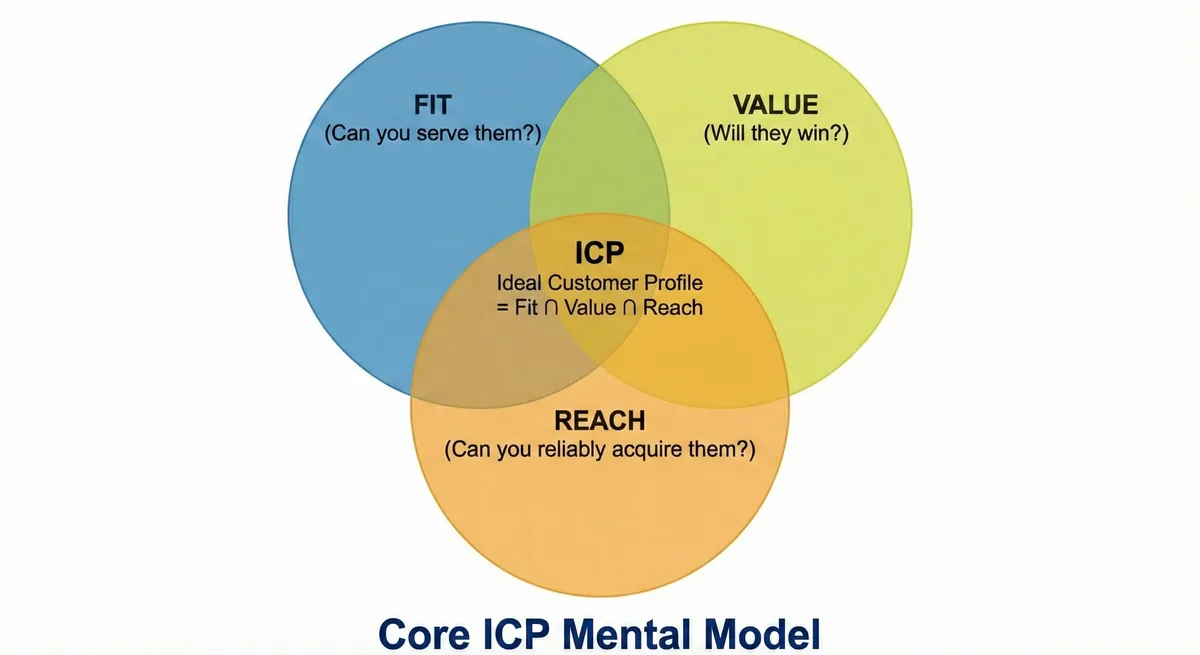
If any circle is missing, you'll feel it as churn (Value), failed deals (Fit), or runaway CAC (Reach).
Rules of thumb#
💰 The LTV/CAC Rule
Your ICP should ideally yield an LTV/CAC above 3. If it is below 3, your ICP is too broad or your pricing is misaligned.
⏱️ The "Payback Period" Rule
The ICP should ideally have a CAC payback period below 12 months for many B2B SaaS motions (shorter for PLG).
🔍 The "Rule of 3"
If 3 of your top 5 customers share a specific trait (e.g., "Using AWS" or "Series B funded"), that trait is a candidate for your ICP definition.
Why does ICP matter?#
For startup founders, ICP is the strategic foundation that aligns product, marketing, sales, success, and pricing around one answer:
"If we could only win 100 customers this year, which 100 should they be—and why?"
- Pricing power: Price elasticity is often more dependent on the customer than the product. When you focus on a segment with high pain + high value (and budget/urgency), you can charge premium prices because you're delivering a clear, measurable outcome—not selling a commodity.
- Monetization efficiency: You can't optimize pricing without knowing who you're optimizing for. Different segments have different willingness-to-pay (WTP) and value drivers; a one-size-fits-all approach either leaves money on the table (underpricing) or kills conversion (overpricing).
- Organizational alignment (prevents "ICP drift"): Without a clear ICP, sales chases the wrong leads, product builds the wrong features, and marketing targets the wrong audience. Over time, the company drifts from its strategic focus—wasting resources and producing confused positioning and inconsistent pricing.
Key Facts
68% higher
Organizations with a strong ICP reported ~68% higher account win rates
TOPO 2019 Account-Based Benchmark Report, AdRoll120%+ NRR
Many SaaS teams see 120%+ NRR for ICP-aligned customers versus sub-100% NRR for misaligned accounts
GetMonetizely, 20255× to 25× more
Acquiring a new customer is 5× to 25× more expensive than retaining an existing one
Gallo, Harvard Business Review (2014)How do you implement ICP step-by-step?#
Inputs you need#
- Quantitative Data:
- Transaction history (price paid, discounts, contract terms, renewals, expansion/contraction),
- usage telemetry (who logs in, power-user depth, feature adoption, frequency),
- CRM performance (win rate, sales cycle, deal size, reasons lost),
- Finance (CAC by channel, gross margin by segment, payback period), and
- firmographics (industry, revenue, team size).
- Qualitative Research: "Willingness-to-pay" conversations, interviews regarding customer pain points, and distinct "jobs to be done".
- Internal Alignment: Input from Sales (who is easiest to close?), Product (who uses the features?), and Customer Success (who retains best?).
Step-by-step
Define "best customer" with metrics
Pick 3–5: retention, gross margin, expansion, time-to-value, support load, sales cycle. Pull your top cohort (e.g., top 10–20% by the above) and find commonalities.
- B2B examples: industry, employee size, tech stack, maturity, data availability, buying triggers.
- B2C examples: usage frequency, need intensity, channel affinity, willingness to pay.
Draft an ICP for your top cohort in one page
Include: "Must-have," "Nice-to-have," "Hard no," and top use cases.
Validate with go-to-market tests (2–4 weeks)
Run targeted outbound/ads; track conversion and sales cycle vs. non-ICP. Do 10–15 short interviews with ICP-fit prospects and churned customers (listen to why they say "no.")
Operationalize
Add ICP fields to CRM, build a simple scoring model, route leads accordingly. Revisit monthly, rewrite quarterly. ICP drift happens when product, pricing, or channels change.
Metrics to monitor
Lead-to-Opportunity Conversion
Should increase for ICP-fit leads.
LTV (Customer Lifetime Value) or Average Contract Value (ACV)
Does your ICP have a higher LTV or ACV?
CAC (Customer Acquisition Cost)
Is it lower for your defined ICP than for general leads?
Churn Rate
Monitor specifically for non-ICP customers to justify firing them.
Discounting Levels
Heavy discounting can signal misidentified ICP or unclear value.
Risks & anti-patterns (and how to fix them)#
| Pitfall | Fix |
|---|---|
The "Land and Expand" Trap: Defining an ICP so broad it includes everyone. Startups often give away too much value in the entry-level package to acquire "any" customer. | Add "Negative Constraints" (e.g., "<50 employees," "no data team," "regulated constraint"). |
Over-Indexing on "Easy": Don't base your ICP on the customers who are easiest to reach or survey. | Require evidence across multiple customers/cohorts; run small tests before scaling. |
The "Aspirational" ICP: Defining who you wish you could sell to, rather than who actually buys. | Ground the ICP in current usage data, not just founder dreams. |
Not operationalizing: ICP lives in a deck, not in the funnel. | Put ICP into CRM routing, messaging, qualification, and success playbooks. |
References & Links#
Sources:#
- Blank, S., & Dorf, B. (2012). The Startup Owner's Manual: The Step-by-Step Guide for Building a Great Company. K&S Ranch.
- Dunford, A. (2019). Obviously Awesome: How to Nail Product Positioning so Customers Get It, Buy It, Love It. Ambient Press.
- Kotler, P., & Keller, K. L. (2021). Marketing Management (16th ed.). Pearson.
- Moore, G. A. (2014). Crossing the Chasm: Marketing and Selling Disruptive Products to Mainstream Customers (3rd ed.). HarperBusiness.
- Reichheld, F. F., & Sasser, W. E. (1990). Zero defections: Quality comes to services. Harvard Business Review.
- Ramanujam, M., & Tacke, G. (2016). Monetizing Innovation: How Smart Companies Design the Product Around the Price. Wiley.
- Ghuman, A. (2021). Price to Scale: Practical Pricing for Your High Growth SaaS Startup. Independently published.
Frequently asked questions
01Can I have more than one ICP?
Early-stage startups should focus on one, and optionally one secondary. More than that tends to dilute focus unless you have separate motions/teams.
02Is ICP only for B2B? Does ICP apply to B2C?
In B2C, we usually refer to this as a "High-Value Segment." In B2C, you still define who gets the most value and is profitable to acquire—just with more behavioral/channel emphasis than firmographics.
03When should I pivot my ICP?
Signs: high churn, long onboarding, low expansion, lots of custom work, rising CAC, and sales objections that sound like "this isn't built for us." For example, if your sales cycle for the "Ideal" segment is consistently exceeding 9 months without a clear path to closure, your "Ideal" might actually be "Impossible."
04What if our "Ideal" customer can't afford our product?
Then they are not your Ideal Customer. An ICP must lie at the intersection of "gets high value" and "has willingness/ability to pay." If they love the product but can't pay, you have a product-market fit issue or a cost-structure issue.
Author
Dr. Sarah Zou
Independent economist · EconNova
Commercial strategy for technical products, with a focus on pricing, unit economics, and the operating choices behind the model.
About SarahTopics
Cite this page
Suggested citation
Zou, S. (2026). Ideal Customer Profile (ICP). In Understanding Value & Customers. Pricing & Monetization Wiki. https://sarahzou.com/wiki/pricing/value-and-customers/ideal-customer-profile
Open license
Reuse with attribution
This content is available for reuse. When referencing or republishing it, please credit Dr. Sarah Zou and link back to the original source.
Licensed under Creative Commons Attribution 4.0 International. You may share and adapt the material with appropriate credit.