
Infrastructure and applications run on different economic engines. A founder who builds infrastructure while copying the application playbook—per-seat pricing, ARR-only reporting, "the model is our moat," demo-led sales—will mis-price, mis-measure, and mis-pitch the company.
This piece defines the two businesses, sets them side by side, and gives you a classifier for placing your own.
Two businesses
An application sells a finished job. AI sits inside a workflow. The buyer is a line-of-business owner or the end user, paying for an outcome—a contract reviewed, a ticket resolved, code written—not a capability. Value grows with seats or outcomes, and the product is judged on how well it does the job: copilots, coding assistants, and the vertical tools of law, health, and support.
Infrastructure sells a reusable capability. It sells the building blocks other teams compose into their own products: compute, model serving, retrieval, observability, data pipelines, developer APIs, sensing data. The buyer is a developer or a platform team, paying for a primitive measured by throughput, calls, tokens, gigabytes, compute-hours, events. Value grows with consumption, and the product is judged on reliability, performance, and cost at scale.
For the full map of segments, see the companion piece, Mapping the Emerging AI Infrastructure and Deep Tech Data Platforms.
The test in one sentence: if customers build on you, you are probably infrastructure; if customers get a job done with you, you are probably an application.
Why the application playbook misleads infrastructure founders
Every founder borrows a playbook; infrastructure founders often borrow the wrong one.
The application playbook is tempting because it is concrete and well benchmarked. It can be dangerous for infrastructure companies because the economics are fundamentally different.
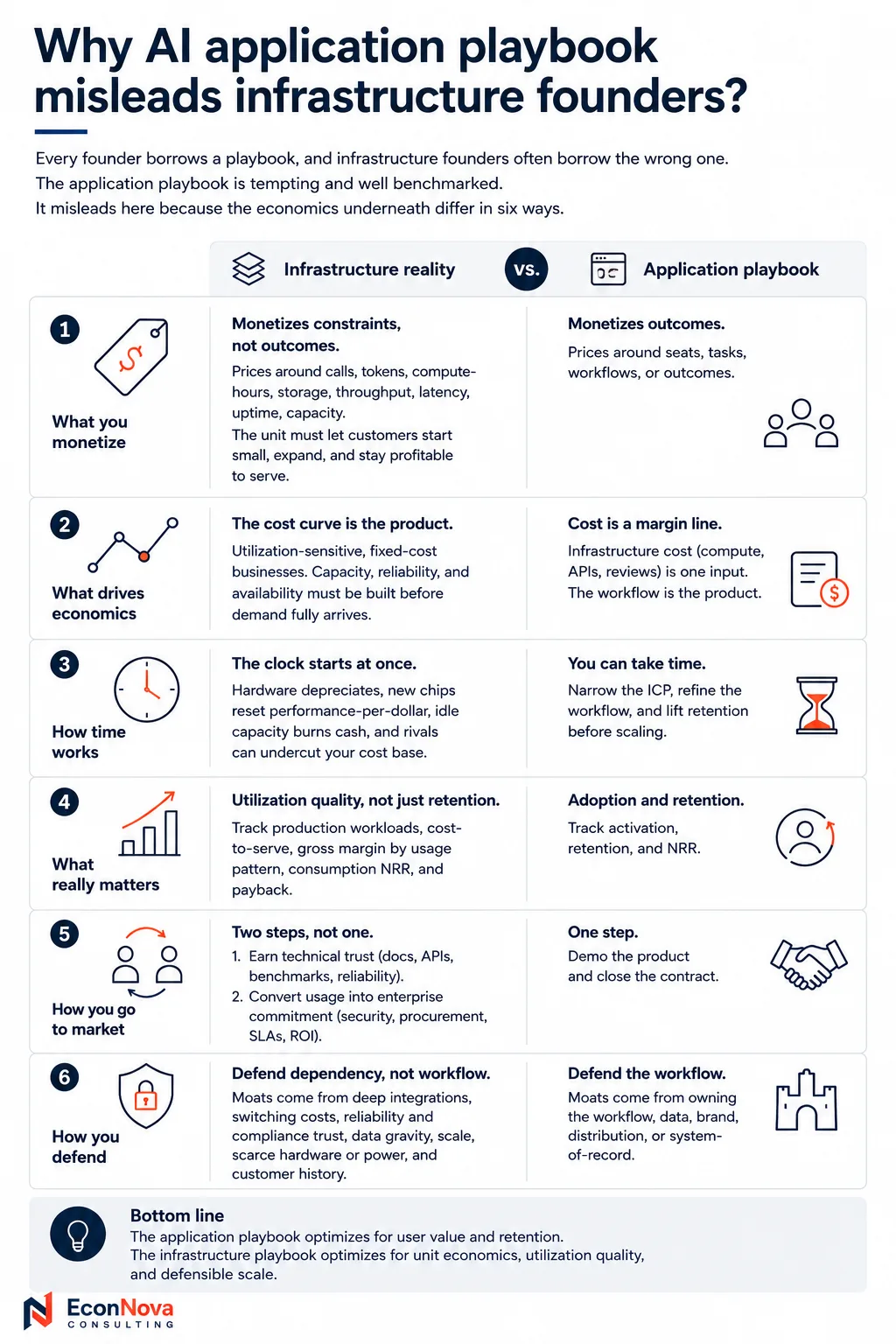
Infrastructure monetizes constraints, not outcomes
An application prices around seats, tasks, workflows, or outcomes.
An infrastructure company prices around constraints: calls, tokens, credits, compute-hours, storage, throughput, fidelity, latency, uptime, committed capacity. Choosing that unit of value is the central act, because it must map three things at once—what the customer values, what you spend to serve them, and how they expand.
Get it wrong and the business breaks quietly: too simple and you undercharge your heaviest users; too punitive and adoption stalls; track cost but not value and you become a commodity; track value but not cost and usage growth compresses your margin.
The question is never "what can we charge?" but "which unit lets a customer start small, expand naturally, and stay profitable to serve at scale?"
For infrastructure pricing mechanics, see usage-based pricing and credits / drawdown models.
The cost curve is part of the product
For an application, infrastructure cost is a margin line: every call, retrieval, and human review adds COGS, but the workflow is the product.
For an infrastructure company the cost curve is the product. Most are utilization-sensitive, fixed-cost businesses that must fund capacity, reliability, and availability before demand fully arrives—which makes blended gross margin a liar. A platform can look healthy on average while losing money on the very customers who use it most.
For a software-layer tool the fixed-cost burden is manageable; for GPU, data-center, sensing, or hardware-heavy infrastructure it can be existential.
The clock starts at once, because infrastructure economics decay
An application founder can usually take time to narrow the ICP, refine the workflow, and lift retention before scaling.
An infrastructure founder who owns or finances expensive capacity cannot. Hardware depreciates, new chips reset performance-per-dollar, power and data-center access turn into strategic constraints, idle capacity burns cash, financing costs compound, and a rival on newer capacity can undercut your cost base.
A slow application loses momentum; a slow infrastructure company loses its economic basis. So demand alone is not product-market fit: fit means predictable production usage at a credible margin, not volume that is spiky, subsidized, or easy to switch away from.
Retention is not enough; utilization quality is
The application playbook optimizes for adoption and retention.
In infrastructure, a retained customer can still be economically weak—small, unpredictable, support-heavy, or expensive to serve—while a fast-growing one can be dangerous if pricing does not scale with cost. A marquee logo can mislead if it creates idle capacity, custom work, and margin leakage.
So track production workloads, cost-to-serve by customer and workload, gross margin by usage pattern, consumption net revenue retention, and payback.
The application asks, "are users coming back?" The infrastructure company asks, "is retained usage expanding predictably and profitably?"
Go to market in two steps, not one
Infrastructure adoption usually starts with a developer, architect, or platform team, but the budget sits with engineering leadership, finance, security, or a business unit.
That splits the motion in two. First earn technical trust—through documentation, APIs, benchmarks, reliability, and a fast time-to-first-value. Then convert that usage into an enterprise commitment—through security review, procurement, SLAs, governance, and ROI evidence.
The sales motion is not "demo → contract." It is "experiment → integration → production workload → expansion → commitment."
Defend dependency, not workflow
Application moats come from owning a workflow, proprietary user data, brand, distribution, or system-of-record status.
Infrastructure moats are operational, and they have to be built on purpose. A bare API, a thin wrapper, or a stateless endpoint is not a moat: if customers can benchmark you, swap you, and route around you, the market will compete you down to price, latency, and procurement convenience.
Defensibility comes instead from deep integrations, switching costs, reliability and compliance trust, ecosystem standards, data gravity, scale, scarce hardware or power, and the customer-specific history of logs, evaluations, and tuning.
The application founder asks, "what workflow do we own?" The infrastructure founder asks, "what would make replacing us risky, slow, and expensive?"
The business-model classifier
Mark the side that fits your core product—the part customers actually pay for, not everything you do.
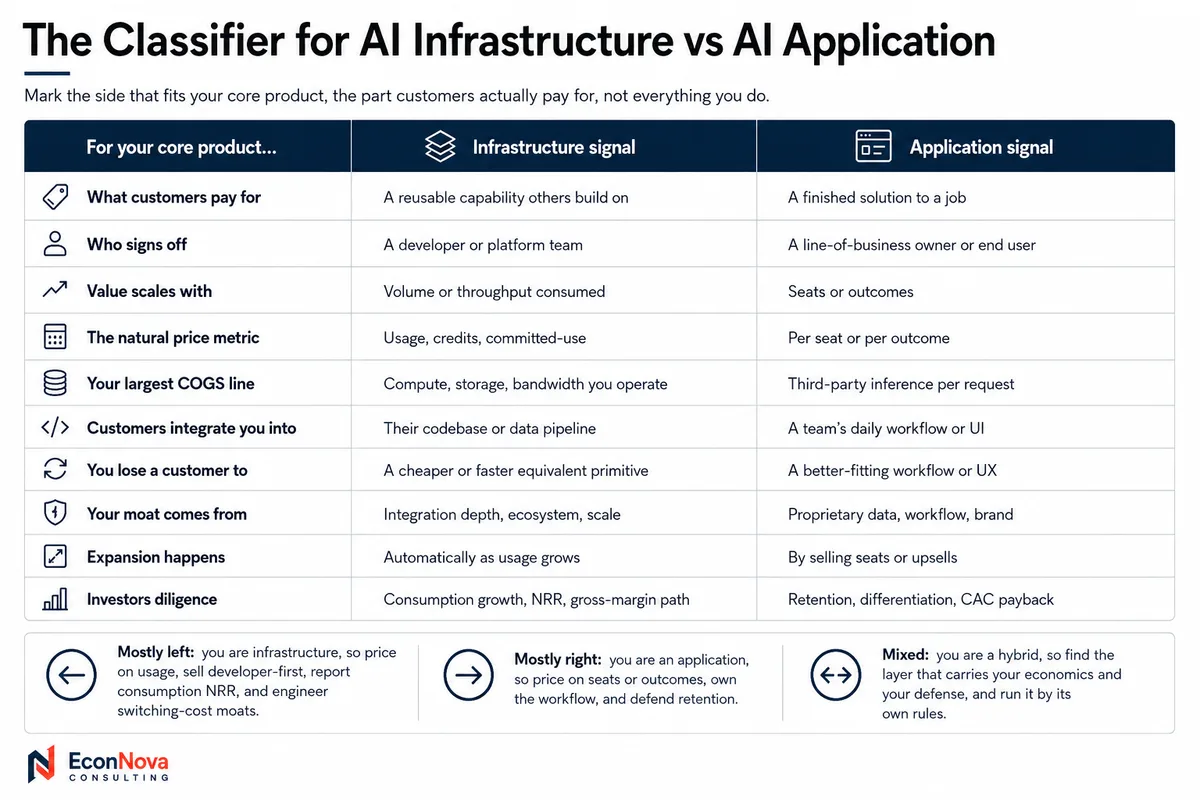
- Mostly left: you are infrastructure—so price on usage, sell developer-first, report consumption NRR, and engineer switching-cost moats.
- Mostly right: you are an application—so price on seats or outcomes, own the workflow, and defend retention.
- Mixed: you are a hybrid—so find the layer that carries your economics and your defense, and run it by its own rules.
The line is blurring, but it still holds
Full-stack companies, infrastructure reaching up into applications, applications building their own, and a16z's own 2020 advice to applied-AI founders to embrace services—all blur the boundary. None of it dissolves the distinction. It only raises the cost of not knowing which layer carries your economics and your defense, and of running that layer by the wrong rules.