Pricing Wiki
Penetration Pricing
Launching at a deliberately low price to quickly win customers and market share, then raising prices once scale and lock-in are achieved.
Snapshot
What it is
A launch strategy where you set prices below long-term profit-maximizing levels to speed adoption, gain share, and build scale or network effects.
Why it matters
For founders in markets with high price sensitivity and network effects, penetration pricing is a powerful land-and-expand tactic. You can trade short-term margin for fast scale, data, and customer footprints that can later be monetized through higher prices, upsells, and expansion revenue.
When to use
- Entering a large, price-sensitive market with many similar alternatives
- Strong economies of scale or learning effects (unit cost falls with volume)
- Product value rises with user base (network/community effects)
- You have runway or cost advantage to survive temporarily thinner margins
Key takeaways
Penetration pricing is about strategic payback, not permanent cheapness—you need a clear path to standard pricing and profitability.
It works best when incremental costs are low and scale or network effects are strong (e.g., SaaS, marketplaces, platforms).
The main dangers are "profitless prosperity" (big share, no profits), low-quality signaling, and competitor retaliation—all of which must be managed deliberately.
Effective penetration strategies are tied to an expansion plan (cross-sell, upsell, usage growth) and explicit exit criteria for when to stop discounting.
On this page9 sections
What is penetration pricing?#
Penetration pricing is a strategy where a product is intentionally priced low relative to its perceived value to accelerate adoption and market share, with a plan to increase prices as the product gains traction, scale, or lock-in.
This approach aims to achieve high market penetration at a high velocity, taking a product from unknown to dominant quickly. It is distinct from "skim pricing," which targets high-margin early adopters first.
- Everyday low price (EDLP): A consistently low pricing strategy with no plan to move higher; different from penetration pricing, which is temporary and strategic.
- Price skimming (another strategy): Launching at a high price to extract surplus from early adopters, then gradually lowering the price as the market broadens.
- Introductory offer vs. penetration price:
- Intro offer: Time-limited discount off a normal list price.
- Penetration price: The list price itself is set low at launch; future list increases are part of the strategy.
Mental model#
Think of penetration pricing as a flywheel: you trade short-term margin for long-term advantage that keeps reinforcing itself.
Penetration Pricing Flywheel:
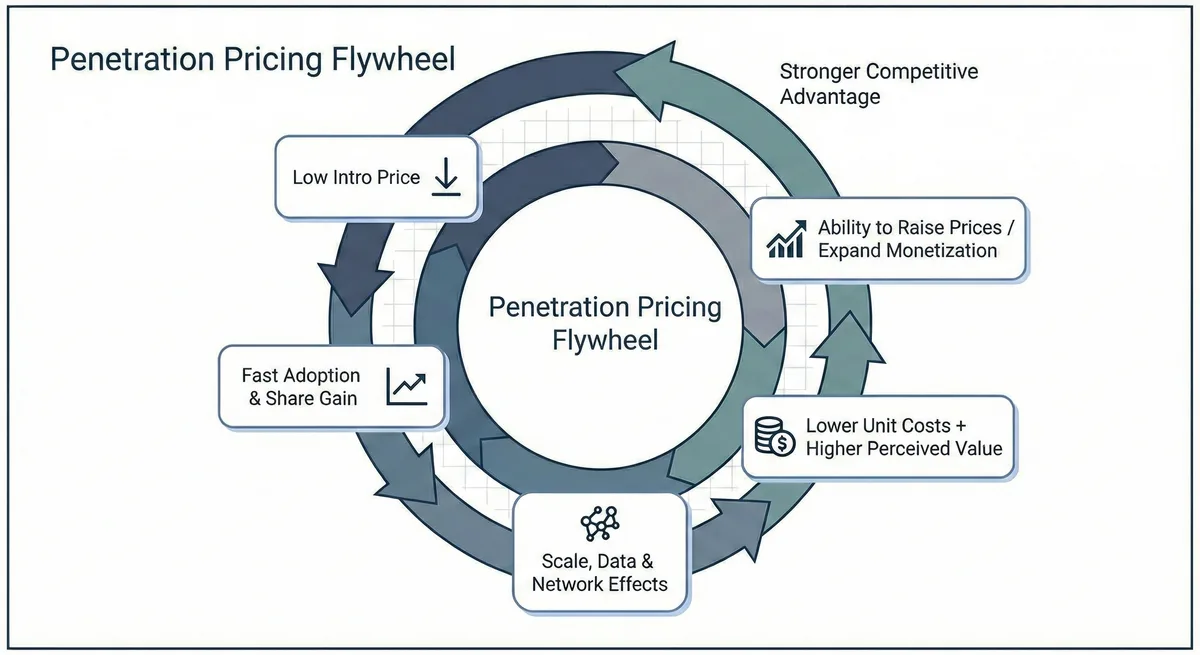
If this loop spins faster than competitors can respond, penetration pricing doesn't just buy share—it locks in an economic advantage.
Strategy comparison snapshot:
A simple way to "see" penetration vs. skimming is to compare early and later stages side by side:
| Skimming Pricing | Penetration Pricing | |
|---|---|---|
Early price | High (↑↑) | Low (↓↓) |
Early volume | Low (↓) | High (↑↑↑) |
Early margin/unit | High | Low |
Later price | Lower (↓) | Higher (↑) |
Later volume | Higher (↑) | High / Stable (↔ / ↑) |
Advantage source | Margin per unit | Scale, network, lock-in |
Penetration pricing works when the scale, network, and lock-in you gain from the right-hand column are worth far more than the margin you give up in the early periods.
💡 Related: See How Maximization differs from Skimming and Penetration for a detailed comparison of these three primary pricing strategies.
When should you use penetration pricing?#
Decision criteria#
| Market / product condition | Penetration pricing? | Why | Example type |
|---|---|---|---|
High price sensitivity, many similar alternatives | ✅ Strong | Low price is a key lever to win share quickly | Consumer apps, utilities |
Strong economies of scale | ✅ Strong | Early volume lowers cost, making later profits higher | Hardware, SaaS infra |
Strong network or data effects | ✅ Strong | More users → more value → easier to raise prices later | Marketplaces, platforms |
Capacity or supply is tightly constrained | ❌ Avoid | You don't need low prices to sell out | Niche luxury goods |
Premium brand positioning | ❌ Usually avoid | Low prices conflict with premium signals | Luxury goods, high-end B2B |
Easy for competitors to match / undercut | ⚠️ Risky | Can trigger price wars; advantage may be short-lived | Commodity categories |
Rules of thumb#
- The Contribution Rule: Penetration pricing is most viable when incremental costs (variable and incremental fixed) represent a small share of the price, e.g. SaaS products.
Penetration vs. skimming rule-of-thumb:
Use penetration pricing when:
- Price elasticity of demand is high (small price cuts drive big volume gains).
- Economies of scale are strong (unit cost drops significantly with volume).
- Lifetime value (LTV) grows with user base (network effects, data, ecosystem).
Use skimming when:
- Capacity is constrained.
- Product is highly differentiated with inelastic demand.
- You want to position as premium or luxury.
Why does penetration pricing matter?#
For startup founders, penetration pricing is essential in markets dominated by network effects—where a product becomes more valuable as more people use it. It is a "land-and-expand" tactic, designed to capture a significant customer footprint early, which can later be leveraged for expansion revenue and increased customer lifetime value.
- Faster scale and network effects: Low entry prices reduce friction to try, helping you build a large user base quickly—critical in categories where "the biggest wins."
- Stronger competitive position: Early share gains and locked-in users make it harder and more expensive for later entrants or incumbents to dislodge you.
- Better unit economics at scale: Higher volume can drive down unit costs (learning curves, supplier terms, infrastructure leverage), widening margins once prices normalize.
- More expansion and LTV upside: A larger installed base gives you more opportunities for upsell, cross-sell, and monetization experiments over time.
- Ability to shape market expectations: By entering with a bold price move, you can redefine value norms in the category and force competitors to respond on your terms.
Key Facts
75% never return capital
Harvard research on 2,000+ venture-backed companies found roughly 75% never return investors' capital — a caution for penetration strategies that buy growth without a path to profitable pricing.
Ghosh, Harvard Business SchoolThe contribution math
at a 90% contribution margin (typical SaaS), a price 30% below the competitive reference still earns 60+ points of margin per sale — why penetration is far cheaper for software than for hardware, where the same cut can erase the margin entirely
Temporary by definition
penetration prices sit below the long-run profit-maximizing level; without explicit exit criteria (share, cohort LTV/CAC, network-density targets), the strategy degrades into everyday-low-price with none of its cost discipline.
Nagle et al. (2023)How do you implement penetration pricing step-by-step?#
Inputs you need#
- Price elasticity and switching behavior: Evidence that enough customers will switch or adopt at a lower price (experiments, past launches, or survey-based elasticity).
- Cost structure and economic floor: Clear view of variable costs, incremental fixed costs, and how unit cost falls with scale so you know how low you can go without destroying long-run economics.
- Competitor cost and pricing benchmarks: Estimates of rivals' cost positions, current price levels, and likely responses so you can judge the risk and payoff of a price war.
- Runway, CAC, and payback constraints: Explicit limits on margin sacrifice, acceptable CAC, and maximum payback period for penetration cohorts.
- Capacity and operational limits: Production, onboarding, and support capacity to handle the extra volume that lower prices are meant to unlock.
- Target outcomes and exit criteria: Concrete goals (e.g., share, user base, LTV/CAC) and milestones that trigger either ending penetration pricing or stepping prices up.
Step-by-step
Identify high-elasticity segments
Target segments that are highly sensitive to price and willing to change suppliers for a clearly better deal, validated through research or controlled tests.
Establish a cost advantage
Before cutting prices, confirm you have the operational efficiency, scale economies, or capital to survive at thinner margins than your competitors.
Set the penetration price
Price noticeably below the competitive reference point but above your incremental cost to serve, and within pre-defined unit-economics guardrails.
Communicate value, not just price
Position the low price as an introductory value for a high-quality product, not as a signal of cheapness; set expectations that pricing will normalize over time.
Execute the expansion path
Once you have "landed" accounts, grow revenue through cross-selling, up-selling, and usage-based expansion until cohorts reach your target LTV and profitability.
Metrics to monitor
Market Share Growth
The primary goal of penetration is to gain dominant positioning quickly. New customers/users per period, conversion rates (trial → paid, visitor → signup → active user), and share of the target market or category.
Unit economics and payback
Contribution margin per unit or per customer, CAC, CAC payback period, and LTV/LTV-to-CAC ratios by cohort (penetration cohorts vs. later cohorts). Measuring whether the long-term value of the customers captured justifies the cost of the aggressive pricing.
Customer quality and behavior
Churn after price increases, ARPU by cohort, and the share of customers upgrading to higher tiers or expanding usage. Ensuring that once customers are "landed," they are staying and expanding their spend.
Competitive dynamics
Competitor price reactions (follow, undercut, hold), and changes in promotional intensity and discounting in the category.
Risks & anti-patterns#
| Pitfall | Fix |
|---|---|
The "Profitless Prosperity" trap: • You gain impressive headline metrics (users, market share, GMV) but never reach sustainable profitability • Prices stay low, customers are conditioned to discounts, and unit economics never improve • Combines the dangers of getting stuck in a price trap, attracting unprofitable customers, and ignoring runway constraints | • Link penetration prices to a clear next-step product, tier, or contractually defined price path (e.g., introductory term followed by standard rates) • Set hard guardrails on discount depth, CAC, and payback • Design plans so customers naturally migrate to profitable tiers as they grow • Regularly review cohort profitability so you can course-correct before cash runs out |
The low-quality signal: • Customers interpret low prices as a signal of low quality, which can erode brand equity • Especially problematic for products that aspire to premium positioning or where buyers use price as a proxy for reliability | • Aggressively communicate the benefits and proof points behind the offer (case studies, ROI data, independent reviews) • Frame the price as an introductory opportunity, not the "true" value of the product • Use high-end endorsements, reference customers, or certifications to maintain prestige • Consider confining the most aggressive pricing to specific segments, channels, or entry-level SKUs so your core brand remains premium |
Competitor retaliation: • Your penetration move provokes a price war with a rival who has a lower cost structure, deeper pockets, or more efficient operations • Leaves you worse off despite higher volume | • Only initiate penetration pricing when you have a decisive cost or structural advantage, or when you're targeting a segment too small or unattractive for the rival to defend aggressively • Stress differentiation on product, experience, or ecosystem rather than pure price • Monitor competitor reactions closely so you can dial back, re-segment, or pivot the offer before a destructive price spiral sets in |
References & Links#
Sources:#
- Nagle, T. T., Muller, G., & Gruyaert, E. (2023). The strategy and tactics of pricing: A guide to growing more profitably (7th ed.). Routledge.
- Ramanujam, M., & Tacke, G. (2016). Monetizing innovation: How smart companies design the product around the price. Wiley.
- Raju, J. G., & Zhang, Z. J. (2010). Smart pricing: How Google, Priceline, and leading businesses use pricing innovation for profitability. Pearson.
- Ghuman, A. (2021). Price to scale: Practical pricing for your high-growth software startup. Independently published.
Frequently asked questions
01Is penetration pricing the same as being "cheap"?
No, it means the price is low relative to the perceived value in that segment, not necessarily a low absolute dollar amount.
02Can a startup use this if it doesn't have a cost advantage?
It is highly risky unless the startup has enough capital to "buy" the market or has high-value complementary products.
03How long should a penetration strategy last?
It is typically a timing-driven, short-lived strategy used at launch or market entry, eventually replaced by more neutral or value-based pricing.
04Does it work in B2B?
Yes, especially for software-as-a-service (SaaS) where high upfront costs and low marginal costs make volume gains highly profitable.
05What if a competitor matches my low price?
The strategy fails if the rival matches; you must ensure they have "no incentive" or "no ability" to follow you down.
Author
Dr. Sarah Zou
Independent economist · EconNova
Commercial strategy for technical products, with a focus on pricing, unit economics, and the operating choices behind the model.
About SarahTopics
Cite this page
Suggested citation
Zou, S. (2026). Penetration Pricing. In Core Philosophies & Strategy. Pricing & Monetization Wiki. https://sarahzou.com/wiki/pricing/foundations/penetration-strategy
Open license
Reuse with attribution
This content is available for reuse. When referencing or republishing it, please credit Dr. Sarah Zou and link back to the original source.
Licensed under Creative Commons Attribution 4.0 International. You may share and adapt the material with appropriate credit.