Fundraising Wiki
How Startup Funding Works: A Founder's Guide
Startup funding converts a milestone-sized cash gap into a financing choice with specific repayment, dilution, control, and legal consequences.
Snapshot
What it is
Startup funding is the process of obtaining cash or other resources to build and grow a company before operating cash flow can finance the plan. The capital may come from customers, founders, grants, lenders, or investors. Each source creates a different claim on the company: no claim, repayment, future equity, or current ownership and governance rights.
Why it matters
Funding is not just money. It changes the company's survival time, growth rate, ownership, control, risk, and future financing options. A round that is too small can leave the company fundraising again before it reaches a meaningful milestone. A round that is too large can create unnecessary dilution, an inflated cost base, or investor expectations the business cannot support.
On this page9 sections
What is startup funding?#
How much should you raise? Enough to reach the next value-changing milestone plus a realistic buffer — not a benchmark round size, and not "as much as possible." Size the amount from your own operating plan first, then test it against what the market will fund.
Core rule: Raise enough to reach the next value-changing milestone with a realistic buffer, then choose the least harmful capital that fits the company's cash-flow profile and risk.
Key formula:
Funding need = (monthly net burn x months to milestone) + one-time milestone costs + cash buffer - cash on hand - committed non-dilutive inflows
Do not confuse: Pre-seed, seed, and Series A are market labels, not distinct legal exemptions. In the United States, an offer or sale of a security must be registered or fit an exemption regardless of what the round is called. (SEC, Early-Stage Investors, updated 2026)
Startup funding is external or internally generated capital used to pay for product development, hiring, inventory, customer acquisition, regulatory work, equipment, and other costs before the business can fund those activities from its own cash flow.
The useful distinction is not simply "funded" versus "bootstrapped." It is the economic claim created by the capital:
| Capital source | What the provider receives | Main founder cost | Best fit |
|---|---|---|---|
Customer revenue / prepayments | Product or service | Delivery obligation; possible discounts or concentration | A product customers can buy early |
Founder capital / bootstrapping | Nothing from the company, unless documented as a loan | Personal financial exposure and slower growth | Low initial cost, fast path to revenue |
Grants and qualifying programs | Usually no equity and no repayment, subject to program terms | Application time, restricted uses, reporting | R&D, public-interest or mission-aligned work |
Debt | Principal, interest, fees, covenants and sometimes collateral or guarantees | Fixed cash payments and default risk | Predictable cash flow or financeable assets |
SAFE or convertible note | A contractual right that may convert into equity | Future dilution; note interest and maturity where applicable | Early rounds when pricing the company is difficult |
Priced equity | Shares, economic rights and often governance or information rights | Immediate dilution and possible control constraints | High-risk growth that cannot support debt repayment |
Securities crowdfunding | Debt, equity or another security sold through a regulated pathway | Disclosure, platform, compliance and investor-management burden | A broad customer/investor community and suitable campaign economics |
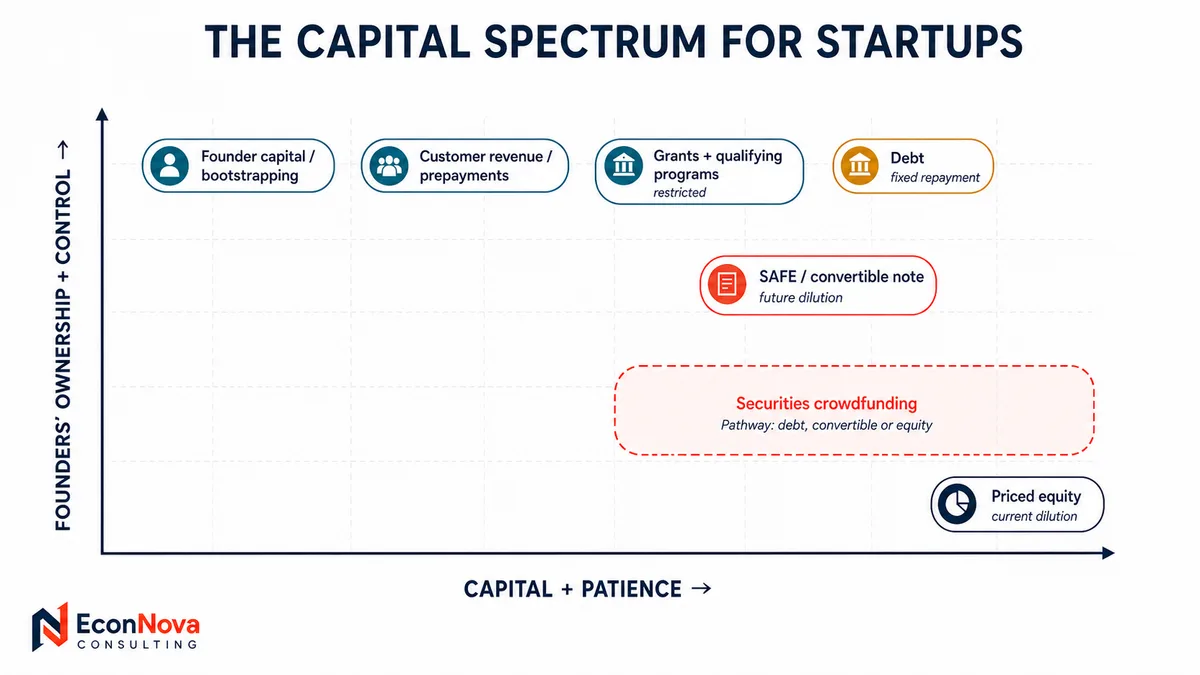
Read the table as a spectrum of claims, from weakest to strongest: no claim (a customer who simply buys the product) → repayment (a lender) → future equity (a SAFE or note holder) → current ownership and control (a priced-equity investor). Moving right generally buys more capital and more patience, but concedes more of the company's future economics and decision rights.
The SEC's funding roadmap groups grants and loans as generally non-dilutive because the provider does not normally receive ownership, while investor capital is dilutive because it reduces existing owners' percentage interests. Debt may be non-dilutive, but it is not free: it creates repayment and default risk. (SEC funding roadmap, 2026)
Why startup funding matters to founders#
Funding affects five operating decisions at once:
- Survival: Cash determines runway. A company can be strategically right and still fail because it runs out of cash before the strategy works.
- Speed: Capital can compress the time needed to build, hire, obtain approvals, or acquire customers. Speed is valuable only if the underlying motion is learning or scaling effectively.
- Ownership and control: Equity and equity-linked instruments reduce the founders' eventual ownership. Priced rounds may also add board, consent, information, pro rata, liquidation and protective rights.
- Risk allocation: Bootstrapping concentrates risk on founders. Debt moves timing risk into required payments. Equity transfers some downside risk to investors but gives away part of the upside.
- Future options: Today's instrument and valuation affect the next cap table, financing negotiation and exit waterfall. A cluttered SAFE stack, aggressive valuation or restrictive debt covenant can make the next round harder.
This is why "raise as much as possible" is not a strategy. The correct question is: What milestone must this capital buy, and what claim can the business responsibly give in return?
Key Facts
Venture is concentrated, not a default
In 2025, U.S. venture firms deployed about $320 billion across 15,352 deals, and artificial intelligence captured roughly 65% (~$222 billion) of all deal value — a small number of very large AI rounds alongside a normal-sized market for everything else. Building an ask from headline averages imports that skew.
NVCA 2026 YearbookMost small firms do not use outside equity
Federal Reserve survey data on employer firms shows businesses most commonly meet financing needs with owners' personal funds, retained earnings, and debt; outside equity is a comparatively narrow channel.
Federal Reserve Banks, 2026Securities crowdfunding has a hard cap
Under Regulation Crowdfunding, a company may raise up to $5 million in a rolling 12-month period through an SEC-registered intermediary, subject to disclosure requirements.
SEC, Regulation CrowdfundingThe mechanism: from cash gap to financing choice#
Step 1: Define the next value-changing milestone#
A good milestone changes what a rational investor, lender or operator can believe about the company. Examples include:
- a working product that resolves the highest technical risk;
- paid pilots that show willingness to pay;
- a repeatable acquisition channel with measured CAC and payback;
- regulatory clearance or a completed clinical/technical validation;
- positive contribution margin at a useful scale;
- enough revenue quality and retention evidence to support a larger round.
"Hire a team" is a use of funds, not a milestone. "Reach $1 million ARR with at least 90% gross retention and sub-18-month CAC payback" is a milestone because it specifies an outcome that can change the financing case.
Step 2: Calculate the cash gap#
Start with monthly net burn:
Monthly net burn = cash operating outflows - cash operating inflows
Then size the funding requirement:
Funding need = (monthly net burn x months to milestone) + one-time milestone costs + cash buffer - cash on hand - committed non-dilutive inflows
Use cash, not accounting profit. Include working-capital timing, taxes, debt service, capital expenditures, transaction costs and hiring lead times. Model base, downside and severe-but-plausible cases. If burn varies materially by month, use a monthly cash schedule instead of a single average.
Treat the formula as a scenario tool, not a precise number. Months-to-milestone and burn are not independent: slower-than-planned progress usually increases both the number of months and the total spend, so stress-test the combined figure rather than flexing one input at a time.
The funding target should connect directly to the pitch deck's use of funds, milestones, financial forecast, and fundraising ask. Every major spend category should explain which risk it removes or which repeatable engine it builds.
Step 3: Match the capital to the business#
Use four filters:
Cash-flow fit. Can the company make scheduled payments even if growth is slower than planned? If not, conventional debt may be dangerous.
Risk fit. Is the capital paying for an uncertain experiment or a predictable asset? Equity is structurally better suited to uncertain, long-duration outcomes; debt is better suited to cash-generating activity or assets with clear repayment capacity.
Return fit. Venture capital generally seeks high-growth companies and a future liquidity event. The SBA describes VC as equity capital focused on high-growth companies, with a longer horizon and active investor involvement. A healthy business that cannot plausibly produce venture-scale outcomes may be a poor VC fit even if it can raise. (SBA, 2024)
Control and dilution fit. Decide which rights and ownership outcomes are acceptable before negotiating. Compare the full cap table after all SAFEs, notes, warrants, option-pool changes and the new round — not only the headline valuation.
Step 4: Choose the instrument#
Bootstrapping and revenue. Best when customers can finance development through purchases, deposits, paid pilots or services. It preserves ownership and forces commercial learning, but it can constrain speed and expose founders personally.
Grants and non-dilutive programs. Best when the project fits a defined program, but understand the cost of qualifying.
SBIR/STTR Funding Caveats
For eligible U.S. R&D companies, SBIR/STTR offers equity-free funding for technology development and commercialization. However, the program is both slow and tightly restricted:
- Review cycles often take 4–6 months from submission to award (or even longer with resubmissions).
- Eligibility is narrow: the company must usually be majority-owned by individual U.S. citizens or permanent residents; venture, hedge-fund, and private-equity ownership is limited; foreign ownership and control face scrutiny.
- The work funded must be genuinely high-risk R&D, and equipment purchased is often required to be U.S.-made.
- Allowable uses, timelines, and reporting are heavily constrained, which can limit flexibility.
- Many awards—including reimbursement-based grants—pay after you spend, so “committed” non-dilutive funding may still require bridge cash on hand.
Debt. Best when the company can demonstrate repayment capacity. Model principal, interest, fees, covenants, collateral and personal guarantees. SBA 7(a) loans, for example, are made by participating lenders with an SBA guaranty; eligibility includes creditworthiness and a reasonable ability to repay. (SBA 7(a), 2026)
SAFEs. A SAFE is a security that can convert into equity under its terms. It is generally simpler than a priced round, but "simple" does not mean dilution-free. Y Combinator's post-money SAFE is designed to make ownership from the SAFE round more legible; it has no maturity date or interest, unlike a typical convertible note. The SAFE still dilutes founders, and it will generally be diluted by new money in the priced round. (YC SAFE documents, YC Post-Money SAFE User Guide)
Convertible notes. Notes are debt that may convert into equity, commonly with a valuation cap, discount or both. Unlike a SAFE, a note usually has interest and a maturity date. Those features create negotiation and extension risk if the expected financing does not occur.
Priced equity. Investors buy shares at an agreed price, normally preferred stock in institutional venture rounds. The valuation is explicit, but the economics are not captured by valuation alone. Liquidation preference, anti-dilution, participation, board composition, protective provisions, information rights, pro rata rights and the option pool can matter more than a small difference in headline valuation — those trade-offs show up in the term sheet. NVCA's model financing documents are useful starting points for understanding how these rights fit together, but they require transaction-specific legal advice. (NVCA model legal documents, updated 2025-2026)
Crowdfunding. Rewards crowdfunding is generally a customer transaction; securities crowdfunding gives investors a financial interest. In the United States, Regulation Crowdfunding offerings must use an SEC-registered intermediary and may raise up to $5 million in a rolling 12-month period, subject to disclosures and other requirements. (SEC offering pathways, updated 2026, SEC Reg CF interpretations, 2026)
Step 5: Run diligence, negotiate, close and operate#
The practical sequence is:
- Build a financing model and fully diluted cap table.
- Prepare the pitch deck, data room, financial model and use-of-funds plan.
- Identify investors or lenders whose stage, sector, check size and decision process fit.
- Compare offers on total economics, governance, timing, certainty and relationship quality.
- Use qualified legal and tax counsel to choose the offering pathway and documents.
- Close only after approvals, signatures, funds flow and required filings are complete.
- Update the cap table and operating plan; report progress against the milestone the money was raised to reach.
Federal securities law applies even to private-company sales to friends, family, angels or VCs. A U.S. company selling securities generally needs registration or an exemption, and state law can also apply. (SEC, 2024)
Worked example: sizing a seed round and estimating dilution#
Assume a B2B software startup has:
- $200,000 of unrestricted cash;
- $140,000 monthly cash operating outflows;
- $60,000 monthly cash inflows;
- 18 months to reach a target of $1 million ARR with acceptable retention;
- $160,000 of one-time security, legal and implementation costs;
- a desired three-month cash buffer; and
- a committed $300,000 non-dilutive grant.
First calculate monthly net burn:
$140,000 - $60,000 = $80,000 monthly net burn
Then calculate the funding need:
($80,000 x 18 months) + $160,000 + ($80,000 x 3 months) - $200,000 - $300,000 = $1,340,000
The base-case need is $1.34 million. The founder might target $1.5 million to cover forecast error and transaction costs, but should also show a downside plan: slower hiring, lower acquisition spend or a smaller milestone if the full amount is not available.
This example holds monthly inflows flat at $60,000 for simplicity, even though a $1 million ARR target implies revenue that grows over the 18 months. That simplification makes the average burn — and therefore the raise — a rough figure. A real model should schedule inflows and outflows month by month rather than trust a single average, and should confirm the $300,000 grant is unrestricted and disbursed on a timeline that actually offsets burn.
Suppose investors offer $1.5 million in a priced round at a $6 million pre-money valuation.
Post-money valuation = $6.0 million + $1.5 million = $7.5 million
New investor ownership = $1.5 million / $7.5 million = 20%
Before the round, founders own 90% and the employee option pool represents 10%. Ignoring SAFEs, notes, warrants and a pool increase, after the round:
- founders:
90% x 80% = 72%; - existing option pool:
10% x 80% = 8%; - new investors:
20%.
This is only the clean headline calculation. If existing SAFEs convert or investors require a larger option pool to be created pre-money, founders can own materially less than 72%. That is why the negotiation should use a pro forma, fully diluted cap table rather than a valuation slide alone.
Common mistakes and misinterpretations#
Raising to a date instead of a milestone#
"Eighteen months of runway" is incomplete. The round should fund a result that improves the next financing or creates a path to sustainability. Otherwise, time passes without reducing the company's core risk.
Calling debt "non-dilutive" as if it were costless#
Debt avoids immediate ownership dilution but creates senior cash claims. It can be more damaging than dilution if the business has uncertain cash flow, a personal guarantee or restrictive covenants.
Assuming a SAFE has no price or dilution#
A SAFE defers or conditions the equity calculation; it does not eliminate it. Multiple SAFEs at different caps, discounts and pro rata terms can produce a surprising cap table.
Optimizing only for valuation#
A higher valuation can reduce immediate dilution but make the next round harder if the company does not grow into it. Terms, option-pool treatment, liquidation preference, governance and investor quality can dominate a modest valuation difference.
Believing venture capital is the default#
Federal Reserve survey data on employer firms shows businesses commonly respond to financial pressure with personal funds, retained earnings and repayable financing; outside equity is a much narrower channel. Venture capital is a specific fit for high-risk, high-growth companies, not a universal graduation step. (Federal Reserve Banks, 2026)
When this breaks#
This framework is useful, but it can fail or mislead in several conditions.
Burn is not stable. Hardware deposits, annual insurance, inventory builds, tax payments or enterprise implementation costs make average monthly burn unreliable. Use a weekly or monthly cash schedule.
The milestone is not financeable. Reaching a product or revenue target does not guarantee another round. Capital markets, sector sentiment, investor concentration and company-specific execution can change. Build a path that can survive a delayed or unavailable next financing.
The cap table has convertibles or special rights. The simple ownership formula breaks when SAFEs, notes, warrants, liquidation preferences, anti-dilution, secondary sales or option-pool top-ups are present. Use a security-by-security capitalization model and exit waterfall.
Cash flow can turn positive. When monthly net burn is zero or negative, runway defined as cash divided by burn is not meaningful. Model liquidity, working capital and downside cash instead.
The forecast is treated as truth. The formula produces a number only as reliable as the hiring, revenue, collection and cost assumptions behind it. Use ranges, scenario triggers and explicit contingency actions.
Frequently asked questions
01How much should a startup raise?
Enough to reach the next value-changing milestone plus a realistic buffer, sized from your own operating plan rather than a benchmark round size. Work from net burn and months to the milestone (see the funding-need formula above), model a base and downside case, then test the number against what the market will actually fund.
02What is the difference between a SAFE and a convertible note?
Both are securities that can convert into equity, often with a valuation cap and/or discount, and neither is priced equity until it converts. A convertible note is debt: it usually carries interest and a maturity date, which creates repayment or extension risk if the expected financing does not happen. A SAFE has neither, so it is simpler — but it still dilutes founders when it converts.
03Is debt really "non-dilutive"?
It avoids immediate ownership dilution, but it is not costless. Debt creates senior cash claims — principal, interest, covenants and sometimes personal guarantees — that can be more damaging than dilution if cash flow is uncertain.
04How much dilution should I expect in a priced round?
Roughly, new-investor ownership equals amount raised divided by post-money valuation (money in ÷ (pre-money + money in)). A $1.5M round at a $6M pre-money is 20% for new investors — but converting SAFEs and pre-money option-pool increases can push founder dilution well above the headline figure, so always model the fully diluted cap table.
05Is venture capital the right path for most startups?
No. VC fits a narrow set of high-risk, high-growth companies aiming at a liquidity event. Most firms fund themselves with revenue, personal funds and debt. A profitable, durable business can be a poor VC fit even if it could raise.
Sources#
- U.S. Securities and Exchange Commission, Roadmap to Funding a Small Business, 2026.
- U.S. Securities and Exchange Commission, Early-Stage Investors, updated 2026.
- U.S. Securities and Exchange Commission, Offering Pathways, updated April 24, 2026; and Regulation Crowdfunding.
- U.S. Small Business Administration, Fund Your Business, updated November 13, 2024; and 7(a) Loans, updated March 26, 2026.
- Y Combinator, SAFE Financing Documents and Post-Money SAFE User Guide.
- National Venture Capital Association, Model Legal Documents, updated 2025-2026; and 2026 NVCA Yearbook, data as of December 31, 2025.
- Federal Reserve Banks, 2026 Report on Employer Firms: Findings from the 2025 Small Business Credit Survey, 2026.
- America's Seed Fund (SBIR/STTR), About SBIR and STTR, accessed July 12, 2026.
Educational note: This page explains financing mechanics for founders. It is not legal, tax, accounting, investment or lending advice. Financing documents and securities offerings should be reviewed by qualified professionals in the relevant jurisdiction.
Author
Dr. Sarah Zou
Independent economist · EconNova
Commercial strategy for technical products, with a focus on pricing, unit economics, and the operating choices behind the model.
About SarahTopics
Cite this page
Suggested citation
Zou, S. (2026). How Startup Funding Works: A Founder's Guide. In Startup Fundraising. Pricing & Monetization Wiki. https://sarahzou.com/fundraising/how-startup-funding-works
Open license
Reuse with attribution
This content is available for reuse. When referencing or republishing it, please credit Dr. Sarah Zou and link back to the original source.
Licensed under Creative Commons Attribution 4.0 International. You may share and adapt the material with appropriate credit.